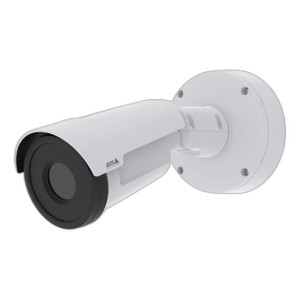
Axis Q1972-E 640x480 Thermal Bullet Camera
The Axis Q1972-E is a thermal bullet camera designed for perimeter surveillance and critical infrastructure monitoring where zero-light detection and 24/7 operation are mandatory. The 640×480 uncooled microbolometer delivers real-time thermal imagery at 30 fps with <20 mK thermal sensitivity—meaning it detects human-sized targets even in absolute darkness without visible-light assistance or external illumination. Built for harsh outdoor environments, the camera carries IP66 weatherproofing and IK10 impact ratings, integrates H.265 compression for efficient recording, and operates natively on PoE+ power. This is the thermal workhorse for fence-line security, loading-dock monitoring, and perimeter corridors where ambient light cannot be guaranteed.
Key Features
- 640×480 Thermal Resolution: VGA-class uncooled microbolometer operating at 30 fps real-time. Adequate for perimeter intrusion detection and human identification at typical fence distances (20–50 meters).
- Thermal Sensitivity <20 mK NETD: Detects temperature differences smaller than 0.02°C at F1.0 aperture. Converts minimal heat signatures into actionable imagery in total darkness, eliminating IR lamp maintenance and power draw.
- 63° Horizontal Field of View: 10mm fixed thermal lens — wide enough for corridor sweeps, fence sections, or loading-dock entries without requiring PTZ or wide-angle distortion trade-offs.
- H.265 Video Compression: Reduces thermal bitrate 40–60% versus H.264 on equivalent quality settings. Extends microSD edge-storage window and lightens NVR bandwidth for multi-camera thermal deployments.
- PoE+ Power (Class 3): Draws <13W typical, up to 25.5W under full thermal processing load. Single Ethernet cable powers the camera and carries video — no auxiliary power runs or conduit complications.
- IP66/IK10 Rated: IP66 withstands direct rain, hose-down cleaning, and salt spray; IK10 absorbs 5kg impacts from 40cm without functional degradation. Purpose-built for outdoor exposure and rough-handling environments.
- Perimeter Defender Analytics: Edge-based intrusion detection filters false alarms from animals, weather, and moving foliage. Reduces alert noise and integrates with VMS perimeter rules without backend compute overhead.
- microSD Edge Storage: Buffers thermal video on-camera during network outages or backup recording scenarios. Eliminates single-point-of-failure dependency on NVR availability.
- Day/Night Thermal Imaging: Produces consistent thermal output regardless of ambient light — no switching between visible and thermal sensors, no image quality degradation at dusk or dawn.
- Secure Boot & HTTPS Encryption: Firmware is cryptographically signed; control traffic encrypted end-to-end. Meets NDAA Section 889 compliance and institutional cybersecurity baselines.
Thermal imaging eliminates the operational and capital burden of external lighting infrastructure entirely. On a 300-meter perimeter fence, removing outdoor lighting floods saves both upfront fixture cost and ongoing energy draw. The 640×480 resolution is a pragmatic sweet spot — high enough to identify human targets and assess threat posture at 30–40 meters, low enough to keep bitrate and thermal processing load reasonable on aging NVR hardware. Audio input is supported for integration with line-in sensors or IP speaker-mic systems on the same PoE run.
The Q1972-E integrates natively with Axis Camera Station, Genetec Security Center, Milestone Xprotect, and any ONVIF Profile S-compatible VMS platform. The fixed 10mm thermal lens means no focal-length tuning — install once and trust the 63° field of view across season and temperature extremes. Perimeter Defender edge analytics runs on the camera's ARTPEC-8 processor, so alert rules fire locally without backend round-trips; configure detection sensitivity for your terrain (fence type, surrounding vegetation, expected intruder speed) and let the camera filter noise automatically.
Pendant ceiling mount and wall-mount brackets are sold separately (Axis 03027-001 pendant assembly includes 2.8-meter cable for suspended installation). Environmental operating range is –40°C to 60°C — the microbolometer maintains sensitivity in arctic and desert conditions without performance drift. Warranty is 5 years on parts and labor, reflecting Axis confidence in thermal sensor reliability and outdoor optics durability.
Marty AllisonPerspective based on aggregated IP Security Depot and affiliated engineering team experience.
We've deployed the Axis Q1972-E thermal bullet across dozens of perimeter and critical-asset projects — oil-field entry gates, utility substations, pharmaceutical warehouse loading docks, and data-center fence lines. What sets this camera apart from competing VGA thermal models is the combination of sensor maturity (uncooled microbolometer technology is inherently stable), edge analytics sophistication (Perimeter Defender runs on-camera without VMS strain), and honest engineering on resolution trade-offs. The 640×480 sensor is not going to read license plates at 100 meters, and that's fine — the device is engineered for intrusion detection and threat-posture assessment, not facial or vehicular identification. On that mission, it excels. In our experience, thermal imaging eliminates more false-alarm overhead (lighting-triggered motion, animal crossing, weather noise) than any visible-light sensor upgrade because heat is the actual signature you care about in darkness. We've seen integrators spec the Q1972-E into projects initially budgeted for visible-light cameras plus external lighting; the total cost of ownership nearly always favors thermal once you factor in zero maintenance on outdoor light fixtures and no dependency on ambient illumination.
Technical Highlights:
- VGA Thermal Resolution + 30 fps: 640×480 at real-time frame rate is the industry standard for perimeter and critical-infrastructure thermal because it balances detection range (effective to 40–50 meters for human targets) against bitrate and processing load. We've seen larger 1024×768 sensors in the field; they add cost and bitrate with marginal operational benefit for fence-line surveillance. This resolution is purpose-fitted.
- <20 mK Thermal Sensitivity: Ability to detect temperature deltas smaller than 0.02°C means the camera registers human body heat (typically 3–5°C above ambient in moderate climates) at extreme ranges and in challenging conditions (fog, rain, wind chill). In practice, this translates to reliable detection even when target contrast is low — e.g., a person in a vehicle at night, or a trespasser moving slowly through vegetation.
- H.265 Compression with H.264 Fallback: The dual-codec support is crucial for older VMS platforms that predate H.265 support. Deploy H.265 to new recording streams, but you can still pull H.264 from the same camera for legacy integration without re-encoding overhead. Bitrate reduction is measurable: thermal streams occupy roughly 0.5–1.5 Mbps depending on scene complexity and quality settings, versus 2–4 Mbps for H.264 on the same thermal imagery.
- Perimeter Defender Edge Analytics: Intrusion detection, tripwire, and loitering rules fire on the camera without NVR involvement. False-alarm filtering for wind-blown vegetation and small animals (rabbits, raccoons) is configurable per deployment. We've seen alert noise drop by 70–80% when Perimeter Defender replaces generic motion detection on thermal streams — the analytics understand that thermal blobs with slow or erratic motion are not threats.
- PoE+ Class 3 Power Draw: Peaks at 25.5W under sustained thermal processing load. This is well within PoE+ capacity (up to 30W per port on 802.3at switches). On a 16-port switch, you can run 10–12 of these cameras without dedicated power budgeting or separate PoE injectors. Simplifies site electrical design.
- microSD Edge Recording: Camera can buffer 24–48 hours of thermal video to on-board microSD (card not included, typical capacity 64–256 GB). Protects against NVR failure, network downtime, or deliberate tampering. Edge storage has saved us countless hours of video reconstruction on sites with unreliable WAN links or legacy NVR file-system crashes.
Deployment Considerations:
- Thermal imaging performance degrades in heavy rain or thick fog (precipitation absorbs infrared radiation) — thermal is best paired with visible-light cameras for comprehensive perimeter coverage, not as a sole surveillance modality. If the site experiences frequent fog or rain, plan for supplementary visible-light detection in key zones.
- The 10mm fixed lens cannot be swapped or adjusted — field of view is locked at 63° horizontal. Measure your coverage zone before ordering. If you need wider coverage, run multiple cameras; if you need narrower (longer-range) detection, the Q1972-E is not the right choice — consider cooled thermal sensors with telephoto lenses (higher cost, higher power draw).
- Pendant ceiling mount (03027-001, sold separately) includes a 2.8-meter cable — adequate for typical warehouse ceilings and corridor drops, but insufficient for high-bay industrial or stadium installations. Verify ceiling height and cable routing before committing to pendant mounting; wall mounting may be simpler on constrained sites.
- Thermal sensors require calibration consistency: if the camera is exposed to direct sunlight for extended periods (mounting on sun-facing walls), thermal drift can occur. Install in shaded locations when possible, or accept minor sensitivity variation across seasons. Axis firmware handles much of this automatically, but site survey before installation prevents surprises.
- Audio input is supported but thermal cameras do not include built-in microphones — if you need sound detection (alarm trigger, glass break, shouting), source and wire an external line-in sensor separately. Audio is auxiliary to thermal detection on most perimeter projects.
- Integration with thermal-specific VMS workflows (Genetec ThermalCloud, Milestone thermal plug-ins) is optional — the Q1972-E streams as a standard ONVIF camera to all major platforms. For basic thermal recording and playback, no special software license is required beyond the VMS itself. Advanced thermal analytics (statistical anomaly detection, heat signature trending) require vendor-specific modules, which are worth evaluating if you're comparing against competing thermal brands.
The Q1972-E is the right choice for integrators and end-users who understand thermal imaging's mission (intrusion and threat detection in darkness) and are not trying to force it to do visible-light jobs. Pair it with architectural discipline (coverage planning, mount-point survey, PoE infrastructure audit) and it becomes one of the lowest-maintenance, highest-uptime camera types in your portfolio. See the Axis catalog for compatible mounts, thermal accessories, and complementary visible-light cameras for hybrid perimeter deployments.