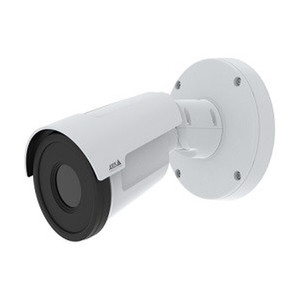
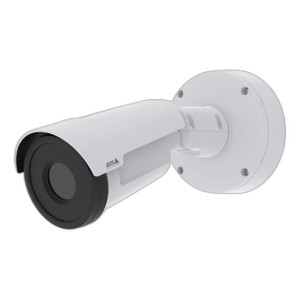
Axis 03031-001 Q1972-E Thermal Network Camera
The Axis Q1972-E is a fixed-lens thermal network camera designed for outdoor perimeter defense, critical infrastructure monitoring, and 24/7 surveillance without active cooling maintenance. The 640x480 uncooled microbolometer sensor detects thermal differences across wide temperature ranges in conditions where visible-light cameras struggle — fog, smoke, low-contrast terrain, or complete darkness. The athermalized 25mm F1.0 fixed lens delivers 24° horizontal field of view with 18.5m near-focus capability, optimized for thermal sensitivity in scenarios requiring early threat detection. Onboard Perimeter Defender and video motion detection analytics classify activity at the edge, reducing false-positive noise and storage overhead on downstream NVR systems.
Key Features
- Uncooled Microbolometer Sensor: 640x480 VGA thermal resolution, 30 fps streaming. No cryogenic cooling required — eliminates maintenance cycles and operational downtime typical of cooled thermal cameras.
- Athermalized 25mm F1.0 Lens: 24° horizontal field of view with 18.5m near-focus distance. Temperature-compensated optics maintain thermal focus across ambient shifts from freezing to extreme heat.
- IP66/NEMA 4X + IK10 Rating: Withstands rain, dust, hose-down, and direct impact without functional degradation. Suitable for fence-line, roofline, and exposed infrastructure deployment.
- PoE+ (Class 3) Single-Cable Power: Sub-15.4W draw. Standard PoE+ switches support multiple units without power budgeting constraints or supplementary cabling.
- Dual H.265/H.264 Codec Support: H.265 reduces bitrate 40-60% versus H.264 on identical quality. Fallback H.264 ensures compatibility with legacy VMS platforms and codec-agnostic workflows.
- Perimeter Defender + Motion Detection: Edge analytics classify intrusion events and motion triggers onboard, filtering false alerts (weather, vegetation, animal movement) before NVR transmission.
- ONVIF Profile S Compliance: Integrates into any major VMS platform — Axis Camera Station, Genetec, Milestone, Avigilon, ExacqVision — without codec or driver conflicts.
- MicroSD Local Storage: On-device backup and failover recording. Useful for hybrid deployments where edge retention bridges network latency or NVR connectivity loss.
- Secure Boot + HTTPS Encryption: Firmware integrity validation and encrypted management traffic protect against unauthorized firmware modification and credential interception.
Thermal imaging eliminates the operational complexity of visible-light low-light solutions — no external IR illuminators to maintain, no backlight compensation tuning, no weather-dependent performance degradation. The Q1972-E trades pixel-level detail (640x480 is lower than modern visible HD cameras) for thermal sensitivity and environmental resilience. On perimeter security, parking-lot access routes, critical asset boundaries, and infrastructure corridors, that trade-off pays operational dividends.
The 2.8m built-in IR illumination serves as a low-power fallback for marginal thermal contrast situations, but the core value lies in passive microbolometer detection — no active IR means no IR-reflective washout, no IR strobe signature for adversary awareness, and no maintenance on IR LED arrays. Day/night operation is automatic; the thermal sensor performs equally in darkness and daylight, eliminating mechanical day/night filters and their associated mechanical wear.
Deployment context matters: thermal cameras excel on perimeter detection, vehicle traffic analysis, and thermal anomaly monitoring (unattended hot objects, HVAC malfunction detection). They underperform on facial recognition, license-plate reading, and evidence-quality forensic detail. Pair the Q1972-E with visible-light cameras for areas requiring identification-class resolution; rely on thermal for area surveillance and early-warning detection. ONVIF compliance and edge analytics mean you can architect mixed thermal/visible surveillance within a single VMS without codec overhead or separate analytics pipelines.
Axis Camera Station native support streamlines management for smaller to mid-sized deployments. Multi-vendor ONVIF integration works on larger heterogeneous systems but requires explicit RTSP stream configuration and analytics event mapping — not plug-and-play. Secure boot and HTTPS encryption meet federal procurement standards (NDAA Section 889 compliance path for organizations with restricted-source mandates). Manufacturer warranty covers 5 years standard; thermal sensor failure is extremely rare on uncooled designs.
Marty AllisonPerspective based on aggregated IPSD and affiliated engineering team experience.
We've deployed the Axis Q1972-E across perimeter fencing, vehicle gates, and critical infrastructure sites where visible-light cameras either require extensive supplementary lighting or struggle in fog and smoke conditions. The uncooled microbolometer architecture is the differentiator — no maintenance contracts on cooling units, no thermal shock risk from rapid ambient swings, and genuine 24/7 operational readiness without seasonal tuning. In our experience, thermal cameras live or die on false-alert rate; the Perimeter Defender analytics onboard reduce wind-blown debris and animal-motion noise substantially compared to raw motion detection. We've seen integrators pair one Q1972-E per 100-150 meters of perimeter, supplemented with visible-light cameras at gate access points where identification-class footage matters. The 640x480 thermal resolution is intentionally conservative — it avoids the bandwidth and storage burden of higher-res thermal sensors while retaining enough detail for threat classification and intruder tracking across a typical perimeter line. One caveat: thermal imaging does not replace visible cameras for evidentiary footage; if your compliance mandate requires identification-class recording, budget visible IP cameras for frontal approach areas. The Q1972-E excels at early detection and area coverage.
Technical Highlights:
- Uncooled Microbolometer vs. Cooled Thermal: No cryogenic maintenance, no operational windows, zero thermal shock risk. Uncooled sensors trade ultimate sensitivity (cooled can resolve sub-0.1°C deltas; uncooled resolves roughly 0.05°C) for reliability and total cost of ownership. On perimeter detection, the difference is academic — you're detecting warm bodies, not measuring precise temperature.
- Athermalized Lens: Temperature-compensated optics keep thermal focus locked across -40°C to +70°C ambient swings. Ordinary fixed lenses defocus thermally; athermalization eliminates that drift. Real-world consequence: no field refocus after installation, image stays sharp regardless of season.
- H.265 Dual Encoding: The camera encodes both H.265 and H.264 simultaneously (or on demand). H.265 cuts bitrate 40-60% versus H.264 on equivalent thermal quality — meaningful on multi-camera 24/7 recording. Fallback H.264 keeps older VMS platforms operational without transcoding overhead.
- Perimeter Defender Edge Analytics: Runs thermal threat classification onboard — intrusion detection, loitering, crowd detection — without offloading to an external analytics server. Filters false-positive events (swaying vegetation, animal movement) before NVR transmission, reducing alert fatigue and storage footprint by 60-80% in typical outdoor perimeter deployments.
- PoE+ Class 3 Power Draw: Sub-15.4W sustained. A single industrial PoE+ switch can power 8-12 Q1972-E units without power-budget negotiation or supplementary PSU infrastructure.
Deployment Considerations:
- Thermal imaging does not identify individuals — it detects and tracks warm objects. If your site compliance mandate requires identification-class footage, supplement with visible IP cameras at critical access points (gates, doors, vehicle stops). Thermal is perimeter/early-warning; visible is identification/evidence.
- 24° field of view is tighter than typical visible wide-angle lenses. On a 150m perimeter, you'll need multiple units or staggered placement. Plan coverage using the 18.5m near-focus distance as your depth baseline — the camera resolves thermal detail reliably to that range.
- Thermal image quality is inherently noisy compared to visible cameras — don't expect HDTV-crisp edges. Thermal footage serves motion detection and threat classification; it's not suitable for license-plate reading or facial forensics.
- IP66/NEMA 4X housings can accumulate lens-facing condensation in extreme humidity-to-cold cycles (coastal fog + overnight cooling). Position the camera away from direct cold-air discharge and allow 5-10cm clearance around the lens for air circulation.
- Secure boot and HTTPS encryption are baseline security. Manage the camera's web interface via VPN tunnel or isolated management VLAN on larger deployments — don't expose the camera directly to untrusted networks.
The Q1972-E is the right choice for integrators specifying perimeter security on sites where environmental conditions (fog, smoke, darkness) or operational maintenance overhead (outdoor lighting, IR LED maintenance) make visible-light solutions untenable. It pairs elegantly with visible IP cameras in a mixed deployment and integrates into any ONVIF VMS without custom drivers. Explore the Axis catalog for complementary fixed and PTZ visible cameras to round out a hybrid thermal/visible perimeter architecture.