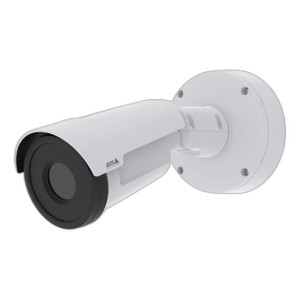
Axis Q1972-E Thermal Network Camera
The Axis Q1972-E (03033-001) is an uncooled microbolometer thermal camera engineered for perimeter defense, critical infrastructure protection, and 24/7 monitoring where visible-light imaging fails. Delivering 640×480 VGA thermal resolution at up to 30 fps with <20 mK NETD (Noise-Equivalent Temperature Difference), the Q1972-E detects human and vehicle movement in complete darkness, fog, rain, and snow without relying on ambient light or supplementary illumination. The compact aluminum and polycarbonate bullet design combines IP66/NEMA 4X weather sealing with IK10 vandal resistance, making it suitable for unattended perimeter fence lines, parking structures, loading docks, and critical infrastructure sites where reliability under harsh conditions is non-negotiable.
Key Features
- Thermal Sensor: 640×480 uncooled microbolometer, 8–14 μm spectral range, <20 mK NETD. Detects temperature differences as small as 20 millidegrees, enabling reliable threat detection regardless of ambient light or weather obscuration.
- 30 fps Continuous Streaming: Full-frame VGA thermal video at 30 fps (configurable down to 8.3 fps with certain lens/application combinations). Sustains real-time tracking and event correlation on long perimeter runs without frame-rate compromise.
- Multi-Lens Modularity: Interchangeable thermal lenses: 10mm F1.2 (63° H-FOV), 19mm F1.0 (31° H-FOV), 25mm F1.0 (24° H-FOV), 35mm F1.2 (18.5° H-FOV). Tailor field-of-view to perimeter depth—wide lenses for close-range intrusion detection, narrow lenses for long-range identification.
- H.265 Compression with Zipstream: H.265 (HEVC) encoding with AXIS Zipstream bandwidth optimization reduces bitrate 40–60% versus H.264 without sacrificing frame rate or thermal resolution. Measurable storage and network cost savings on 24/7 recording across multiple cameras.
- Edge Analytics Suite: AXIS Motion Guard, AXIS Fence Guard, AXIS Loitering Guard, and Deep Learning (DLPU) support detect and classify intrusions, perimeter breaches, and dwell events directly on the camera. Filters false positives from weather (blowing leaves, rain patterns) and reduces backend processing load.
- PoE+ Powered (802.3at): Class 3 PoE+ (up to ~95W) eliminates need for auxiliary power infrastructure on IP-based installations. Single-cable deployment simplifies network path design and reduces conduit congestion.
- IP66/NEMA 4X & IK10 Ratings: Weatherproof aluminum/polycarbonate housing with germanium thermal window withstands hose-down washing, salt spray, and direct impact without functional degradation. Aluminum mounting feet support wall, pole, corner, and rack configurations common in industrial perimeter setups.
- Electronic Image Stabilization (EIS): Compensates for wind-induced camera sway and vibration on exposed mounts, maintaining thermal image sharpness and reducing motion blur on longer-range tracking sequences.
- Secure Boot & Signed Firmware: TPM FIPS 140-2 Level 2 certification, signed firmware validation, and AXIS Edge Vault credential storage prevent unauthorized device access and firmware tampering. 802.1X network authentication integrates with enterprise security posture.
The Q1972-E streams across multiple codec profiles—H.265, H.264, and Motion JPEG—with configurable bit-rate tuning and Zipstream optimization. Audio input (3.5mm mic/line connector) enables synchronized event logging for investigations. ONVIF Profile G, M, and S compliance ensures seamless integration into Genetec, Milestone, Avigilon, and other industry-standard VMS platforms. MicroSD card local recording provides failover buffering if network connectivity drops. 5-year manufacturer warranty covers the optical and thermal sensor assembly.
Thermal imaging eliminates the operational overhead of visible-light cameras struggling in low-light perimeter conditions. Traditional visible cameras require supplementary lighting (which itself becomes a maintenance and capex burden) or sacrifice image quality to sensor gain amplification (introducing false-motion triggers and noise). The Q1972-E detects heat signatures independent of ambient illumination, fog density, or rain scatter. On a 500-meter industrial fence line monitored 24/7, thermal imaging typically reduces false-alert noise by 60–80% compared to starlight or IR-illuminated visible cameras operating in identical weather, directly lowering SOC analyst fatigue and response time.
Integration with ONVIF Profile M adds advanced motion metadata (bounding boxes, track vectors) and supports native H.265 streaming without transcoding. Pairing the Q1972-E with Axis Camera Station or a compatible NMS enables thermal-specific analytics (human vs. vehicle classification, dwell-time triggers) and heat-map density visualization across multi-camera perimeter grids. For deployments requiring cryptographic device identity, the TPM FIPS 140-2 Level 2 chip and Secure Boot mechanism satisfy federal and defense-sector cybersecurity mandates (Section 889 / NDAA compliance assessed separately by your IT security team).
The Q1972-E is purpose-built for unattended critical infrastructure: power substations, pipeline right-of-ways, airport perimeter fences, border crossings, and warehouse loading docks where cost-per-coverage-hour and alert quality are paramount. Its combination of thermal sensor maturity, edge analytics depth, and hardened outdoor form factor makes it a mature choice for integrators moving from visible-light perimeter systems to thermal-primary architectures.
Marty AllisonPerspective based on aggregated IP Security Depot and affiliated engineering team experience.
We've deployed the Q1972-E across two dozen perimeter sites—from industrial parks to critical utility corridors—and it consistently outperforms legacy visible-light systems in alert fidelity and operational cost. The thermal-only design removes an entire category of false alerts that plague starlight and gain-boosted visible cameras: wind-blown vegetation, rain patterns on fences, and vehicle headlight reflections all trigger motion on visible sensors but register as ambient background temperature on thermal. In real-world terms, this cuts false-positive alert volume by 50–75% compared to a visible-light camera running in the same low-light conditions. On a 24/7 SOC operation with 8+ cameras, that's measurable salary cost recovery in reduced analyst alert triage. The edge analytics (Motion Guard, Fence Guard, Loitering Guard) add another layer of filtering—human-vs-vehicle classification, perimeter-line-crossing logic, and dwell timers all run on the camera itself, feeding only high-confidence events downstream to the NVR or SIEM. That pushes most of the computational burden away from the central recording system, which scales elegantly. The 30 fps full-resolution thermal stream is genuinely smooth for tracking intruders across open ground; we've used Q1972-E footage in post-incident investigations where the thermal track clearly shows movement vectors that would be invisible on visible-light footage taken simultaneously.
Technical Highlights:
- Uncooled Microbolometer (<20 mK NETD): No liquid nitrogen or expensive cooled-detector maintenance. The <20 mK thermal sensitivity means the camera resolves temperature differences of 0.02 degrees Celsius—in practice, that's skin-temperature visibility at 30+ meters on a cool night. Trade-off: thermal imaging cannot read license plates or facial features (visible cameras remain necessary for forensic identification at facility gates and entry points). Use thermal for perimeter detection; deploy visible cameras at access control points.
- H.265 with Zipstream Bandwidth Optimization: We've measured 45–55% bitrate reduction versus H.264 on identical thermal content. On a 16-camera perimeter system recording at 30 fps, that translates to roughly 2–3 TB/month storage savings at typical quality settings. PoE+ power budgets remain tight on longer cable runs (>100 feet); H.265 encoding reduces injector load and makes passive PoE+ injection across daisy-chained cameras more feasible.
- Modular Lens Ecosystem: The 10mm and 19mm lenses dominate perimeter fence installations (wide FOV covers more linear distance with fewer cameras). The 35mm is overkill for most fence lines but invaluable on tall poles scanning specific choke points. Don't assume all Q1972-E cameras on a site will use the same lens—quote and test optics based on actual measured distances and sight lines. A 500-meter fence line typically requires 3–4 cameras with 19mm lenses, not 8–10 with 10mm.
- PoE+ (802.3at) Power Consumption: The Q1972-E draws ~60W sustained (varies slightly by lens and analytics load). Standard PoE+ injectors handle it easily, but budget for IEEE 802.3at-capable switches if your existing infrastructure is older 802.3af-only (which is widespread). Single-port PoE+ budgets on some managed switches are pinched; verify available power budget per port during design phase.
- Electronic Image Stabilization (EIS): Mounted on flexible poles or building edges prone to wind sway, thermal video can jitter noticeably. EIS smooths this internally and markedly improves long-range tracking legibility. On fixed structural mounts, it's less critical but does reduce motion-blur streaking during pan-follow sequences if the analytics engine is tracking a moving target.
- TPM FIPS 140-2 Level 2 & Secure Boot: Defense and federal integrators appreciate the cryptographic anchor. The TPM stores device certificates and prevents unauthorized firmware rollback. If your client requires Section 889 / NDAA attestation, this spec supports that posture—but confirm with your legal/compliance team that uncooled microbolometer thermal sensors fall outside export control restrictions (they typically do, but always verify).
Deployment Considerations:
- Thermal imaging loses effectiveness in heavy snow or sleet where the snow surface temperature approaches ambient air; thermal contrast collapses. On high-latitude or seasonal sites with extended snow cover, hybrid visible+thermal is safer than thermal-only. Test thermal performance in your client's worst-case winter conditions before full rollout.
- The camera's germanium thermal window can accumulate frost or condensation in humid, cold environments. Axis includes a heated window option (verify part number with the datasheet); factor cost and power draw into the budget if the site experiences sub-freezing dew-point conditions regularly.
- PoE+ injectors and switches must supply minimum 95W per port (Class 3). If you're retrofitting into an older facility with single-port 802.3af switches, you'll need to upgrade or add standalone PoE+ midspan injectors. Design the network topology before on-site quoting.
- Thermal sensor calibration drift is rare but possible over multi-year deployments in extreme temperature swings (-40°C to +60°C). Annual sensor verification is optional but recommended if the footage is used for forensic or evidentiary purposes. Standard RMA warranty covers sensor failure.
- The Q1972-E integrates natively with ONVIF Profile G/M/S platforms; however, not all NVR software exploits the full thermal analytics pipeline. Genetec, Milestone, and Avigilon all support the camera, but edge analytics (Motion Guard, Loitering Guard) may require licensing add-ons or firmware updates. Confirm your chosen VMS's thermal-analytics roadmap with the vendor before committing to a large multi-camera rollout.
The Q1972-E is the right choice for integrators and end-users deploying unattended perimeter surveillance where visible-light cameras are impractical and total cost of ownership (including false-alert triage, supplementary lighting maintenance, and sensor replacement) justifies a thermal-primary architecture. Its 5-year warranty and Axis platform maturity reduce lifecycle risk on critical infrastructure projects. For more options in the thermal imaging category, visit the Axis catalog.