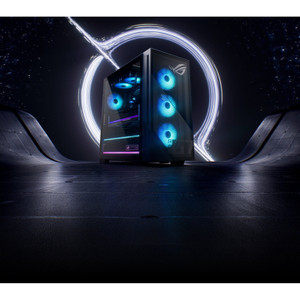
ASUS G700TF-XS987 High-Performance Tower Workstation
Overview
The ASUS G700TF-XS987 is a full-tower workstation built around Intel's Core Ultra 9 285K processor and the NVIDIA RTX 5080 GPU — a pairing that makes it a legitimate candidate for AI-accelerated video management, deep-learning analytics servers, and demanding multi-stream NVR workloads where GPU compute and raw CPU throughput both matter. At 40.39 lb and measuring 9.45 × 20.05 × 18.88 inches, this is rack-adjacent iron: it belongs in a server room, a locked utility closet, or a purpose-built surveillance operations center, not on a desk in a retail office. If you're running Milestone XProtect, Genetec Security Center, or Avigilon Control Center with GPU-accelerated analytics across dozens of high-resolution streams, the G700TF-XS987 (often searched as G700TF XS987) provides the headroom to scale without hitting a compute ceiling early in the deployment lifecycle.
Key Features
- Intel Core Ultra 9 285K — 24 cores, 5.7 GHz boost: The 285K deploys 8 Performance cores (up to 5.5 GHz turbo, 3.7 GHz base) and 16 Efficient cores (4.6 GHz turbo, 3.2 GHz base) for a total of 24 cores and 24 threads. In VMS terms, this means the CPU can handle real-time decoding, metadata processing, and OS overhead simultaneously without the core-count bottleneck that plagues 8- and 12-core platforms under sustained 64-channel+ loads. The 36 MB Smart Cache keeps frequently accessed video index data close to the processor, reducing latency on playback scrubbing and forensic search.
- Intel AI Boost NPU — dedicated neural processing: The on-die Intel AI Boost NPU offloads lightweight AI inference tasks from the CPU, freeing up Performance cores for latency-sensitive video decode. In mixed workloads — simultaneous recording, analytics processing, and live operator review — this translates to more consistent frame delivery without CPU spikes.
- NVIDIA RTX 5080 discrete GPU: The RTX 5080 is the right GPU for deployments running GPU-accelerated analytics (license plate recognition, object classification, crowd density) at scale. Rather than burdening the CPU with compute-heavy inference, workloads offload to the GPU's tensor cores — the same architecture that powers enterprise AI inference in data center environments. This is the spec that separates this machine from standard NVR appliances running embedded ARM silicon.
- 32 GB RAM: 32 GB supports simultaneous live view, recording, and analytics across a large channel count. Operators running multi-monitor command center layouts with dozens of decoded HD streams won't hit the memory ceiling that forces frame-dropping on lighter-configured systems.
- 1 TB M.2 2280 PCIe NVMe storage: The system drive is a PCIe M.2 2280 NVMe SSD — fast enough that OS and application I/O never become the bottleneck for VMS startup, database queries, or event index lookups. For video retention, additional storage (NAS, DAS, or internal SATA expansion depending on enclosure capacity) is expected in production deployments; this 1 TB drive is the OS/application volume.
- PCIe and Ethernet interfaces: Native PCIe expansion lets you add capture cards, additional NIC ports, or RAID controllers without an adapter layer. The onboard Ethernet interface handles VMS network traffic; add a second NIC via PCIe for dedicated camera-network isolation — a standard hardening practice in enterprise security deployments.
- 125 W base / 250 W max turbo processor power envelope: The 285K's 250 W maximum turbo power demand is real — this processor needs adequate chassis cooling and a properly sized UPS. Plan for a UPS with at least 1,500 VA on circuits hosting this system, factoring in the RTX 5080's additional power draw under GPU compute load.
Integration and Compatibility
The G700TF-XS987 runs standard x86-64 Windows or Linux, which means it's compatible with any VMS platform that publishes a Windows or Linux server build — Milestone XProtect, Genetec Security Center, Avigilon Control Center, Hanwha Wisenet WAVE, and others install natively. GPU-accelerated analytics in these platforms typically require an NVIDIA CUDA-capable GPU; the RTX 5080 satisfies that requirement. For network video recorders and server-class VMS deployments, pair this system with a managed PoE switch to keep camera traffic on a dedicated VLAN, isolated from the VMS server's management and storage interfaces. Integrators building out a full IP camera infrastructure should review camera-to-server bandwidth requirements before finalizing channel counts — 4K H.265 streams at 15 fps each consume roughly 8–12 Mbps per camera, and 64 cameras sustained equals approximately 512–768 Mbps of ingestion load on the recording server's NIC. Consult a surveillance system planning guide to size storage and compute accurately before procurement. For power protection of this system in a 24/7 recording environment, a UPS with adequate VA rating is strongly recommended.
Frequently Asked Questions
Q: Is the ASUS G700TF-XS987 suitable as a VMS recording server?
A: Yes — the Core Ultra 9 285K (24 cores, 5.7 GHz boost) and RTX 5080 GPU provide the compute needed for multi-stream recording and GPU-accelerated analytics. It runs standard Windows or Linux, so any major VMS platform (Milestone, Genetec, Avigilon, Hanwha WAVE) installs natively. Add storage beyond the 1 TB system drive for video retention.
Q: How much does the G700TF-XS987 weigh, and what are its dimensions?
A: The G700TF-XS987 weighs 40.39 lb and measures 9.45 × 20.05 × 18.88 inches (L × W × H). Plan for adequate rack-adjacent or floor-mount space and appropriate support structure for the weight.
Q: Does the RTX 5080 in the G700TF-XS987 support CUDA for AI analytics?
A: The NVIDIA RTX 5080 is CUDA-capable, which is the GPU compute framework used by most major VMS platforms (Milestone, Genetec, Avigilon) for GPU-accelerated deep learning analytics including license plate recognition and object classification.
Q: What storage does the G700TF-XS987 ship with, and can I add more?
A: It ships with a 1 TB M.2 2280 PCIe NVMe drive, which is appropriate as an OS and application volume. For video retention in a production recording deployment, supplemental storage via NAS, DAS, or internal expansion (subject to enclosure bay availability) is expected.
Q: What are the power requirements for the G700TF-XS987 in a 24/7 deployment?
A: The Intel Core Ultra 9 285K draws up to 250 W at maximum turbo, and the RTX 5080 adds significant additional load under GPU compute workloads. For 24/7 operation, provision a UPS rated at a minimum of 1,500 VA on the circuit hosting this system, and verify that the rack or utility closet circuit has adequate amperage.
Q: Does the G700TF-XS987 include the Intel AI Boost NPU?
A: Yes — the Intel Core Ultra 9 285K includes the Intel AI Boost NPU on-die. This offloads lightweight AI inference tasks from the main CPU cores, which helps maintain consistent performance in mixed workloads where recording, analytics, and live operator review run concurrently.
The G700TF-XS987 is one of the few consumer-origin tower platforms I'd consider seriously for a production VMS server role, specifically because of the RTX 5080 pairing with the Core Ultra 9 285K. The 285K's 250 W maximum turbo power draw is not a minor detail — this CPU will consume it under sustained multi-stream decode and analytics load, and the RTX 5080 will add substantially on top of that. Power planning is the first conversation to have before specifying this system in a 24/7 recording environment.
Technical Highlights:
- Core Ultra 9 285K — 8P + 16E core topology: The hybrid core design matters for VMS workloads: Performance cores handle latency-sensitive decoding and live view rendering while Efficient cores absorb background tasks (indexing, database writes, OS overhead) without interrupting foreground streams. The 36 MB Smart Cache further reduces seek latency on forensic playback.
- RTX 5080 GPU compute: GPU-accelerated analytics in Milestone, Genetec, and Avigilon offload inference to the GPU's tensor cores. The RTX 5080's compute tier is substantially above the entry-level NVIDIA cards typically bundled in NVR appliances — this is where the platform justifies its cost for high-channel AI workloads.
- Intel AI Boost NPU: On-die AI inference offload reduces the CPU core tax for lightweight model inference tasks, preserving Performance core headroom for video decode and VMS application threads under peak concurrent operator load.
Deployment Considerations:
- The 1 TB PCIe NVMe drive is an OS/application volume only — no production video retention will fit here. Size supplemental storage (NAS or DAS) based on your camera count, resolution, frame rate, and retention period before finalizing the deployment BOM.
- At 40.39 lb and 18.88 inches tall, this chassis does not fit in a standard 2U or 4U rack slot — it requires floor or shelf placement adjacent to the rack. Confirm physical space in the IDF or security closet before ordering.
The G700TF-XS987 is best positioned as the compute backbone for a 32- to 64-channel AI-analytics-heavy VMS deployment where GPU-accelerated object detection, LPR, or crowd analytics runs continuously — scenarios where a standard NVR appliance would throttle under load and a purpose-built server would be over-engineered for the budget.