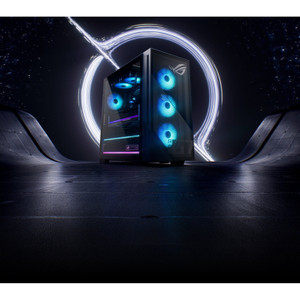
ASUS G700TF-DS996 G Series High-Performance Desktop Workstation
Overview
The ASUS G700TF-DS996 is a full-tower desktop workstation built around Intel's Core Ultra 9 285K processor and NVIDIA's RTX 5090 GPU — a combination suited to computationally demanding workloads where both CPU throughput and GPU compute matter simultaneously. At 40.39 lbs in a 9.45 × 20.05 × 18.88 in chassis, this is a stationary production machine, not a portable system. If your workflow involves real-time workstation-class computing, video analytics processing, AI inference at the edge, or heavy simulation, the G700TF-DS996 is engineered to handle the sustained load. The G700TF DS996 (often searched as G700TF DS996) ships with 32GB of RAM, a 1TB M.2 2280 PCIe NVMe SSD, and a black chassis ready for rack-adjacent or dedicated workstation deployment.
Key Features
- Intel Core Ultra 9 285K — 24 cores, 5.7 GHz boost: The 285K is Intel's Arrow Lake flagship, combining 8 Performance cores (5.5 GHz turbo, 3.7 GHz base) with 16 Efficient cores (4.6 GHz turbo, 3.2 GHz base). That 24-core/24-thread topology handles heavy multi-threaded workloads — video transcoding, parallel analytics pipelines, large simulation runs — without the performance-core bottleneck you hit on consumer-grade quad- or hexa-core systems. The 36MB Smart Cache keeps frequently accessed data close to the cores, reducing memory latency under mixed workloads.
- 250W maximum turbo power envelope: The 285K runs at 125W base power but scales to 250W under sustained turbo load. This means real-world burst performance on the G700TF-DS996 can draw heavily from the platform's power delivery — verify your facility circuit capacity if this machine will run alongside other high-draw equipment in a dense workstation bay or server-adjacent rack setup.
- Intel AI Boost NPU onboard: The integrated Neural Processing Unit handles AI inference tasks in parallel with the CPU and GPU rather than competing for their cycles. For deployments running local AI inference workloads alongside GPU-bound rendering or analytics, this offload path keeps the primary compute resources available for their intended tasks rather than burning CPU/GPU cycles on model inference overhead.
- NVIDIA RTX 5090 discrete GPU: The RTX 5090 is NVIDIA's current high-end GPU, delivering the VRAM capacity and compute throughput needed for large model inference, real-time 3D rendering, and GPU-accelerated video analytics at scale. Paired with the Core Ultra 9 285K on a PCIe interface, this configuration avoids the GPU-CPU bandwidth bottleneck that throttles entry-level desktop systems under sustained heterogeneous workloads.
- 32GB system RAM: 32GB is sufficient for most professional workstation use cases — multi-camera analytics servers, engineering simulation, 3D content creation. If your workload involves very large datasets held entirely in memory (e.g., in-memory databases, massive point-cloud processing), evaluate whether this is the ceiling or if the platform supports expansion — check the motherboard specification for available DIMM slots and maximum supported capacity.
- 1TB M.2 2280 PCIe NVMe SSD: The PCIe NVMe form factor delivers sequential read/write speeds far beyond SATA — relevant when loading large model weights, handling high-throughput video I/O, or running workloads that read/write large files continuously. 1TB is workable as a primary OS and application drive; plan external or network-attached storage for large media archives or long-term data retention beyond the primary drive.
- PCIe and Ethernet connectivity: Native PCIe expansion and Ethernet connectivity mean this machine integrates directly into structured network environments. PCIe slots allow addition of capture cards, RAID controllers, or specialized accelerators without USB adapter compromises. Ethernet enables direct connection to network-attached storage, managed switches, and enterprise network infrastructure.
- Compact tower at 9.45 × 20.05 × 18.88 in: At just under 19 inches tall and about 20 inches deep, the G700TF-DS996 fits standard under-desk or workstation-bay footprints. The 40.39 lb weight means one-person transport is possible but two-person placement is advisable for rack-adjacent installs or elevated shelving.
Integration and Compatibility
The PCIe interface on the G700TF-DS996 provides expansion headroom for specialized hardware — capture cards, additional NVMe storage, GPU compute accelerators, or network interface cards — without being constrained to external USB bandwidth. The onboard Ethernet port connects to standard 802.3 managed network infrastructure. For deployments integrating this system with network video recorder infrastructure, IP camera networks, or AI-driven analytics platforms, the Core Ultra 9 285K with Intel AI Boost NPU provides both the CPU pipeline and dedicated AI inference path to handle multi-stream processing without fully saturating the RTX 5090. The M.2 2280 PCIe slot form factor for primary storage is industry standard, meaning drive replacement or upgrade follows a straightforward procedure. Organizations deploying this into a managed IT environment should verify driver support for the RTX 5090 under their target OS — GPU driver support for latest-generation hardware can lag enterprise Linux distributions by several months post-launch. Review workstation selection guidance to confirm this configuration matches your compute and storage requirements before committing to deployment.
Frequently Asked Questions
Q: What processor does the ASUS G700TF-DS996 use?
A: The G700TF-DS996 is equipped with the Intel Core Ultra 9 285K, a 24-core (8 Performance + 16 Efficient) processor from the Intel Core Ultra Series 2 (Arrow Lake) family. It boosts up to 5.7 GHz and carries a 36MB Smart Cache.
Q: How much RAM and storage does the G700TF-DS996 ship with?
A: The system ships with 32GB of RAM and a 1TB M.2 2280 PCIe NVMe SSD as the primary storage drive.
Q: What GPU is included in the G700TF-DS996?
A: The G700TF-DS996 includes the NVIDIA GeForce RTX 5090 — NVIDIA's current-generation high-end discrete GPU — connected via PCIe.
Q: What are the physical dimensions and weight of the G700TF-DS996?
A: The chassis measures 9.45 × 20.05 × 18.88 inches (L × W × H) and weighs 40.39 lbs. Plan for two-person placement for elevated or rack-adjacent installs.
Q: Does the G700TF-DS996 have an NPU for AI workloads?
A: Yes. The Intel Core Ultra 9 285K includes Intel AI Boost, an integrated Neural Processing Unit (NPU) that handles AI inference tasks independently of the CPU cores and RTX 5090 GPU, allowing parallel execution of AI inference alongside other compute workloads.
Q: What connectivity interfaces does the G700TF-DS996 provide?
A: The G700TF-DS996 provides PCIe expansion slots and onboard Ethernet for network integration. PCIe allows addition of specialized cards — capture cards, RAID controllers, additional NVMe storage, or supplemental network interfaces — without USB bandwidth constraints.
The G700TF-DS996 is one of those platforms where the processor architecture actually matters to how you deploy it. The Core Ultra 9 285K's split between 8 Performance cores at 5.5 GHz turbo and 16 Efficient cores at 4.6 GHz turbo isn't just a spec sheet detail — it means the OS scheduler can route latency-sensitive foreground tasks to P-cores while background analytics, transcoding, or inference workloads run on E-cores without competing for the same silicon. That's meaningful when you're running a multi-stream video analytics platform alongside active management consoles on the same box.
Technical Highlights:
- 24-core hybrid architecture (285K): 8 P-cores at 5.5 GHz turbo handle latency-sensitive processes; 16 E-cores at 4.6 GHz absorb background workloads — the 36MB Smart Cache ties them together and reduces the inter-core data movement penalty on mixed workloads.
- 250W turbo power envelope: The 285K scales from 125W base to 250W under full turbo load. In a sustained compute scenario — multi-stream video processing, large model inference — expect real power draw to average above 200W for the CPU alone, before accounting for the RTX 5090. Circuit planning matters here.
- Intel AI Boost NPU + RTX 5090 coexistence: The NPU handles inference tasks on a dedicated silicon path, freeing the RTX 5090 for rendering or GPU-compute workloads. In practice this means you're not choosing between running AI inference and GPU-accelerated analytics — you can pipeline both simultaneously.
Deployment Considerations:
- At 40.39 lbs and 18.88 inches tall, rack-adjacent placement needs shelf-weight verification — most standard 4U shelves are rated 30–35 lbs; this machine exceeds that. Floor placement or dedicated workstation furniture is the safer path.
- RTX 5090 GPU driver support on enterprise Linux distributions (RHEL, Ubuntu LTS) typically lags 3–6 months behind the hardware launch. If your deployment target is Linux-based, validate driver availability for your specific OS version before provisioning.
The G700TF-DS996 is best positioned for AI workstation deployments running simultaneous multi-stream video analytics and GPU-accelerated inference — command center builds, simulation labs, or high-throughput encoding stations where CPU and GPU compute need to run in parallel without resource competition.