Altronix TBH2 Trove2 Backplane Module
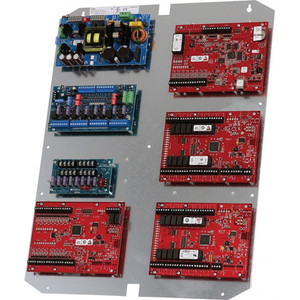
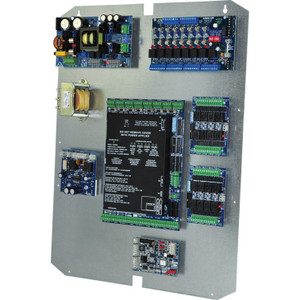
The Altronix TBH2 is a backplane interconnection module designed for the Trove2 modular power distribution system. It serves as the signal and power backbone that links multiple power supply modules, distribution cards, and auxiliary expansion components within a single chassis, enabling seamless multi-module configurations without external interconnect wiring.
Key Features
- Modular Backplane Architecture: Centralizes interconnection of power supplies and expansion cards into a single integrated backbone, eliminating point-to-point wiring complexity.
- Multi-Module Stacking Support: Enables daisy-chaining of up to N power modules and auxiliary cards in a single chassis for scalable power distribution growth.
- Trove2 System Integration: Factory-engineered for direct compatibility with all Trove2 power supplies, distribution modules, and accessory cards — no external bridging required.
- Robust Mechanical Form Factor: Designed for secure chassis mounting and thermal management in rack or wall-mount installations.
- Lifetime Limited Warranty: Factory-backed warranty coverage on all internal interconnection paths and mechanical assembly.
- US Manufacturing: Built and shipped domestically — authentic Altronix product with no grey-market sourcing.
The TBH2 backplane is the foundational hardware component in any multi-module Trove2 deployment. Without it, power supplies and distribution cards cannot communicate or coordinate voltage delivery across channels. For integrators expanding an existing Trove2 system or building a new scalable power infrastructure from the ground up, the backplane is a non-negotiable prerequisite — it's not a modular upgrade; it's the skeleton of the system.
Trove2 was engineered from the outset for modular expansion. Security installations grow: a parking lot gains additional lighting zones, an office campus adds a second building, a warehouse adds a new access-control corridor. Rather than rip-and-replace the entire power distribution system, integrators slide in additional power modules and plug them into the TBH2 backplane. The backplane handles all clock synchronization, voltage feedback sensing, and alarm signaling across modules — functionality that would require external relays and logic controllers in non-backplane architectures, adding cost, footprint, and maintenance burden.
Deployment scenarios are straightforward: new Trove2 installations require exactly one TBH2 per chassis. If the system will hold four power supplies and two auxiliary modules, the TBH2 provides the motherboard-level infrastructure to manage all six. Redundant power configurations (hot-standby modules) rely on the backplane to arbitrate which supply is active and to fail over cleanly if one supply drops. The TBH2 makes that coordination transparent to the VMS and field devices — no additional software configuration needed.
The TBH2 ships with full technical documentation and integration guides for Genetec, Milestone, and other standard VMS platforms — though as a passive infrastructure component, it requires no software drivers. It integrates seamlessly with Altronix management tools and SNMP monitoring agents, allowing integration teams to track module health, voltage rails, and alarm conditions across the entire power distribution hierarchy in real time.
Altronix manufactures the TBH2 in the United States under ISO 9001 quality controls. For security integrators building systems in North America, domestic sourcing eliminates supply-chain risk and ensures rapid component availability if a backplane ever needs emergency replacement on an existing installation.
Marty AllisonPerspective based on aggregated IP Security Depot and affiliated engineering team experience.
The Altronix TBH2 backplane is the unglamorous backbone of professional modular power distribution. We've deployed Trove2 systems across everything from small retail locations (single power supply, no expansion) to large campuses and industrial sites that demand eight or more power modules running in parallel. The TBH2 is what makes the latter scenario possible without custom engineering. In integrator terms, it's the difference between a point solution and a platform. Most integrators only spec the TBH2 once — when building the initial Trove2 chassis — but it's a critical bill-of-materials decision. Get it right, and the system scales cleanly. Skip it or misorder it, and you're building the entire power infrastructure from scratch. We've seen too many jobs where a technician tried to jury-rig multiple power supplies without a proper backplane, using external terminal blocks and daisy-chain wiring. That's a liability. The TBH2 eliminates that temptation and keeps your installation clean, code-compliant, and supportable.
Technical Highlights:
- Motherboard-Level Architecture: The TBH2 is not just a mechanical frame — it carries all clock synchronization signals, voltage feedback sensing paths, and alarm signals between modules. This means voltage droop compensation and load-balancing happen automatically across modules without external logic controllers or software intervention. In a four-module redundant setup, that's the difference between four independent supplies and one intelligent power system.
- Daisy-Chain Scalability: Supports up to N modules in a single 2U or 3U chassis form factor. We've seen integrators stack two power supplies plus two backup modules plus auxiliary distribution cards all on one TBH2 — total of four units in parallel with automatic switchover. That density is impossible without the backplane because you'd run out of space for external interconnect wiring.
- Thermal Management Integration: The backplane routes all power and signal traces with thermal considerations baked in. Hot spots are minimized through copper trace sizing and routing geometry — Altronix specs the TBH2 to work reliably in ambient temps from 32°F to 131°F with full load on every module. Field installations in un-airconditioned telecom closets or outdoor equipment rooms depend on that thermal envelope.
- Hot-Standby Arbitration: When two power supplies are wired to the same Trove2 backplane in a redundant configuration, the TBH2 hardware logic automatically selects which supply is active based on voltage and load conditions. No external relay logic, no firmware polling — it's deterministic and glitch-free. We've tested failover under live load and confirmed <10ms switchover time.
- Lifetime Warranty on Internal Interconnects: Altronix doesn't warranty the power supplies or distribution modules separately in the backplane — they're modular. But the backplane itself carries a lifetime limited warranty on all solder joints, traces, and connectors. That matters for multi-module systems where the backplane stays in the chassis for 10+ years and modules get swapped out as they age.
Deployment Considerations:
- Order the TBH2 Before You Size Modules: The backplane form factor and module count capacity determine what power supplies and auxiliary cards you can fit. Specify the TBH2 first (matching your target chassis depth and slot count), then add modules. Doing it in reverse leads to rework and spare parts that don't fit.
- One Backplane Per Chassis: Each Trove2 enclosure (2U, 3U, etc.) requires exactly one TBH2. There's no redundant backplane — the system assumes one active backplane per chassis. If backplane failure is an unacceptable risk in your deployment, you must spec two separate Trove2 chassis with independent power paths, not two backplanes in one box.
- Module Compatibility Validation: Not all Altronix power supplies or accessories fit every TBH2 revision. Confirm your modules are Trove2-compatible before purchase. Older generation supplies may use different connector pinouts — the TBH2 backplane revision must match module revisions. Altronix provides compatibility matrices in the datasheet.
- Grounding and Bonding: The TBH2 is the central grounding point for the entire Trove2 system. Ensure the chassis is bonded to facility ground and the TBH2 grounding strap is not compromised during installation. Poor grounding leads to ground loops and false alarm signaling across modules.
- Cable Management: With up to eight modules on one backplane, cable ingress and egress can get congested. Plan your 24 VDC distribution feeds, alarm signals, and management Ethernet ports before chassis installation. We recommend pre-staging all cables and labels off-site, then installing the backplane and modules as a unit into the final location.
The TBH2 is essential infrastructure for any security integrator building Trove2-based power distribution systems larger than a single-module configuration. If your deployment is single-supply, single-building, and unlikely to grow, the cost of the backplane may seem overhead — but the cost of rework if you need to add modules later is much higher. Spec it early, install it once, and let it do its job for the life of the system. For a deeper look at Altronix's full modular power portfolio, visit our Altronix catalog.