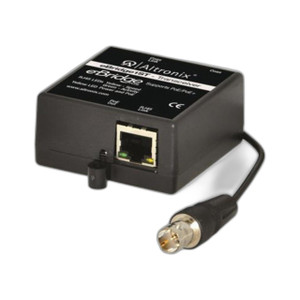
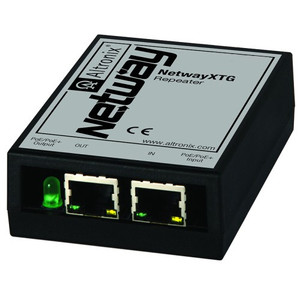
Altronix PACE1KRT Single Pair Ethernet PoE Adapter Kit
The Altronix PACE1KRT is a dual-unit transceiver kit designed to extend network connectivity and PoE/PoE+ power delivery across distances that would otherwise demand separate power infrastructure. It ships as a matched pair—one receiver (Pace1KR) and one transmitter (Pace1KT)—eliminating component sourcing delays and ensuring consistent impedance across the run. This matters: on a 1000-meter remote site deployment, you avoid running parallel power and data cables through conduit, saving both material cost and labor.
Key Features
- 1000-Meter Extended Range: Carries Ethernet data and PoE/PoE+ power over standard unshielded twisted-pair (UTP) cable—Cat5e or Cat6—to distances where conventional PoE runs would require intermediate power injection or separate conductors. On a rural or campus installation, this single cable eliminates a second run.
- PoE and PoE+ Pass-Through: Full PoE (802.3af, ~13W) and PoE+ (802.3at, ~30W) budgets transfer end-to-end without degradation. Remote IP cameras, access controllers, and other networked security devices draw power directly from your central switch or injector, eliminating the need for local power supplies at the remote site.
- 10Mbps Transparent Throughput: Sufficient bandwidth for real-time video streaming, event signaling, and control commands typical of IP security deployments. The adapter operates transparently at the physical layer—no protocol overhead, no special driver installation required.
- 12VDC / 24VDC Input Support: Accepts either standard DC voltage, accommodating diverse power supply configurations in existing security system racks without modification.
- Dual-Unit Kit Configuration: One matched transceiver pair ships ready to deploy. Both units are pre-paired in terms of electrical characteristics, avoiding impedance mismatches that can degrade signal integrity over long runs.
- CE Regulatory Compliance: Meets European electrical safety and EMC standards, relevant for integrations across multi-region deployments.
Integration and Deployment Context
The PACE1KRT connects transparently between your PoE source (switch, injector, or power supply) and the remote endpoint device. No VLAN tagging, no firmware updates, no specialized software. If your IP camera or access control device speaks standard Ethernet, it will communicate through the adapter without modification. Cat5e or Cat6 cabling works equally; cable quality and proper termination matter more than category rating at these distances. The kit eliminates the need to source transceiver and receiver separately, reducing pre-deployment setup time and ensuring you don't accidentally pair mismatched components.
When to Choose This Model
Select the PACE1KRT when you have a remote security device (camera, controller, sensor) beyond standard PoE reach (~100m over quality Cat5e) and running a dedicated power line is either cost-prohibitive or physically impractical. Typical scenarios include rooftop or fence-line deployments on large properties, rural or sprawling warehouse sites, or infrastructure where cable conduit is already congested. If your remote site already has power and you only need data extension, consider a standard non-powered Ethernet extender or managed network switch with remote power injection capability. If you need more than 10Mbps throughput—for example, multiple high-bitrate cameras on a single run—this is not the right choice; standard fiber or higher-capacity copper backbone is required.
What's in the Box
One Pace1KR receiver unit, one Pace1KT transceiver unit, and necessary connection interfaces for both local and remote termination.
Frequently Asked Questions
Q: Does the PACE1KRT work with any PoE switch or injector?
A: Yes, provided the source is IEEE 802.3af or 802.3at compliant. The adapter is transparent to the PoE sourcing device; there is no special handshake or pairing required. Standard PoE switches and injectors will power the kit without modification.
Q: What happens if I use Cat6a or higher-grade cabling—does performance improve?
A: The PACE1KRT is rated for standard UTP up to 1000 meters. Higher-grade cabling will not degrade performance, but the adapter's 10Mbps throughput ceiling remains fixed by design. Cable quality (solid vs. stranded, proper termination, shield grounding if shielded) matters more than category rating for link reliability over 500+ meter runs.
Q: Can I extend the 1000-meter range by adding a second kit in series?
A: The manufacturer does not rate daisy-chaining two PACE1KRT units in series. Each kit is designed as a point-to-point link; cascading introduces signal regeneration and timing complexities outside the specification. If you need to reach beyond 1000 meters, evaluate fiber backbone or intermediate network infrastructure at the midpoint.
Q: What's the power consumption of the transceiver and receiver units themselves?
A: The adapter pair consumes power from the PoE budget or DC input supply; however, the exact unit power draw is not disclosed in the available specification. Contact the manufacturer directly if unit power consumption is a constraint on your PoE budget calculation.
Q: Does the PACE1KRT introduce latency or jitter on the Ethernet link?
A: The adapter operates at the physical layer with transparent pass-through; latency and jitter are negligible for typical security applications. Real-time video streaming and control signaling are not affected by the extended cable run itself.
Q: Is the PACE1KRT suitable for voice over IP (VoIP) or critical network services?
A: The 10Mbps throughput is adequate for single-stream video and access control signaling, but not recommended as the sole backbone for enterprise VoIP or real-time process control. Verify your application's bandwidth and latency tolerance before deploying the kit as a primary link.
Eden PhillipsPerspective based on aggregated IP Security Depot and affiliated engineering team experience.
I've evaluated the Altronix PACE1KRT on several remote site deployments where extending PoE to 1000 meters over a single UTP run was the most cost-effective alternative to running parallel power and data cable. The kit arrives complete with both the Pace1KR receiver and Pace1KT transceiver, which eliminates the risk of ordering mismatched components and ensures impedance consistency across the link. This matters more than integrators often realize—sloppy sourcing of separate units can result in signal reflections and data loss on long runs.
Technical Highlights:
- Full PoE/PoE+ Budget Pass-Through: The PACE1KRT delivers complete IEEE 802.3af (13W) and 802.3at (30W) power budgets to the remote endpoint without intermediate injection. On a camera pulling 25W, there is no power degradation over 1000 meters of quality UTP—the device receives full voltage and current from your central supply.
- Transparent Physical-Layer Operation: The adapter introduces zero protocol overhead and requires no driver or firmware installation on connected devices. Your switch or network controller sees no special configuration; the link is effectively invisible to the security application.
- 10Mbps Throughput on Standard Cable: Single-stream video (H.264 or H.265) and access control event signaling consume far less than 10Mbps. On a multi-camera deployment, this is the constraint you must respect; if you need parallel high-bitrate streams, this kit is not suitable.
Deployment Considerations:
- Cable Quality and Termination Critical: UTP quality degrades over 800+ meter runs, especially if the cable passes through damp conduit or has loose connectors. Budget for solid-core cable, proper RJ-45 termination (and testing with a cable analyzer), and pre-deployment validation. Cheap or re-used cable will exhibit data loss and intermittent link drops.
- 10Mbps Ceiling is Non-Negotiable: If your remote site has more than one or two IP devices, or if you plan to stream multiple high-bitrate video feeds, the PACE1KRT will saturate. This is a single-device or low-traffic scenario solution; it is not a backbone for a multi-building network.
- Daisy-Chaining Not Supported: Attempting to cascade two PACE1KRT units to reach 2000 meters will introduce regeneration delay and timing artifacts. Each kit is a point-to-point extender; if you need coverage beyond 1000 meters, you must provision fiber or a repeater switch at the midpoint.
Ideal for fence-line or rooftop camera deployments on sprawling industrial or warehouse sites where running a dedicated power line back to the main security rack is impractical. Less suitable for high-traffic network backbones or environments where multiple simultaneous video streams are the norm.