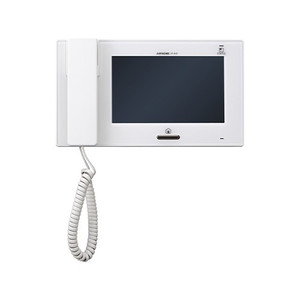
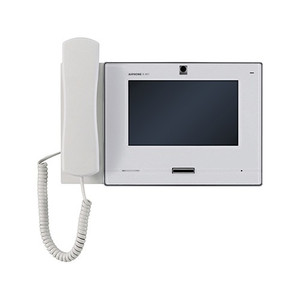
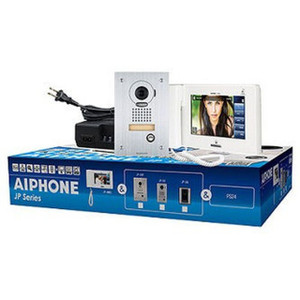
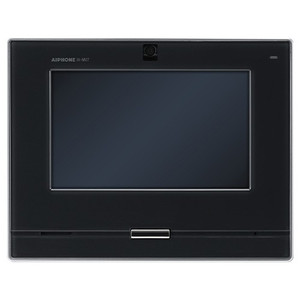
Aiphone JP-4MED 7" Touchscreen Master Station
Overview
The JP-4MED is the primary answering station for Aiphone's JP Series video intercom platform. Built around a 7" touchscreen LCD display delivering 800 x 480 pixel resolution, this wall-mountable unit handles both handset (duplex) and hands-free (VOX) communication. It connects to up to 4 video door stations and 8 sub-stations, making it suitable for multi-unit residential, commercial, and institutional deployments where centralized call management and visitor verification matter. Power arrives via PoE (802.3af) at a maximum 340 mA draw—low enough to avoid straining standard switch power budgets and eliminating the need for a separate AC power supply at the master location.
Key Features
- 7" TFT Color LCD Touchscreen (800 × 480): Responsive interface for call routing, door release control, and system navigation. Resolution is adequate for visitor face verification and call history display without the power or cabling complexity of higher-resolution displays.
- Dual Communication Modes: VOX (voice-activated hands-free) for quick entry confirmation or handset operation for traditional two-way conversation. VOX mode is practical for rapid visitor screening; handset mode suits private tenant conversations or management discussion.
- PoE Power (802.3af, 340 mA max): Single Cat-5e/Cat-6 run powers the master station, eliminating dedicated AC infrastructure at the master location. This matters in retrofit scenarios where running new power lines is costly or impractical.
- Picture Memory and SD Card Expansion: Internal memory stores up to 20 calls with 6 images per call (5 calls protected from overwriting). SD/SDHC card expansion extends this to 1,000 call recordings with 40 images per call (100 calls protected). Audit trail capability is essential for security-conscious deployments—the protected-call structure prevents accidental overwrites of critical visitor records.
- Per-Station Door Release Control: Each connected sub-station has an independent door release button; the master unit supplies a 24V AC/DC 0.5A N/O dry closure contact for electrified lock integration. This distributed design lets tenants or staff manage their own entry without routing every unlock through a central station.
- Pan, Tilt, Zoom Display Control: Digital PTZ capability on video feed provides closer visitor examination without requiring PTZ cameras at door stations. Brightness adjustment compensates for varying ambient lighting, ensuring usable image quality in lobbies with poor or changing daylight.
- Multi-Unit Connectivity: Supports room-to-room calling between master and sub-stations (JP-8Z) without accessing door stations—useful for internal communications. Cat-5e/Cat-6 runs extend sub-station range up to 650 feet, enabling distributed answering points in large facilities.
- Hearing Aid T-Mode: Telephone compatibility mode for users with hearing aids reduces feedback and improves clarity for accessibility compliance.
- Operating Range: Rated 32–104°F (0–40°C) for indoor wall-mounted installations. This indoor specification is typical for master stations—verify if your deployment requires extended temperature tolerance.
Integration and Cable Runs
Door station connections use 2-conductor, mid-cap solid non-shielded cable (Aiphone part #871802 recommended) at distances up to 165 feet with 22 AWG or 330 feet with 18 AWG wire. PoE power supply to the master operates within 16 feet (22 AWG) or 33 feet (18 AWG)—plan your PoE injector placement accordingly. Sub-stations integrate via standard Cat-5e or Cat-6 cabling for distances up to 650 feet, enabling installations across multi-story buildings or distributed campuses. The JP-4MED mounts flush to walls or on desks via the MCW-S/A accessory mount (sold separately), accommodating recessed or surface placement in lobbies, corridors, or common areas. Physical dimensions are 5-11/16" H × 10-1/16" W × 1-7/8" D.
Frequently Asked Questions
Q: Can the JP-4MED control multiple door locks independently?
A: Yes. Each sub-station has its own independent door release button, and the master unit provides a 24V AC/DC 0.5A N/O dry closure contact for lock integration. This allows distributed control—each tenant or floor manager can release their own entry point without central intervention.
Q: How long can I run cable from the PoE source to the JP-4MED?
A: PoE power supply runs are limited to 16 feet (22 AWG) or 33 feet (18 AWG) from the injector. Plan your PoE injector location accordingly to stay within these distances and avoid voltage drop.
Q: What happens if I exceed the 20-call internal memory limit?
A: The oldest unprotected calls are overwritten. Inserting an SD/SDHC card expands storage to 1,000 calls, with 100 calls protected from overwriting—essential for deployments requiring full audit trails.
Q: Does the JP-4MED work with an existing Aiphone JP Series door station?
A: Yes. The JP-4MED is the primary answering station for the JP Series platform and connects to up to 4 video door stations and 8 sub-stations.
Q: Can I wall-mount the JP-4MED, or do I need a desk mount?
A: The JP-4MED is designed for wall mounting and integrates into standard electrical boxes. The optional MCW-S/A accessory mount supports both recessed and surface wall installation, or desk placement if needed.
Q: What power supply is required for the JP-4MED?
A: The JP-4MED is powered entirely by PoE (802.3af) at 340 mA maximum—no separate power supply is needed. A standard PoE injector or PoE switch port supplies all power.
Ted PerryPerspective based on aggregated IP Security Depot and affiliated engineering team experience.
I've evaluated the JP-4MED in multi-unit residential and small commercial deployments, and it delivers solid value as a PoE-powered answering station. The 7" touchscreen is responsive, the picture memory with SD card expansion provides genuine audit capability, and the hands-free VOX mode works well for quick visitor verification. The unit is straightforward to deploy—PoE eliminates a power supply installation step at the master location, and Cat-5e runs to sub-stations reduce infrastructure cost compared to older proprietary cabling schemes.
Technical Highlights:
- PoE Power Efficiency (340 mA max): At roughly 3.4W draw via 802.3af, the JP-4MED won't consume meaningful power budget from a standard PoE switch. This is particularly valuable in retrofit installations where adding dedicated power circuits is expensive or infeasible.
- Picture Memory with Protected Calls: The combination of 20 internal calls with 5 protected plus SD expansion to 1,000 calls with 100 protected gives real flexibility. Small deployments run on internal memory alone; larger or compliance-driven sites can swap SD cards for auditable retention without fussing with network storage or external recorders.
- Sub-Station Range via Cat-5e (650 feet): Standard network cabling to remote answering points eliminates the cost of running proprietary cable to every floor or wing. This is a genuine competitive advantage if you're deploying across a distributed facility.
Deployment Considerations:
- PoE Injector Placement Matters: Power runs to the master are capped at 16–33 feet depending on wire gauge. Don't assume you can put the PoE injector in a distant equipment room—you'll need it reasonably close to the master station location.
- Picture Memory is Not a VMS Replacement: This unit stores call snapshots locally, which is audit-capable but not a substitute for a networked video management system. If your compliance or security posture demands centralized recording and advanced search, plan for an NVR or software VMS platform alongside the JP-4MED.
The JP-4MED is your best bet for a compact, PoE-powered multi-station video intercom in residential or small commercial environments where simplicity and cost-effectiveness matter more than sophisticated analytics or massive call logging.