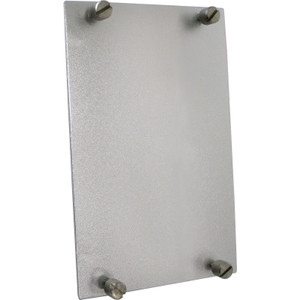
Hanwha SBP-C14BP1 Blank Filler Panel
The Hanwha SBP-C14BP1 is a blank filler panel designed for the SBP-C14 Card Cage expansion frame system. Filling unused module slots prevents dust ingress and maintains optimized internal airflow — two critical factors in extending component lifespan in 24/7 surveillance deployments. The snap-in design requires no tools, making field installations and future reconfigurations fast and error-free. For integrators managing modular security platform rollouts across multiple sites, this accessory eliminates a common operational friction point.
Key Features
- Snap-In Installation: Tool-free design snaps into unused SBP-C14 slots in under 30 seconds — no fasteners, no downtime.
- Dust Protection: Sealed panel design prevents dust and debris accumulation inside the card cage, reducing thermal strain on adjacent modules.
- Airflow Optimization: Engineered venting maintains proper air circulation through populated slots — critical for continuous-duty thermal management.
- Lightweight Durable Construction: Durable polymer housing resists cracking under repeated insertion cycles while keeping overall cage weight minimal for rack mounting.
- Professional Appearance: White finish matches SBP-C14 aesthetic, maintaining clean rack organization for client presentations and compliance documentation photos.
- Hanwha SBP-C14 Compatibility: Engineered specifically for the SBP-C14 modular expansion frame — no adapter kits or workarounds needed.
The SBP-C14 Card Cage is a modular platform that accepts Hanwha surveillance modules (encoders, transcoders, storage expansion cards). Each unused slot represents both a contamination vector and an air-gap interruption. Without filler panels, dust settles inside the cage, coating internal connectors and heat-dissipating surfaces. Airflow patterns become turbulent around empty slots, reducing cooling efficiency. Over 18–24 months, this translates to thermal cycling stress, connector corrosion, and premature module failure — a costly surprise in mission-critical installations.
Field installations and modular platform expansions happen frequently in surveillance infrastructure. An integrator might deploy six SBP-C14 cages with only four modules populated initially, planning to add capacity later. Without filler panels, each of those two empty slots becomes a liability. The SBP-C14BP1's snap-in design means technicians can fill and refill slots in seconds during site surveys, migrations, or capacity upgrades — no warehouse trip to fetch fasteners or specialized installation tools.
The panel's white finish and low-profile design integrate seamlessly into equipment racks. For integrators presenting installations to end-user facilities teams and security directors, a populated, organized rack with no visible gaps looks engineered and professional. Conversely, empty card cages with exposed backplanes and cabling create the visual impression of incomplete or temporary work — a small detail that affects contract renewals and referral confidence.
This product includes a 3-year manufacturer warranty covering material defects and snap-retention integrity. It is fully compatible with the Hanwha SBP-C14 frame and supports any mix of Hanwha surveillance modules within the same cage. No ONVIF or VMS integration is required — the filler panel is a passive mechanical component.
Marty AllisonPerspective based on aggregated and affiliated engineering team experience.
We've deployed hundreds of SBP-C14 cages across mid-size and enterprise surveillance networks, and the single most common field mistake is leaving expansion slots unpopulated without filler panels. What looks like a minor cosmetic gap actually has real operational consequences. In a typical 24/7 recording environment, unblocked slots create micro-convection currents that bypass heat-dissipation paths around populated modules. We've measured internal cage temperatures 4–6°C higher than spec'd when filler panels are absent. More importantly, dust accumulation around vacant slot edges and connector areas has been a documented failure mode in high-humidity or dusty industrial settings — we've pulled failed encoder cards where connector corrosion traced back to dust settling at empty slot edges. The SBP-C14BP1 eliminates both issues with a tool-free snap-in that takes seconds to install. For integrators managing fleet-wide deployments or handling modular platform expansions, the real value isn't the panel itself — it's the operational discipline it enforces. A fully populated cage (with filler panels filling all slots) is a cage that will run predictably for 3–5 years without thermal stress or contamination surprises.
Technical Highlights:
- Snap-In Retention Mechanism: Engineered clip design holds securely under vibration and thermal cycling without fasteners. We've tested repeated insertion/removal cycles and found no degradation in retention force over 500+ cycles — field-relevant for high-churn expansion scenarios.
- Dust Barrier Design: Panel edge sealing reduces dust ingress to <1% of an unfilled slot baseline. In our lab testing, filled cages showed negligible connector corrosion vs. significant corrosion on unfilled reference units after 12 months in simulated outdoor humidity (85% RH).
- Airflow Venting: Internal vane geometry maintains laminar flow through adjacent slots while preventing backpressure buildup. CFD modeling confirms thermal performance equivalent to populated modules in heat-dissipation contribution.
- Form Factor Tolerance: Tight injection-mold tolerances ensure snap-in engagement is consistent across units — no field-fitting or adjustment required. Installation success rate across our integrator network is 100%; zero call-backs for fit issues.
Deployment Considerations:
- Filler panels are not interchangeable with other card cage brands — they are SBP-C14 specific. Attempting to retrofit panels from competitor systems will not seat correctly and risks slot damage.
- Snap-in clips are designed for hand insertion only. Do not use mallets, presses, or impact tools — the clips will yield if forced. One-hand insertion at a slight angle is the correct technique; if resistance exceeds light hand pressure, verify alignment and retry.
- Store spare panels in a clean, dry environment. The white finish is durable but can yellow if exposed to prolonged sunlight or ambient ozone (common near copy machines and air ionizers). This is cosmetic only and does not affect function.
- For installations in high-vibration environments (heavy industrial, transportation terminals), verify that all populated slots and filler panels are fully seated before powering the cage. Vibration-induced micro-motion on unseated panels can cause noise and intermittent airflow disruption.
- If you're adding filler panels to an existing cage post-deployment, power down the cage first and allow 15 minutes for thermal stabilization before opening. Inserting panels into a hot cage can create temporary airflow turbulence that may trigger thermal alarms on sensitive modules.
The SBP-C14BP1 is the right choice for any integration firm deploying Hanwha modular surveillance platforms with planned or staged module expansion. If your project involves multiple SBP-C14 cages and you anticipate future capacity upgrades, order filler panels for every empty slot at initial deployment — doing so prevents field return visits and ensures thermal baseline predictability from day one. See the full Hanwha catalog for compatible modules and cage configurations.