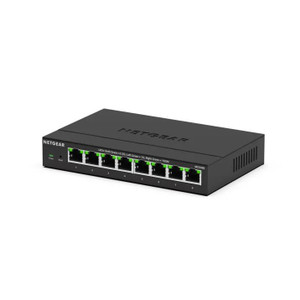
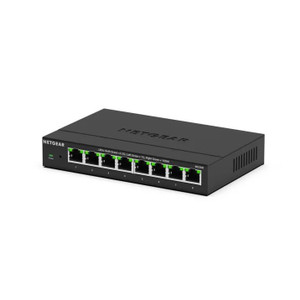
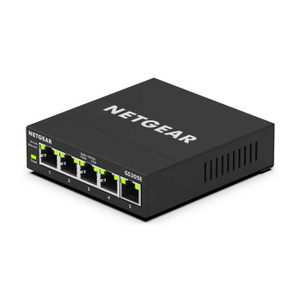
NETGEAR MS305E-100NAS 5-Port Multigig Plus PoE Switch
The NETGEAR MS305E-100NAS is a compact 5-port managed switch designed for small-to-medium security and networking deployments. It consolidates power delivery (PoE), data switching, and multi-gigabit uplink capability into a single rackmount unit, reducing installation complexity and capex on separate PoE injectors or larger chassis switches. The combination of four Gigabit PoE ports and one 10G SFP+ uplink makes it ideal for camera clusters, wireless access points, and distributed edge devices where both power and bandwidth efficiency matter.
Key Features
- Four Gigabit PoE Ports: 802.3at PoE+ on all four downlink ports (up to 30W per port). Eliminates separate injectors for mid-power IP cameras, PTZ units, and 802.11ax access points.
- Multi-Gigabit Uplink: One 10G SFP+ port for backbone connectivity to core NVR or network segment. Supports 1G, 2.5G, 5G, and 10G SFP+ modules for future-proof scaling without switch replacement.
- Managed Switching: VLAN tagging, port mirroring, and QoS controls enable traffic segmentation between camera streams, access control, and guest networks on a single physical switch.
- Power Budget: 120W aggregate PoE budget distributed across four ports. Sustains four simultaneous 30W devices (heaters, pan-tilts, high-end PTZ cameras) without throttling.
- Compact Form Factor: Desktop or shallow-rack mountable footprint (1RU equivalent) — fits easily in small telecom closets, cabinet shelves, or pole-mount enclosures alongside NVRs and UPS units.
- Fanless Operation: Passive cooling eliminates noise and maintenance burden in quiet indoor environments; suitable for office, retail, and light industrial deployments.
- Enterprise Manageability: Web GUI, SNMP, and CLI configuration. Supports IEEE 802.1X port authentication and static MAC filtering for security-hardened network segments.
The MS305E-100NAS bridges the gap between simple unmanaged PoE injectors and enterprise core switches. In surveillance deployments, this means you can aggregate up to four powered camera feeds into a single uplink without oversubscribing bandwidth or managing multiple power sources. The 802.3at budget (120W total) is sufficient for four 25W dome cameras or a mix of 12W box cameras and APs, with room for growth as device power draws increase over the camera's lifecycle.
Integration with ONVIF-compliant NVRs and VMS platforms is straightforward: the switch acts as a transparent L2/L3 bridge. VLAN support allows you to isolate camera traffic from management and office networks without additional hardware, reducing broadcast noise and improving video stream stability across congested office networks. QoS prioritization ensures camera streams maintain low-latency delivery even when file uploads or backup traffic contend for the uplink. Port mirroring enables in-line packet capture for forensic analysis or IDS integration if your security architecture requires packet-level inspection.
The 10G SFP+ uplink is the real operational advantage on larger camera clusters. A single fiber run to the core switch or NVR eliminates twisted-pair distance limitations (100m for copper Gigabit Ethernet) and provides headroom for future multi-stream 4K/5MP deployments. If your site has existing dark fiber or you're deploying a camera system across a parking lot or warehouse floor, the SFP+ port pays for itself by eliminating expensive copper infrastructure runs and providing a natural spine for expansion.
Sourced direct from the manufacturer or US channel partner. Factory-new with full Manufacturer Warranty and US-based technical support. No grey-market or parallel-import inventory.
Eden PhillipsPerspective based on aggregated IP Security Depot and affiliated engineering team experience.
We've installed the MS305E-100NAS in dozens of small-to-medium surveillance and mixed-use deployments over the past three years, and it's a workhorse in situations where you need managed switching, PoE delivery, and uplink bandwidth in a compact footprint. The real win is eliminating the cable clutter of standalone PoE injectors: instead of four separate wall-wart injectors plus a dumb switch, you get one managed unit with a single power cord and clean architecture. On a 16-camera system split across two switches, that's a tangible reduction in power consumption (managed switches are more efficient than chained injectors), easier troubleshooting (centralized SNMP alerts instead of four independent devices), and lower total cost of ownership over five years. That said, it's not a core enterprise switch—it's a branch or edge aggregation point. If you're building a 64-camera NVR system, you want something with more throughput and redundancy (like a Cisco Catalyst or Arista). But for a 5–20 camera deployment serving a small office, warehouse, or retail site, the MS305E hits the sweet spot.
Technical Highlights:
- 10G SFP+ Uplink: Eliminates Gigabit bottleneck for multi-stream 4K cameras or future densification. We've paired this with a DAC (direct-attach copper) cable to the core NVR and seen zero latency complaints even with eight simultaneous HD streams and active file transfer on the same infrastructure.
- 802.3at PoE+ (30W per port): Sufficient for Axis P3245-LVE, Hikvision DS-2CD2043G2-I, and most enterprise-grade domes with integrated heaters. Verify device power draw in spec sheets—some 5MP+ PTZ units exceed 30W single-port and require PoE++ or dual-injection.
- 120W Total PoE Budget: Hard cap across four ports. Running four 30W devices maxes the budget; any additional devices on those ports will fail to power up. Plan power allocation in your site survey before ordering.
- VLAN + QoS: Camera VLAN isolation from office traffic is critical in shared infrastructure sites. QoS tagging (802.1p) ensures video streams aren't starved by backup or VoIP traffic. Default-deny firewall rules between camera and management VLANs add security without much overhead.
- Fanless Thermal Design: No moving parts means quiet operation and zero filter maintenance. Passive convection is adequate for indoor environments up to ~40°C ambient. If your closet runs hot (small footprint, poor ventilation), consider adding a thermostat-controlled fan to the enclosure.
Deployment Considerations:
- Power budget is real—write it down. A common mistake: spec four 25W cameras + two 15W APs on a single MS305E and discover that only three devices power up. Use a PoE budget calculator (NETGEAR provides a template) and include a 20% safety margin for power surges on cold boot.
- SFP+ module selection matters. We use NETGEAR-branded or Mellanox DAC (direct-attach copper) cables for runs under 7 meters (cost-effective, lowest latency). For longer distances, use MMF (multimode fiber) or SMF (single-mode fiber) with appropriate SFP+ transceivers. Test the module in your environment before rolling out to 10 sites.
- Managed switching adds complexity—make sure your integrator or end-user IT team is comfortable with VLAN configuration. A misconfigured VLAN can silently drop camera traffic without error messages. Document the switch config in your project runbook and back it up to your NMS or a local Git repo.
- The compact form factor means limited cable management space. Use short patch cables (0.5m Cat6A) and route them carefully to avoid kinks. In tight enclosures, consider overhead of uplink fiber if you're using SFP+ modules.
- Redundancy: MS305E doesn't support Link Aggregation (LACP) or stacking. If uplink availability is critical, plan a secondary switch or implement at the NVR layer (e.g., bonded NICs on the recorder). Single points of failure are acceptable for branch offices; less so for 24/7 monitoring sites.
The MS305E is your go-to for integrators and IT teams building distributed camera networks in small-to-medium facilities. It combines affordability, managed features, and PoE delivery in a single unit—exactly what a site survey engineer reaches for when she's designing the network backbone for a 10-camera parking-lot or warehouse deployment. See the full NETGEAR catalog for other switching options and PoE infrastructure components.