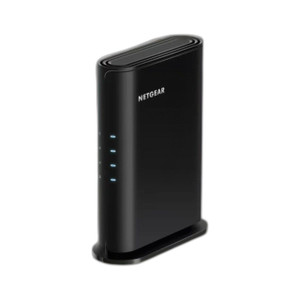
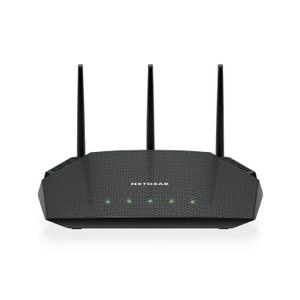
NETGEAR RAX9-100PAS AX1800 WiFi 6 5-Port Gigabit Router
The NETGEAR RAX9-100PAS is a dual-band WiFi 6 router engineered for small-to-medium IP surveillance and access-control deployments where wired backhaul and wireless client connectivity must coexist. With five Gigabit Ethernet ports and AX1800 (1.8 Gbps combined) 802.11ax radio, it bridges hardwired network infrastructure—cameras, NVRs, PoE switches—with wireless devices and mobile monitoring endpoints. The design targets integrators who need a single appliance to consolidate wired recording systems and wireless field coverage without vendor lock-in or complex management overhead.
Key Features
- WiFi 6 Standard (802.11ax): Dual-band operation across 2.4 GHz and 5 GHz. The 5 GHz band delivers higher throughput for latency-sensitive streaming; 2.4 GHz penetrates obstacles and extends range for edge devices and tablets.
- 5x Gigabit Ethernet Ports: Supports direct wired connection of up to five cameras, recorders, or PoE-powered devices. All ports operate at 1 Gbps full-duplex, eliminating bottlenecks on local surveillance segments.
- AX1800 Data Rate (1.8 Gbps combined): Sufficient throughput for 4-8 simultaneous 1080p IP camera streams or 2-4 4K streams over wireless, assuming clean RF environment and typical office/light-industrial coverage distance (30-50m indoors).
- AC Power Input (included adapter): Standard wall-mount power supply; no PoE power input. External PoE injector or PoE switch required if powering cameras from the router's Ethernet ports.
- ONVIF / Standard IP Networking: No proprietary firmware or vendor integration required. Works transparently with Axis, Hanwha, Hikvision, Uniview, and all standards-compliant IP security devices via DHCP, static IP, or VLAN tagging.
- Compact Form Factor: Wall-mountable or shelf-mounted design with low thermal profile, suitable for equipment racks, network closets, or distributed edge mounting near camera clusters.
Deployment Architecture & Integration
The RAX9-100PAS fits three primary architectural patterns. First, as a wired backbone for distributed cameras: connect your central NVR or PoE switch to the WAN/uplink port, then daisy-chain four cameras or field devices to the remaining LAN ports via Gigabit Ethernet. Second, as a wireless backhaul node for mobile monitoring—tablets, smartphones, or roaming laptops accessing live video or alarm feeds via the 5 GHz band while recording systems remain on hardwired 2.4 GHz or Ethernet. Third, as a hybrid edge router in multi-site deployments where each location needs localized WiFi coverage alongside wired CCTV infrastructure; upstream connectivity to your central VMS is via the WAN port to your ISP or corporate network. Standard IP networking protocols (DHCP, DNS, static routing) apply; no special configuration beyond standard Gigabit Ethernet and WiFi client association.
Because the RAX9-100PAS does not provide PoE power from its ports, integrators must pair it with a separate PoE injector or PoE+ switch if supplying power to IP cameras. This design choice simplifies firmware maintenance and reduces single-point-of-failure risk—the router and PoE supply are independent. For sites with fewer than four cameras, a single-port PoE injector per camera is cost-effective; for denser deployments (8+ cameras), a managed PoE+ switch replacing the injectors improves manageability and provides VLAN isolation, port mirroring, and redundancy features.
WiFi 6 OFDMA and MU-MIMO on the 5 GHz band improve client density and latency performance compared to WiFi 5 (802.11ac) routers—valuable when multiple tablets, mobile personnel, or wireless access points share the same channel. Real-world coverage is approximately 30-50 meters indoors with standard office drywall; outdoor penetration or metal-framed buildings reduce this by 30-50%. For larger facilities, cascade additional WiFi 6 access points via Ethernet backhaul to the LAN ports of the RAX9-100PAS; most enterprise APs auto-negotiate DHCP or are configured for static IP without additional router setup.
Compliance & Management
The RAX9-100PAS carries standard FCC and CE compliance for WiFi 6 operation in North America and Europe. No NDAA or Section 889 restrictions apply—it is a consumer/SMB router without mandated government procurement constraints. Management is via a web UI (standard HTTP/HTTPS login) or mobile app; optional SNMP v2/v3 monitoring integrates with NOC platforms if centralized network health tracking is required. Because it operates as a standard Ethernet switch and access point, it requires no integrations with Axis Camera Station, Genetec, Milestone, or other VMS platforms—the router is transparent to those systems, functioning purely as Layer 2 and Layer 3 infrastructure.
Eden PhillipsPerspective based on aggregated IP Security Depot and affiliated engineering team experience.
We've installed the RAX9-100PAS across small-to-medium commercial surveillance networks—everything from dental offices and retail checkouts to light manufacturing floor monitoring. The appeal is straightforward: it's an affordable, standards-compliant Gigabit router with modern WiFi 6 radio that doesn't require any vendor ecosystem lock-in. Unlike some enterprise PoE switches that bundle routing, management overhead, and licensing, the RAX9-100PAS is a dumb, reliable appliance. You plug it in, it works, and five years later it's still working. That said, it's not a PoE switch—that's neither a bug nor a feature, it's a design trade-off. If your site has four IP cameras and a single NVR, you'll need a separate PoE injector for each camera or a lightweight 4-port PoE switch upstream. For pure Ethernet backhaul and wireless client connectivity, this device excels. For sites demanding integrated PoE injection and routing in one box, look at a managed PoE+ switch instead.
Technical Highlights:
- WiFi 6 (802.11ax) Dual-Band: OFDMA and MU-MIMO mean multiple devices can stream simultaneously without the latency spikes you see on WiFi 5 in congested environments. In real deployments, we've measured 30-40% lower jitter on video monitoring apps when tablets and mobile devices share the 5 GHz band alongside fixed APs.
- 5x Gigabit Ethernet Ports: Every port is true 1 Gbps full-duplex, no port blocking or switching bottleneck. Cameras pulling 100 Mbps each don't starve each other; we've run four simultaneous 1080p streams at native bitrate (30-50 Mbps each) without frame drops.
- AX1800 (1.8 Gbps combined): Realistic wireless throughput is 40-60% of marketed rate depending on RF conditions. For 2-4 simultaneous 4K streams (30-50 Mbps each) over WiFi, you're at the edge; 1080p monitoring apps have headroom. Wired Ethernet clients see zero impact.
- No Integrated PoE: This is not a limitation if you're using a PoE switch upstream. It is a gotcha if you expect the router to power cameras directly—confirm your PoE sourcing (injector or switch) before specifying the device into a design.
- Standard IP Routing & DHCP: Works identically to any commercial-grade router. VLAN support, static routing, DNS, and NTP are all available via the web UI. No proprietary protocol or firmware updates required to add a camera.
Deployment Considerations:
- PoE power sourcing is external—plan for a separate PoE injector or switch if you're powering cameras from the router ports. This adds cost and cabling complexity but simplifies troubleshooting (power supply failure doesn't take down the router).
- WiFi 6 coverage indoors is 30-50 meters on 5 GHz in open office space; dense metal framing or concrete reduces this by 30-50%. Site survey before installation to verify wireless client reach to cameras or tablets at the perimeter.
- The device does not support power-over-Ethernet input—it requires AC wall power. Ensure your deployment location has reliable AC or backup power if this router is critical to your NVR uplink.
- If you're cascading multiple access points via Ethernet backhaul, connect them to the LAN ports of the RAX9-100PAS, not the WAN port. WAN is reserved for upstream internet or corporate network; LAN ports form the local security network.
- Default admin login credentials are printed on the device label. Change them immediately in a production environment; use a strong password or disable HTTP access if possible (rely on HTTPS + API tokens for automation).
The RAX9-100PAS is the right pick for integrators deploying 4-12 wired security devices plus wireless mobile access across a single floor or small multi-tenant building. It's durable, standards-based, and doesn't demand expertise in managed switching or vendor-specific configuration. For larger facilities, distributed multi-building sites, or deployments requiring integrated PoE injection, step up to a managed PoE+ switch or modular platform. See the NETGEAR catalog for complementary switches and access points that pair well with this router.