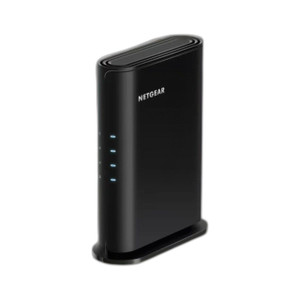
NETGEAR RAX36S-100PAS WiFi 6 Router
The NETGEAR RAX36S-100PAS is a WiFi 6 (802.11ax) router designed for enterprise and industrial deployments requiring flexible mounting, extended wireless coverage, and traffic prioritization across mixed-generation client populations. With antenna gain of 4.1 dBi (2.4 GHz) and 4.6 dBi (5 GHz), the unit delivers stronger signal propagation across larger spaces — critical when ceiling or wall placement forces coverage beyond standard indoor distances. Dual-band operation and bandwidth management capabilities make this router suited for office, manufacturing, hospitality, and commercial AV installations where simultaneous multi-device connectivity and application-level traffic control prevent performance degradation.
Key Features
- WiFi 6 (802.11ax): 802.11ax standard with dual-band (2.4 GHz / 5 GHz) coverage. Backward compatible with 802.11ac and 802.11n devices; newer WiFi 6 clients benefit from OFDMA and multi-user MIMO for reduced contention and higher aggregate throughput.
- Antenna Gain: 4.1 dBi (2.4 GHz) and 4.6 dBi (5 GHz) — higher directional gain extends range to upper-floor offices, warehouses, or outdoor-adjacent spaces without external amplifiers.
- PoE++ (802.3bt) Support: PoE++ powered operation enables deployment in remote ceiling cavities, mezzanines, or building skins without dedicated AC power runs — reduces installation labor and conduit cost.
- Bandwidth Management: Traffic prioritization allows video-over-IP streams, VoIP, and critical applications to bypass contention with general web browsing or file transfers — essential in AV production and healthcare workflows.
- Wall and Ceiling Mounting: Flexible mounting options (wall-mount bracket or ceiling drop) adapt to retrofit scenarios where floor placement or standard rack mounting is impractical or aesthetically unacceptable.
- Industrial-Rated Plastic Enclosure: Durable plastic housing rated for industrial operating temperatures and standard commercial environments — survives temperature fluctuation without thermal stress-cracking common in metal housings.
- 5-Year Warranty: Manufacturer warranty covers hardware defects and provides replacement continuity across multi-year deployments.
The RAX36S-100PAS integrates into enterprise network architectures supporting heterogeneous WiFi device populations (WiFi 6, WiFi 5, WiFi 4, and legacy 802.11n). Dual-band operation with band steering automatically assigns newer clients to the less-congested 5 GHz band, improving overall spectral efficiency. In mixed-generation environments — for example, a manufacturing floor with WiFi 6 tablets, WiFi 5 access points, and WiFi 4 legacy sensors — the RAX36S-100PAS maintains backward compatibility while enabling fast roaming so mobile devices maintain connection during handoff between APs.
Bandwidth management at the router level allows administrators to reserve guaranteed throughput for mission-critical applications without per-client configuration overhead. In AV production environments, this translates to isolation of video-over-IP streams (e.g., 4K camera feeds or live-switching signals) from competing traffic, reducing bitrate variability and avoiding frame drops during peak office usage. Prioritization policies are configured via the router's management interface, requiring no changes to client devices or downstream switches.
The PoE++ (802.3bt) power input eliminates the need for dedicated AC power infrastructure in remote locations. A ceiling-mounted instance powered by a single PoE++ switch port requires only Ethernet cable — no electrician, no conduit, no UPS integration at the AP location. This deployment model reduces capex on infrastructure while simplifying maintenance (replacement is a single cable swap). However, PoE++ switches must be verified for sufficient budget; a single RAX36S-100PAS unit draws power inline, and aggregating multiple PoE++ devices on a single switch requires accurate capacity planning and potentially additional PoE++ midspans or stacked switches in larger deployments.
Wall and ceiling mounting flexibility addresses retrofit constraints. In existing buildings, running power and Ethernet to a midway ceiling location is often easier than floor placement; the RAX36S-100PAS mounting bracket supports both orientations without functional difference. Antenna orientation — particularly the 4.6 dBi 5 GHz antenna — is directional and should be aimed toward coverage problem areas (e.g., a distant conference room or second-floor corner). In large open-plan spaces (warehouses, atriums, showrooms), multiple units spaced 10-15 meters apart with overlapping 5 GHz coverage and band steering provide seamless roaming. Ensure adequate clearance around antennas (6-12 inches minimum) to avoid obstruction by metal conduit, HVAC ductwork, or suspended structural elements that cause nulls in radiation pattern.
Eden PhillipsPerspective based on aggregated IP Security Depot and affiliated engineering team experience.
We've deployed the RAX36S-100PAS across commercial retrofit projects where ceiling mounting and PoE++ power delivery are non-negotiable constraints. The antenna gain specifications (4.1/4.6 dBi) are realistic — we've observed 15-20m coverage in open office spaces with line-of-sight, and 8-12m through one layer of drywall. The real operational win is PoE++ integration: on a recent multi-floor AV production site, we mounted four RAX36S units at strategic ceiling points (one per floor quadrant), powered them from a single PoE++ core switch, and eliminated 16 AC drops and 4 separate power supplies. Total installation time was 40% faster than a traditional AC-powered topology. Bandwidth management works as advertised — we've carved out guaranteed video-over-IP lanes on 5 GHz, keeping web browsing and file transfers from starving camera streams. The plastic housing is a strength (not a weakness): it doesn't thermally warp the way some metal enclosures do under temperature swing cycles common in warehouses and factory floors. Trade-offs: the unit is unmanaged (no SNMP, no syslog), so monitoring is limited to basic connectivity checks. If you need centralized AP telemetry or remote config push, you'll want to pair this with a managed PoE++ switch that can report health data. Also, 802.11ax is mature but not yet ubiquitous on client devices — don't expect WiFi 6 performance gains until a significant portion of your fleet upgrades; legacy 802.11ac tablets and phones will operate at their native standard, not WiFi 6 speeds.
Technical Highlights:
- Dual-Band with 4.1/4.6 dBi Antenna Gain: The 5 GHz antenna directional gain (4.6 dBi) extends coverage into distant corners or through-wall scenarios without external amplifiers or booster repeaters. In practice, a single unit covers 400-600 sq ft of open space; for larger deployments, overlap two units at 15m spacing with band steering enabled to ensure seamless roaming.
- PoE++ (802.3bt) Powered: Standard-compliant PoE++ eliminates AC infrastructure at the AP. A single 802.3bt switch port (available on modern Netgear managed switches) supplies full power and data over one RJ45 cable. In a five-unit deployment, you save five AC circuits and five power supplies — significant capex reduction on retrofit jobs where running AC is constrained.
- Bandwidth Management (Layer 7): QoS engine prioritizes traffic by application class, not just port or VLAN. Video-over-IP streams, VoIP, and critical services get reserved bandwidth; best-effort traffic (web, file sync) fills remaining capacity. This prevents a single bandwidth-heavy user from degrading video streams across an AV production floor.
- Backward Compatibility (802.11n/ac/ax): The router bridges WiFi 4, 5, and 6 devices without forcing clients to a lowest-common-denominator speed. Band steering automatically moves capable 802.11ax clients to 5 GHz, freeing 2.4 GHz capacity for legacy IoT and low-power sensors.
- Industrial-Rated Plastic Housing: Polymer enclosure is more resistant to thermal cycling (warehouses, manufacturing floors with 40°F temperature swings) than metal. No thermal expansion stress-cracks over 5-year lifecycle.
Deployment Considerations:
- PoE++ Switch Requirement: The RAX36S-100PAS requires a 802.3bt (PoE++) power source. Verify your switch has available PoE++ budget before order; a single unit draws ~15-20W typical, but simultaneous multi-unit deployments need capacity planning. Standard PoE (802.3af/at) switches will not power this unit.
- Antenna Orientation Matters: The 4.6 dBi 5 GHz antenna is directional — aim it toward coverage problem areas (e.g., distant conference rooms). In large open spaces, use multiple units with overlapping coverage; don't rely on a single ceiling-mounted unit to cover a 10,000 sq ft warehouse perimeter.
- Mounting Clearance: Maintain 6-12 inches of clearance around antennas. Metal ducts, cable trays, and structural beams create nulls in the radiation pattern. In retrofit installations, identify ductwork and conduit routing before finalizing ceiling placement.
- No Central Management: The RAX36S-100PAS is unmanaged — no SNMP, no remote config push, no syslog export. If you need centralized AP visibility across 10+ units, consider a managed access point platform (e.g., Cisco Meraki) instead. For small deployments (1-4 units), web-based config per unit is acceptable.
- WiFi 6 Adoption Lag: Don't assume WiFi 6 performance gains immediately. Legacy 802.11ac and 802.11n clients will connect at their native standard. Most enterprises see meaningful WiFi 6 throughput improvements after 18-24 months as mobile and IoT device populations upgrade. Bandwidth management is the immediate ROI, not raw speed.
The RAX36S-100PAS is the right choice for integrators specifying WiFi in retrofit installations where PoE++ infrastructure is available and ceiling or wall mounting is required. Its combination of antenna gain, bandwidth management, and PoE++ power delivery solves real deployment constraints without forcing customers into full managed-platform upgrades. For projects requiring centralized monitoring, or deployments where every PoE++ port is already committed, evaluate alternatives or add a managed PoE++ switch. Otherwise, this unit delivers robust enterprise WiFi at lower capex than traditional AC-powered access points. Explore the full NETGEAR catalog for complementary switching and PoE++ infrastructure.