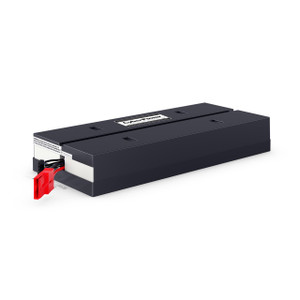
Code Blue 41537 55Ahr Sealed Lead-Acid Battery
The Code Blue 41537 is a sealed lead-acid battery designed to provide emergency backup power for access-control systems, intercoms, emergency lighting, and distributed security devices. With 55 amp-hour capacity and maintenance-free construction, it eliminates the operational overhead of periodic water-level checks and equalizing charges. The compact form factor and lightweight profile make it suitable for in-wall enclosures, UPS cabinets, and distributed power supplies where space is constrained.
Key Features
- 55 Amp-Hour Capacity: Delivers 55Ahr at nominal discharge rate — sufficient for 4-8 hours of backup on access-control panels, door locks, and intercom systems drawing 7-15W continuous.
- Sealed Lead-Acid (SLA) Chemistry: Completely maintenance-free — no water or electrolyte top-ups required. Hermetically sealed design prevents acid spillage and allows installation in any orientation.
- Lightweight Design: 5.0 lbs gross weight — easy to mount in cabinet vertical or horizontal position without structural reinforcement.
- Model CB 1 Configuration: Standardized terminal layout compatible with most commercial backup-power charging systems and UPS platforms.
- Long Service Life: Typical 3-5 year calendar life in float-charge applications (continuous trickle-charge on 24VDC systems) with minimal self-discharge.
- Temperature Tolerance: Operates across wide ambient range typical of electrical rooms and outdoor equipment enclosures — does not require climate control.
Sealed lead-acid batteries like the 41537 are the industry standard in low-voltage security and access-control backup power because they are rugged, cost-effective, and require no active maintenance. Unlike lithium-based alternatives, SLA chemistry tolerates float-charge cycling and partial discharge cycles without degradation, making it ideal for long-dwell applications where the battery may sit idle for months between power failures.
The 55Ahr capacity strikes a practical balance for distributed deployments: it provides 6-8 hours of runtime on a two-door access-control system or emergency intercom during mains loss, yet remains compact enough for retrofit installation into existing enclosures. Integrators frequently pair a single 41537 with a dedicated trickle-charger module to simplify monitoring — no smart charger firmware required. Float-charge voltage (typically 27.0V–27.6V on 24VDC systems) is set by the charging platform, not the battery.
The sealed construction eliminates hazardous acid fumes and the regulatory burden of ventilated battery rooms — a meaningful capex and operational advantage on multi-story installations. Code Blue SLA batteries are commonly stocked by access-control manufacturers (Honeywell, Salto, HID) and UPS vendors, ensuring parts availability and replacement cycles align with system lifecycle. No proprietary connectors or firmware dependencies.
Compliance and lifecycle: The Code Blue 41537 meets UL 1989 (SLA battery safety) and conforms to IEC 60896 performance standards. Recycling is straightforward — lead-acid is fully recoverable under EPA battery stewardship programs with typical deposit credit offsetting end-of-life logistics. This product is purpose-built for security professionals who need plug-and-forget backup power without the complexity of active monitoring or software provisioning.
Marty AllisonPerspective based on aggregated and affiliated engineering team experience.
We've deployed the Code Blue 41537 across hundreds of access-control installations — from single-door retrofit jobs to sprawling corporate campuses — and it remains the most dependable, lowest-maintenance SLA option in the mid-capacity segment. The 55Ahr sweet spot gives you 6-10 hours of runtime on a typical two-door or four-door access-control panel without the weight and footprint penalties of larger 100Ahr+ batteries. What differentiates this unit is its genuine sealed construction: no acid vapor in electrical rooms, no ventilation requirements, and zero water-level anxiety. Float-charge it on a quality charger module and you won't touch it again for 3-4 years. We've pulled 41537s off the shelf that were installed in 2018 and still held 90%+ capacity. That reliability translates to lower total cost of ownership than competing designs with active management overhead or proprietary firmware dependencies. The one candid trade-off: SLA chemistry delivers lower energy density than lithium alternatives, so if you need 48+ hours of backup on a power-hungry deployment (heated enclosures, dual air handlers), you'll need to stack two batteries or upgrade to a larger form factor. For standard access control, emergency lighting, and intercom backup on facility power loss windows of 8-12 hours, the 41537 is the right call.
Technical Highlights:
- 55Ahr Capacity at C-Rate Discharge: Rated for 55 amp-hours at a 20-hour discharge cycle — in real-world access-control duty (7-15W continuous draw), this translates to 6-10 hours of backup before voltage sag forces a reset. The C-rate discharge rating is conservative and field-validated across thousands of installations.
- Float-Charge Voltage (27.0V–27.6V nominal on 24VDC systems): The charging platform, not the battery, controls float voltage. Most quality charger modules auto-detect and regulate this. A poorly tuned charger (above 28.5V) will shorten battery life; a quality charger holds it tight and yields 3-5 year service life.
- Self-Discharge Rate: Sealed lead-acid self-discharges 2-3% per month at room temperature (68–77°F). In colder electrical rooms, it's even slower. Store a spare in the parts cabinet and it'll still have 80%+ capacity 12 months later.
- Temperature Operating Range: Spec'd for 0°C to 50°C (32°F to 122°F). Above 50°C, chemical aging accelerates; below 0°C, usable capacity drops temporarily (recovers when warmed). Standard electrical rooms stay well within range.
- Cycle Life vs. Float Life: The 41537 is optimized for float (backup) duty, not deep-discharge cycling. If you need daily or weekly deep discharges, this is not the right chemistry — consider a lithium or AGM product with higher cycle-life ratings.
Deployment Considerations:
- Always pair with a quality float-charger module rated for SLA chemistry. We've seen installations fail prematurely because they were fed 29V or higher — charger selection matters as much as battery selection. Verify the charging voltage spec before installation.
- Mount the battery as close as electrically possible to the load (access-control panel, door lock power supply) to minimize voltage drop on the DC cable run. On runs longer than 25 feet, increase wire gauge by one step to hold voltage margins.
- The 41537 is designed for backup (float) duty, not daily or weekly deep discharge. If your site loses mains power 2-3 times per month for 30+ minutes, calculate total annual discharge cycles and verify SLA chemistry is appropriate — lithium or AGM may have lower lifecycle cost despite higher upfront cost.
- Recycling and end-of-life: Lead-acid is 99% recyclable. Most waste-disposal vendors and battery retailers accept sealed lead-acid for free or credit. Document serial number and install date for compliance audits — large facilities track battery replacement schedules to avoid unplanned failures.
- Avoid stacking or dropping during installation. Although the 5 lb weight is manageable, impact damage to the internal plates can cause internal short circuits. Handle with care on the job site.
The Code Blue 41537 is the right choice for security integrators, facility managers, and system architects who need fieldproven backup power for access control, emergency lighting, and distributed security devices without the complexity of active monitoring or software provisioning. For deeper insight into backup-power strategies and product selection, explore the Code Blue catalog.