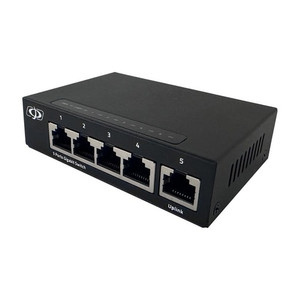
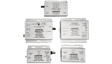
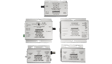
Comnet CNFE4+1SMSS2POE Self-Managed Industrial PoE Switch
Overview
The Comnet CNFE4+1SMSS2POE is a five-port self-managed Ethernet switch built for surveillance and industrial deployments where you need both copper PoE delivery and singlemode fiber reach. Four 10/100TX ports each supply up to 30W via IEEE 802.3af/at PoE — enough to power typical IP cameras, WiFi access points, and network-attached devices without a separate injector. The fifth port is a 100FX singlemode fiber interface with duplex ST connectors, letting you span distance (kilometers) and cross electrical noise barriers that would kill standard twisted pair. This is a working switch for integrators building distributed surveillance systems, remote SCADA networks, and utility installations where reliability matters and fiber isolation adds genuine value.
Key Features
- Four 10/100TX RJ45 ports with 30W PoE per port (IEEE 802.3af/at): Delivers full power budget to standard PoE cameras and edge devices without requiring a separate PoE injector or midspan. Covers typical fixed-dome and turret cameras (12–25W draw) at line rate. If you're deploying 10+ cameras across a surveillance network, eliminating the injector simplifies wiring and reduces single points of failure.
- 100FX singlemode fiber port with duplex ST connectors: Extends your network backbone across multiple kilometers without copper runs vulnerable to lightning, ground loops, or electromagnetic interference. Singlemode fiber (not multimode) means longer distance before signal degradation — critical for campus networks, power substations, and rail yards where distance and isolation matter equally.
- Self-managed operation: No dedicated management port or external controller required. The switch learns MAC addresses, forwards frames intelligently, and works standalone out of the box. Reduces complexity in field deployments where IT management resources are thin and uptime must be self-evident.
- 48VDC external PSU (sold separately): Decouples the power supply from the switch itself, meaning you can place the PSU in a UPS-backed cabinet and run a single 48V line to remote locations. Comnet recommends the PS-A48170 for balanced overhead, with PS-A48060 (minimum) and PS-A48280 / PS-A48500 (heavier-duty) alternatives depending on your four-port PoE load and ambient temperature range. This architecture is standard in telecom and utility networks for a reason: modularity and fault isolation.
- Industrial hardened enclosure: Built to operate in the temperature and vibration environment of a surveillance tower, outdoor cabinet, or utility substation — not a clean server room. Comnet's surveillance and industrial product line prioritizes long lifecycle and environmental resilience as part of their design philosophy.
- ST fiber connectors (duplex singlemode): ST is industry standard in utility and older telecom installations. If your backbone already runs ST fiber (common in SCADA and power networks), the CNFE4+1SMSS2POE plugs in directly without transceiver swaps or media converter chains that add cost and latency.
Integration and Compatibility
The CNFE4+1SMSS2POE operates as a Layer 2 bridge with no VLAN, QoS, or spanning-tree controls — it's not a managed switch. This simplicity is a strength in remote, unattended deployments: no firmware updates, no web interface to secure, no management credentials to rotate. Connect it to your surveillance backbone (an NVR, core switch, or managed fiber gateway), and it forwards traffic at line rate.
The four copper ports support standard IP camera discovery and PoE handshakes (802.3af/at negotiation is passive — any device requesting 30W or less will get it). The fiber port carries any traffic the copper side receives: video streams, management traffic, NTP, syslog — all transparent. This makes it suitable for hybrid networks: copper cameras in a building linked via fiber to a remote recording facility or multi-site surveillance cluster.
Comnet's application notes (referenced in the product documentation) detail fiber run planning, cabinet mounting, and PSU sizing — standard practice for utility-grade installs. If you're unfamiliar with singlemode fiber termination or 48VDC distribution, those documents are essential reading before field deployment.
What's in the Box
The package includes the switch unit itself and basic mounting hardware. The 48VDC power supply is ordered separately — you'll specify the appropriate model (PS-A48060, PS-A48170, PS-A48280, or PS-A48500) based on your total PoE load across the four ports and your UPS/redundancy strategy. No fiber patch cables, transceivers, or RJ45 cables are included — standard practice for industrial products where field runs are custom-cut and connectorized on-site.
Frequently Asked Questions
Q: What is the total PoE power budget across all four ports?
A: Each port supports up to 30W per IEEE 802.3af/at. Total available PoE is 120W across four ports, contingent on your 48VDC PSU capacity. The recommended PS-A48170 supplies 170W at 48VDC, which translates to roughly 120W usable PoE plus switch overhead. Verify your PSU choice against Comnet's sizing guidance for your deployment.
Q: Can I use multimode fiber instead of singlemode?
A: No. The CNFE4+1SMSS2POE's 100FX fiber port is designed for singlemode fiber (typically 9/125µm). Multimode (62.5/125µm or 50/125µm) will not work reliably. If your backbone is multimode, you'll need a media converter (a separate Comnet product) to bridge the two standards.
Q: Is the CNFE4+1SMSS2POE NDAA Section 889 compliant?
A: Evidence does not confirm NDAA compliance for this model. Contact Comnet pre-sales directly if this is a requirement for your deployment.
Q: What happens if the PSU fails?
A: The switch and all four PoE ports go offline. There is no internal battery or hot-swappable redundancy. If uptime is critical, provision a dual-PSU setup with a switchover relay, or place the PSU on a UPS-backed outlet. Utility and telecom installations typically architect this upstream.
Q: Does the CNFE4+1SMSS2POE support VLANs or traffic filtering?
A: No. This is a self-managed (Layer 2) switch with no VLAN tagging, QoS, or access lists. It bridges all traffic between copper and fiber ports transparently. If you need granular traffic control, use a managed switch upstream or downstream.
Q: What is the typical latency through the CNFE4+1SMSS2POE?
A: Switching latency is sub-millisecond (typical wire-speed forwarding). The fiber port adds negligible additional latency compared to copper-to-copper bridging. This is not a concern for surveillance or SCADA applications.
The CNFE4+1SMSS2POE sits in that practical middle ground between a dumb unmanaged switch and a full-stack managed appliance. When I spec this for remote surveillance towers or utility SCADA tie-ins, the dual-port architecture (four copper + one singlemode fiber) solves a real problem: copper PoE cameras on-site, and fiber backbone to a distant head-end without noise loops or ground-potential isolation issues. The 30W per-port PoE budget handles most fixed cameras, but the star of the show is the singlemode fiber port — that's kilometer-scale reach and bulletproof electrical isolation in a single connector.
Technical Highlights:
- 30W IEEE 802.3af/at per port (four RJ45 ports): Eliminates the need for mid-span injectors on typical surveillance cameras (12–25W draw). You run a single Cat5e/Cat6 from the camera to this switch and it negotiates power without external gear. Cleaner installations, fewer single points of failure in the field.
- 100FX singlemode fiber (duplex ST): Spans kilometers without copper signal loss and bypasses electrical noise entirely. Singlemode means you're not limited to the few-hundred-meter reach of multimode — if your backbone runs 2–5 km away, fiber is the only realistic option, and ST connectors mate directly into existing utility/telecom infrastructure.
- Self-managed (no active management required): No firmware updates, no credentials, no web interface to lock down. The switch learns MACs, bridges frames at line rate, and works offline. In unattended remote cabinets, this is a feature — one less thing to patch or debug.
Deployment Considerations:
- The 48VDC PSU is external (purchased separately), which is both good and bad: good because you can place it in a UPS-backed cabinet miles away; bad because if it fails, the entire switch dies and you need on-site swaps or remote power-cycle tricks. Size your PSU carefully — the recommended PS-A48170 (170W) supports roughly 120W usable PoE across the four ports plus overhead, so don't oversubscribe.
- This is a Layer 2 transparent bridge with zero VLAN, QoS, or filtering logic. If you're used to managed switches, you'll find no web UI, no SNMP, no granular traffic control. That's not a gotcha if you understand it up front — it's intentional industrial design for simplicity and uptime.
Deploy the CNFE4+1SMSS2POE when you're building a hybrid surveillance network that spans both campus copper (cameras, APs) and long-haul fiber (to a central NVR or edge recorder). It's also a natural fit for utility substation monitoring, rail yards, and other environments where electrical isolation and multisite fiber backbones are architectural requirements, not nice-to-haves.