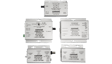
Comnet CNFE4+1SMSM2 5-Port Self-Managed Ethernet Switch
Overview
The Comnet CNFE4+1SMSM2 is a compact five-port self-managed Ethernet switch designed for surveillance and industrial network deployments where you need both copper and fiber connectivity without the overhead of a managed switch. It combines four 10/100 Mbps copper ports with a single multimode fiber port (ST connector), making it well-suited for bridging standard PoE camera runs across longer distances or linking distributed camera clusters via fiber backbone.
Key Features
- Four 10/100 Mbps Copper Ports: Standard RJ-45 connectivity for PoE cameras and network devices. 10/100 Mbps auto-sensing keeps installation flexible—no speed negotiation headaches on mixed-generation networks.
- One Multimode Fiber Port (ST Connector): 1 FX MM fiber interface eliminates distance limitations and electrical isolation concerns when running trunk lines between buildings, across EMI-heavy industrial floors, or through areas where copper runs would introduce noise. Multimode fiber keeps cost reasonable for distances under 2 km.
- Self-Managed Architecture: No configuration console, no IP address assignment, no firmware updates required. Plug it in and it bridges traffic between copper and fiber domains automatically—ideal when you want zero-touch operation and minimal IT dependency on the camera network layer.
- Wide Input Voltage Range (9–24 VDC): Accepts power from standard 12 VDC power supplies, 24 VAC/VDC sources, or battery backup systems without voltage conditioning. Simplifies power distribution in remote or retrofit installations.
- Surface-Mount Power Connector: Quick-disconnect terminal block for fast swap-out or integration into existing power harnesses. No proprietary barrel connectors to stock or replace.
- Compact Standalone/Rack/DIN-Rail Mounting: Flexible form factor fits wall-mounted enclosures, DIN-rail racks, or standalone shelf deployment. Minimal footprint saves space in crowded telecom closets or field cabinets.
Integration and Compatibility
The CNFE4+1SMSM2 operates at Layer 2 (MAC bridging), meaning it works transparently with any IP camera, IP intercom, or network device that speaks Ethernet and TCP/IP. No ONVIF driver, no VMS API binding needed—it simply passes traffic between copper and fiber ports. This makes it ideal for mixed-vendor surveillance systems where you want network isolation without management complexity.
Multimode fiber (ST) is the industry standard for short- to mid-range backbone runs in surveillance deployments. If you're connecting this switch to a distant fiber-equipped PoE injector, fiber receiver, or fiber-capable NVR, ensure the remote side supports the same fiber type (multimode, ST connector). For single-mode or longer-distance runs, you'll need a different fiber port configuration.
What's in the Box
No package contents were available in the manufacturer evidence for this product.
Frequently Asked Questions
Q: Can the CNFE4+1SMSM2 power PoE cameras directly?
A: No. The CNFE4+1SMSM2 is a passive Layer 2 switch—it does not inject PoE power. You must supply PoE via a separate PoE injector, PoE switch, or midspan device upstream of the copper ports. The switch simply passes the PoE traffic and power from the injector through to your cameras.
Q: What is the maximum distance for the fiber port on the CNFE4+1SMSM2?
A: Multimode fiber (MM) with ST connectors typically supports distances up to 2 km (about 1.2 miles) at 10/100 Mbps, depending on the quality of the fiber run and termination. For distances beyond 2 km or for applications requiring longer range, single-mode fiber is required, which would necessitate a different switch model.
Q: Is the CNFE4+1SMSM2 managed or unmanaged?
A: The CNFE4+1SMSM2 is self-managed, meaning it operates as a plug-and-play bridge with no management interface, no IP address, and no configuration menus. It automatically learns MAC addresses and forwards frames between ports without intervention. This makes it ideal for simple deployments but unsuitable if you need VLAN tagging, port mirroring, or QoS controls.
Q: What power supply do I need for the CNFE4+1SMSM2?
A: The CNFE4+1SMSM2 requires 9–24 VDC input. Any standard 12 VDC or 24 VDC industrial power supply will work. If your cabinet runs 24 VAC, use a bridge rectifier to convert it to DC. Typical current draw is modest (confirm with pre-sales engineering for your specific load), so a small 24 VDC power supply rated for 1–2 A is generally sufficient.
Q: Does the CNFE4+1SMSM2 support VLAN tagging or QoS?
A: No. As a self-managed (unmanaged) switch, it does not support VLAN tagging (802.1Q), RSTP, or QoS. All ports are on the same broadcast domain and forward traffic based on MAC address learning only. For more advanced networking needs, you will need a managed switch.
Q: Can I use the CNFE4+1SMSM2 to extend PoE camera runs beyond 100 meters?
A: No. Copper Ethernet (10/100 Mbps) is limited to approximately 100 meters per run regardless of whether the signal carries PoE. The fiber port on this switch allows you to bridge two copper segments via fiber (up to ~2 km), but each individual copper run from the switch to a camera must remain under 100 meters. For longer camera runs, use fiber-to-copper media converters or fiber-capable cameras.
I've deployed the Comnet CNFE4+1SMSM2 in several warehouse and campus surveillance setups where fiber backbone was non-negotiable but managed switching overhead wasn't justified. The key strength is the 9–24 VDC wide input range paired with the multimode fiber port (ST)—it's a rare combination in low-cost unmanaged switches, and it eliminates the need for separate power conditioning or fiber media converters in simple point-to-point trunk applications.
Technical Highlights:
- Self-managed bridging: Zero configuration, zero IP address assignment, zero firmware updates. Plug four PoE camera runs and one fiber trunk into the CNFE4+1SMSM2, apply 12 or 24 VDC, and traffic flows. Ideal when you want the camera network layer decoupled from IT infrastructure management.
- 1 FX MM (ST) fiber port: Multimode fiber with ST connectors is the backbone standard for surveillance environments under 2 km. Eliminates EMI coupling and distance limitations that plague 100-meter copper runs—real value in factories, parking structures, or multi-building sites with noisy electrical gear nearby.
- 9–24 VDC input with surface-mount terminal block: One power input handles 12 VDC supplies, 24 VDC PoE injectors, or 24 VAC rectified backup systems without external regulators. Terminal block (not barrel connector) integrates cleanly into hardened power harnesses.
Deployment Considerations:
- This is a Layer 2 bridge, not a PoE switch—you still need a PoE injector or upstream PoE switch to power cameras on the copper side. Plan accordingly on your power budget before installation.
- Self-managed means no VLAN, no QoS, no port mirroring. If your project demands isolation or traffic shaping between camera clusters, step up to a managed switch—this unit will not scale into those requirements.
Deploy the CNFE4+1SMSM2 in fiber-to-copper bridging scenarios where you control the topology and don't need in-band management—campus perimeter loops, warehouse cross-dock fiber trunks, or industrial sites where simplicity and passive operation are worth more than configurability. It fills a specific niche well.