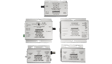
Comnet CNFE4+1SMSM2POE 5-Port PoE Ethernet Switch with Multimode Fiber Uplink
Overview
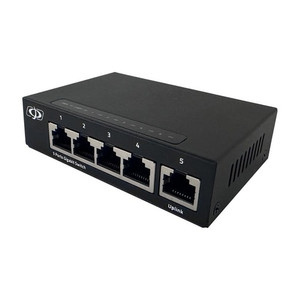
The Comnet CNFE4+1SMSM2POE is a five-port self-managed Ethernet switch combining four 10/100 Mbps copper ports with PoE+ capability and a single multimode fiber uplink. Designed for distributed surveillance systems where you need to extend network reach beyond twisted pair, this switch arrives pre-programmed—no field configuration required. The model uses 2-fiber 62.5/125µm multimode optics at 1310nm wavelength, supporting distances up to 3 km, making it suitable for bridging cameras across buildings, across parking areas, or into remote equipment rooms without signal loss or EMI interference that plagues long copper runs.
Key Features
- 4 Copper Ports with 30W PoE+: Each of the four 10/100 BASE-T ports supplies up to 30 watts of IEEE 802.3at power, enough to run most fixed domes, turrets, and compact bullets without a separate PSU. Auto-negotiation on each port handles 10 or 100 Mbps operation and full/half duplex automatically—no dip switches to fiddle with for speed.
- 1 Fiber Uplink, 100 BASE-FX: The multimode ST connector accepts two fibers for duplex optical transmission at 100 Mbps full duplex. Multimode reaches 3 km—sufficient for most campus and industrial layouts. If you need 48 km single-mode range, the CNFE4+1SMSS2POE variant is available in the same form factor.
- No Programming Required: The unit ships pre-configured. Dip switches let you designate the fiber port as uplink or configure it as an unmanaged pass-through. No VLANs, no CLI, no licensing—plug in power and network cables and it works.
- Automatic MDI/MDI-X Crossover: Copper ports detect straight-through or crossover cables and adjust on the fly. You can patch cameras with standard patch cables without worrying about wiring pinouts.
- Voltage Transient Protection on All Ports: Lightning strike or power surge on the fiber line or any copper port won't fry the switch. Solid-state current limiters and transient suppression protect data and power terminals—critical in outdoor surveillance clusters where ground loops and induced surge are constant risks.
- Compact, Fanless Design: Measures 6.1 × 5.3 × 1.1 inches and draws only 12W max power consumption. Mounts as a standalone unit on flat surfaces or racks using one slot with hot-swappable ComFit modules. No fans means silent operation—no acoustic signature in server rooms or equipment enclosures.
- Extended Operating Temperature Range: Rated -40°C to +75°C, surviving unheated cabinets in northern climates and sun-baked equipment boxes in the field. MTBF rating >100,000 hours supports long equipment lifecycles in fixed installations.
- LED Status Indicators: Separate indicators for optical link activity, electrical link activity per port, and PoE+ status. Quick visual check confirms the switch is forwarding traffic without logging into a management system.
Integration and Compatibility
The CNFE4+1SMSM2POE integrates into any IP video network using standard ONVIF or vendor-specific protocols. The four copper ports behave as transparent Ethernet ports—they carry ARP, DHCP, multicast, and unicast frames without filtering or modification, so your VMS discovery, NTP synchronization, and camera management traffic passes through unaffected. The fiber uplink is equally transparent, making this switch ideal for:
- Extending PoE reach to remote camera clusters beyond 100m copper limit
- Isolating camera subnets from IT backbone via fiber, reducing EMI ingress on surveillance circuits
- Bridging separate buildings with runs that would be impossible or unreliable over twisted pair
- Aggregating four ground-floor cameras onto one fiber strand routed up a conduit or cable tray
The switch does not perform any filtering, spanning tree, or VLAN tagging by default. If your network requires VLAN segregation or loop prevention, you'll need to manage that upstream on your core switch or configure the fiber port appropriately. The CNFE4+1SMSM2POE itself does not perform per-port rate limiting or QoS scheduling—all ports share the 100 Mbps uplink capacity equally.
Power and Environmental Considerations
The switch operates on 48 VDC nominal input, supplied via a terminal block (not a standard connector). Power consumption peaks at 12W, so even a modest 48V/1A PSU provides ample headroom. The -40°C to +75°C operating window and sealed construction handle humidity up to 95% non-condensing, making this suitable for unheated metal boxes, outdoor enclosures with minimal ventilation, and harsh factory floors.
Because the unit cannot draw power from a ComNet rack PSU (when used in a rack), you must provision a separate external 48VDC supply. Plan power distribution accordingly in your installation documentation.
Frequently Asked Questions
Q: Can I use the CNFE4+1SMSM2POE with single-mode fiber instead of multimode?
A: No. The CNFE4+1SMSM2POE is factory-configured for multimode 62.5/125µm fiber at 1310nm wavelength. If you need single-mode range (up to 48 km), order the CNFE4+1SMSS2POE variant instead. Both use ST connectors by default, but SC versions are available (CNFE4+1SMSM2POE/SC and CNFE4+1SMSS2POE/SC).
Q: Does the CNFE4+1SMSM2POE support VLAN or QoS prioritization?
A: No. This is a self-managed, non-programmable switch. It forwards all traffic transparently without VLAN tagging, prioritization, or port filtering. All four copper ports and the fiber uplink share equal bandwidth on a first-come, first-served basis.
Q: What is the warranty on the CNFE4+1SMSM2POE?
A: Comnet provides a lifetime warranty on this product, as stated in the technical documentation.
Q: Does the CNFE4+1SMSM2POE require any field configuration after installation?
A: No. The unit ships pre-programmed and ready to use. Dip switches allow you to select the fiber port as an uplink (recommended in most deployments) or as an unmanaged switch port, but no other configuration is necessary. Simply connect power and network cables and the switch forwards traffic immediately.
Q: Can the CNFE4+1SMSM2POE power cameras during power failure or brownout?
A: Only if your 48VDC power supply is backed by UPS or battery. The switch itself draws 12W max, so if your external 48VDC PSU has battery backup, the PoE ports will continue delivering power to cameras as long as the battery holds.
Q: What is the maximum cable distance on the copper ports?
A: Standard 10/100 BASE-T specifications allow up to 100 meters (328 feet) per cable run. This is why the CNFE4+1SMSM2POE fiber uplink is valuable—it extends reach beyond that limit.
The CNFE4+1SMSM2POE solves a specific problem: you have four IP cameras that need PoE power and Ethernet uplink, but they're more than 100 meters from your core switch or across too much EMI-rich environment for copper to be reliable. Running fiber eliminates both distance and noise constraints. The 30W PoE+ budget per port means you can power compact domes and turrets without additional PSUs at each location, and the multimode 62.5/125µm spec with 1310nm wavelength gives you 3 km of usable range for most campus and industrial surveillance layouts.
Technical Highlights:
- 30W PoE+ per copper port (IEEE 802.3at): Sufficient for fixed mini-domes and compact turrets. Four ports means four cameras on independent power budgets—no sharing, no brownout risk if one camera spikes draw during night mode switching. Each port has automatic current limiting so a shorted PoE load won't cascade across the switch.
- Multimode fiber at 1310nm, 3 km reach: Two-fiber duplex at 100 BASE-FX full duplex. Multimode is forgiving of bending radius in conduit and simpler to terminate than single-mode if you're splicing in the field. Three kilometers covers most buildings and parking lots; if you need interstate distances, that's when you step to single-mode (CNFE4+1SMSS2POE variant, 48 km range).
- Zero configuration required: Ships pre-programmed. Dip switches select fiber as uplink or pass-through. No CLI, no web interface, no licensing. Plug power and network cables and traffic flows. If your IT team doesn't need to touch it, they won't misconfigure it.
- -40°C to +75°C operating range with >100,000 hour MTBF: Survives unheated equipment boxes in winter and direct sun exposure on metal poles. MTBF rating is conservative for long-term fixed infrastructure where you can't replace hardware mid-fiscal year.
- Transient protection on all ports: Solid-state limiters on power and signal lines. One lightning strike on the fiber line or a shorted PoE cable won't cascade failure across all four cameras—the damage is isolated.
Deployment Considerations:
- The switch itself requires 48VDC external power input via terminal block—it cannot draw power from a ComNet rack PSU. Provision your 48V distribution carefully if you're running multiple switches in a cabinet. Plan for a dedicated 48V supply and UPS backup if PoE continuity matters during mains failure.
- All four copper ports and the fiber uplink share a single 100 Mbps bottleneck. If all four cameras are streaming simultaneously at high bitrate, expect congestion at the fiber interface. This is fine for typical surveillance (sub-20 Mbps per camera), but don't expect this switch to aggregate four 50 Mbps streams without frame drops.
- This is a transparent, non-managed switch. If you need VLAN isolation, loop prevention (STP), or per-port rate limiting, implement that upstream on your core switch or VMS. The CNFE4+1SMSM2POE is a dumb appliance—it's reliable precisely because it doesn't try to be smart.
Deploy the CNFE4+1SMSM2POE in remote camera clusters—loading dock, far corner of parking lot, separate warehouse building—where fiber distance and EMI immunity outweigh the cost of a small managed switch. This is not a core network device; it's a point solution for extending PoE and Ethernet into places where copper fails or where you need isolation.