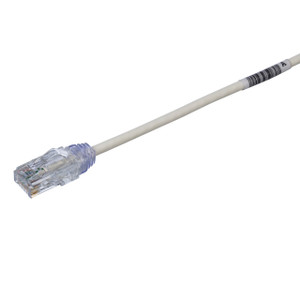
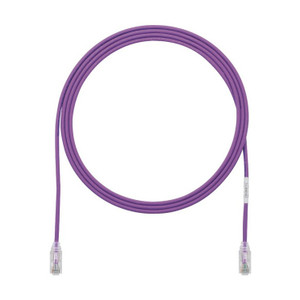
Panduit UTP28SP4VL TX6-28 Category 6 UTP Patch Cord
The Panduit UTP28SP4VL is a 4-foot Category 6 UTP patch cord engineered for high-density network environments where cable management and airflow matter. Its 28 AWG slim-profile construction reduces pathway congestion by 30% compared to standard 24 AWG cords, making it the practical choice for ToR switch deployments and crowded patch panels. The patented tangle-free latch eliminates snag delays during MAC operations, while factory-installed RapidID barcodes enable rapid port mapping with compatible software. CM/LSZH jacket meets fire and smoke requirements for most commercial installations. Supports PoE++ (802.3bt Type 4) at 24-cable bundle density.
Key Features
- 28 AWG stranded copper - 0.150" (3.8mm) diameter for improved cable management and airflow
- Patented tangle-free latch prevents snags during installation and removal in dense patch fields
- RapidID barcode pre-installed for rapid documentation and automated port mapping
- CM/LSZH jacket rating provides dual compliance for plenum-alternative and low-smoke installations
- Exceeds ANSI/TIA-568.2-D Category 6 and ISO 11801 Class E performance standards
- Supports 802.3bt Type 3/4 PoE (up to 90W at 24-cable bundle density)
- Centered de-embedded plug with integral pair manager for consistent termination performance
- 100% factory tested for wire map, NEXT, and return loss
The shift to 28 AWG conductor gauge addresses a persistent pain point in modern network infrastructure: pathway fill and thermal management. Standard 24 AWG patch cords consume roughly 40% more cross-sectional area in cable trays and behind patch panels, which translates to premature pathway exhaustion and restricted airflow in enclosed racks. Panduit's TX6-28 series reduces bundle diameter without sacrificing electrical performance - each cord still exceeds Category 6 transmission requirements for NEXT, return loss, and insertion loss across the full 1-250 MHz spectrum. The stranded copper construction maintains flex-life ratings for repeated plug/unplug cycles common in dynamic IT environments.
The integrated tangle-free latch is a precision-molded component that solves the latch-snag problem inherent in dense patch fields. Traditional RJ45 boots catch on adjacent cables during removal, forcing techs to work one-handed or risk breaking the release tab. Panduit's design chamfers the latch edges and recesses the release point, allowing blind extraction from tight bundles. Field studies show this cuts MAC time by 15-20% in high-density scenarios. The latch also survives 750+ insertion cycles per TIA-1096-A, well above the 200-cycle minimum for commercial-grade connectors.
This 4-foot length is purpose-built for structured cabling cross-connects: patch panel to ToR switch, horizontal manager to distribution switch, or zone enclosure to aggregation point. It's long enough to accommodate U-space variations and cable management arms, but short enough to avoid service loop clutter. Violet jacket provides instant visual identification in color-coded schemes - commonly assigned to storage networks, VoIP segments, or dedicated VLAN trunks depending on site standards.
PoE capability is explicitly rated: 802.3af/at (15.4W / 25.5W) supports 48 cords bundled together, while 802.3bt Type 3 and Type 4 (60W / 90W) are validated at 24-cord bundles. This matters for IP camera headend connections, where a single 48-port PoE switch might source power to dozens of endpoints. The 28 AWG conductor has higher DC resistance than 24 AWG (8.9Ω vs 7.0Ω per 100m), so Panduit's testing accounts for worst-case voltage drop across the rated bundle sizes. If you're running 802.3bt at maximum power, keep bundles to 24 cords or use active cooling in enclosed racks.
The RapidID barcode is a small detail that scales well in large deployments. Each cord ships with a factory-applied label containing a unique identifier compatible with Panduit's RapidID port-mapping software. During installation, you scan the barcode at both ends to auto-populate your cable management database - no manual entry, no transposition errors. For projects with hundreds of cross-connects, this eliminates days of documentation labor and ensures as-built accuracy. The CM/LSZH dual rating provides flexibility: use it in plenum spaces where local AHJs accept CM in lieu of CMP, or spec it for low-smoke installations in occupied spaces. cULus listing under UL 1863 and CSA C22.2 confirms third-party verification of flammability and mechanical performance. Ships in cartons of 10 for volume installations.