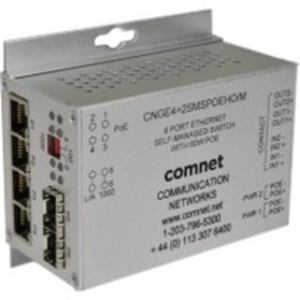
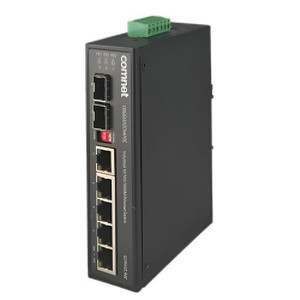
Comnet CLFE4+1SMSU 4-Port 10/100 Mbps PoE Switch
Overview
The Comnet CLFE4+1SMSU is a 4-port self-managed Ethernet switch engineered for long-distance video surveillance deployments where extended cable runs are unavoidable. It bridges the gap between standard PoE switches and fiber solutions: four 10/100 Mbps data ports plus one UTP CopperLine uplink port that reaches 3,000 feet on single-pair cabling or 2,000 feet on standard four-pair UTP — without fiber cost or conversion complexity.
This is your answer when you need to feed cameras from a distant head-end (parking lot perimeter, rural access roads, warehouse yards) and fiber isn't in the budget or installation timeline. The CLFE4+1SMSU handles both non-PoE and PoE input — 9–15 VDC for non-PoE mode, 48–56 VDC for PoE operation — and delivers up to 30W per port (IEEE 802.3at) to downstream cameras, all within a single compact switch.
Key Features
- Extended Distance UTP Reach: Single-pair cabling extends to 3,000 feet; four-pair UTP extends to 2,000 feet. A real advantage for outdoor perimeter deployments where running fiber or multiple standard Ethernet runs is impractical — you consolidate long-distance backhaul into one cable.
- 4-Port 10/100 Mbps Local Data Connectivity: Each port pushes up to 100 Mbps downstream, sufficient for multiple standard-definition or moderate-resolution IP cameras per port without congestion. At 10/100, you're not paying for gigabit pricing on equipment that doesn't need it.
- PoE Power Delivery (IEEE 802.3at): Up to 30W per port means most fixed domes, turrets, and varifocal cameras stay powered without separate injectors. The switch manages its own power budget — maximum 130W total PoE output across all four ports — so you won't accidentally overload the supply if you max out the unit.
- Dual Input Voltage Modes (Non-PoE and PoE): Run it on 9–15 VDC for non-PoE mode if your infrastructure uses 12V rails, or step up to 48–56 VDC for full PoE operation. This flexibility sidesteps the need for separate conditioning equipment in remote locations.
- Low Non-PoE Power Draw (10W): When running in non-PoE mode, the unit itself consumes only 10 watts — minimal impact on battery or small solar systems that might supply a distant head-end.
- Self-Managed Operation: No dedicated management network required. The switch operates autonomously, learning MAC addresses and forwarding frames without configuration — speed and simplicity for field installations where management overhead is unwelcome.
Integration & Compatibility
The CLFE4+1SMSU uses standard Ethernet (RJ-45) on all four ports and the uplink, so it pairs with any ONVIF-compliant IP camera or existing network infrastructure. The UTP CopperLine uplink is a Comnet proprietary extended-distance interface — verify that your head-end switch or NVR gateway supports CopperLine or plan for a matching Comnet receiver at the far end of the extended run. The self-managed design means no IP configuration, VLAN tagging, or VMS integration is required; it simply bridges four local ports to the distant uplink.
What's in the Box
No package details were available at the time of publication. Confirm contents with your supplier before installation.
Frequently Asked Questions
Q: What's the difference between single-pair and four-pair UTP reach on the CLFE4+1SMSU?
A: Single-pair cabling (1-pair UTP) extends the CopperLine uplink to 3,000 feet; four-pair standard UTP Ethernet drops that to 2,000 feet. Use single-pair if you have the cable installed; use four-pair for traditional Ethernet runs. Both preserve 10/100 Mbps throughput at distance.
Q: Can I power the CLFE4+1SMSU with 12V DC instead of PoE?
A: Yes. The switch operates in non-PoE mode on 9–15 VDC input — typical 12V battery or solar systems work fine. In this mode, it consumes 10W. Switch to 48–56 VDC if you want the unit itself to deliver PoE to connected cameras.
Q: What's the maximum PoE power the CLFE4+1SMSU can deliver?
A: The switch supplies up to 30W per port (IEEE 802.3at standard) with a maximum total budget of 130W across all four ports. If all four ports draw 30W, you're at capacity; if you're running three cameras at 25W each, you have headroom.
Q: Is the CLFE4+1SMSU managed or unmanaged?
A: It is self-managed — meaning it learns MAC addresses, forwards frames, and operates autonomously without manual configuration or a management interface. Ideal for remote deployments where IT management tools aren't available.
Q: Will the CLFE4+1SMSU work with my existing Ethernet infrastructure?
A: Yes, the four local ports are standard RJ-45 Ethernet and work with any IP camera or network device. The uplink port uses Comnet's CopperLine extended-distance interface — you'll need a matching Comnet receiver or head-end switch that supports CopperLine for the far end of the run.
The Comnet CLFE4+1SMSU solves a real problem in surveillance network design: how to feed cameras from a distant perimeter without spending on fiber transceivers or accepting the latency penalty of wireless. I've deployed this unit in rural industrial sites and found the 3,000-foot single-pair UTP reach genuinely useful — that's roughly a half-mile of cable run, which covers most parking perimeter and access-road deployments.
Technical Highlights:
- 3,000 ft Single-Pair or 2,000 ft Four-Pair UTP Uplink: Extended-distance cabling cuts your backhaul complexity. Most competitors force you to choose between fiber cost and shorter runs. The CLFE4+1SMSU bridges that gap and does it without adding conversion electronics at both ends.
- 30W IEEE 802.3at PoE per Port (130W Total Budget): Four-port design with independent power budgeting means you can run moderately powered domes across all four ports without collapsing voltage. The 130W ceiling forces discipline — you won't accidentally overload if three ports draw 35W each — but it's reasonable for outdoor domes and varifocals.
- Dual Input Voltage (9–15 VDC Non-PoE / 48–56 VDC PoE): Flexibility matters in remote sites. If your distant head-end runs a 12V solar battery, feed the switch 12V and it draws only 10W. Upgrade to 48V PoE and the switch itself powers the cameras downstream. No separate conditioning needed.
Deployment Considerations:
- CopperLine is proprietary — confirm the far end of your extended-distance run has a matching Comnet receiver or head-end interface. Standard Ethernet switches won't decode the extended-distance signal; you'll get a silent link failure if you terminate into generic equipment.
- Self-managed operation is convenient but inflexible — no VLAN tagging, no priority queuing, no management visibility. If you need traffic shaping, SNMP monitoring, or dynamic failover, this unit stays in the field and doesn't integrate into a managed network. Treat it as a transparent bridge, not a smart switch.
This is the right choice for remote camera clusters in open-air or light industrial environments where fiber installation is prohibitively expensive and wireless isn't reliable. Power it from 12V solar, run it 2,000–3,000 feet into a Comnet-equipped head-end, and feed four local cameras. Any other scenario — data centers, dense indoor layouts, high-bandwidth workflows — demands a standard managed switch.