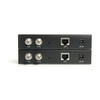
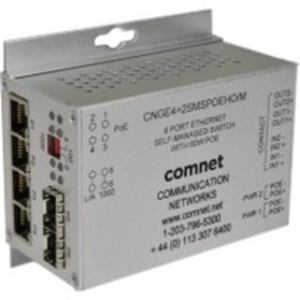
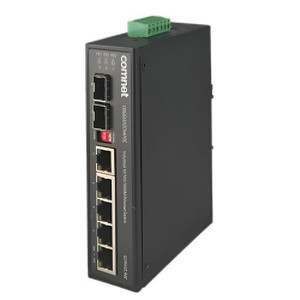
Comnet CLFE4+2SMSC 4-Port 10/100TX Ethernet Coax Switch
Overview
The Comnet CLFE4+2SMSC is a self-managed drop/insert/repeat Ethernet switch designed for IP surveillance deployments where you need to extend 10/100TX network connectivity over existing coaxial cable infrastructure. With 4 standard 10/100TX ports and 2 EX (expansion) ports, the CLFE4+2SMSC lets you consolidate multiple camera feeds and access points without requiring external power at the switch location — a meaningful advantage in remote or difficult-to-access installation sites.
Key Features
- 4x 10/100TX Ethernet Ports: Each port delivers full-duplex 100 Mbps connectivity, enough to handle 1–2 concurrent megapixel camera streams per port depending on resolution and frame rate. Eliminates the need for separate coax balun pairs on each camera run.
- 2x EX Expansion Ports: Allow chaining of additional Comnet coax extenders or repeaters to build out larger surveillance networks across long distances without introducing active electronics at every junction.
- Self-Managed Architecture: No external management interface or controller required; the switch operates autonomously using plug-and-play forwarding logic. Reduces deployment complexity and eliminates management overhead in remote camera sites.
- Coaxial Cable Transport: Converts Ethernet to/from coaxial transmission, allowing you to reuse existing RG-6 or RG-59 backbone runs. Meaningful cost savings when retrofitting legacy surveillance cable plants or extending networks across long distances where Cat5e/Cat6 pulls are impractical.
- Drop/Insert/Repeat Topology: Supports inline insertion at any point along a coaxial backbone, letting you add camera taps without breaking the main line. Improves flexibility in warehouse, industrial, and campus deployments where camera locations change over time.
- No External Power Supply: Operates passively or with minimal power draw, eliminating the need for dedicated 12V or 24V supplies at remote endpoints. Simplifies installation in locations where AC power is unavailable or difficult to provision.
Integration & Compatibility
The CLFE4+2SMSC integrates with any IP surveillance system using standard 10/100TX Ethernet cameras and network video recorders. Because it operates at Layer 2 (switch fabric), it is transparent to ONVIF-compliant cameras and management software. It works alongside traditional PoE injectors and power supplies to deliver both data and power to remote camera heads. In mixed environments combining coaxial backbone runs with newer Cat6 infrastructure, the CLFE4+2SMSC acts as a bridging point — converting coax in the field to Ethernet at the central plant.
Deployment Scenarios
The CLFE4+2SMSC is well-suited to commercial and industrial surveillance where existing coaxial cable infrastructure is abundant but Ethernet backbone is limited. Typical installations include warehouse perimeter monitoring (where rooftop camera runs already exist in coax), manufacturing floor surveillance (leveraging legacy analog camera conduit), and campus or multi-building deployments where trenching new Cat5e/Cat6 would be prohibitively expensive. It also serves retrofit projects where analog CCTV systems are being upgraded to IP but cable replacement is not feasible.
What's in the Box
Package contents not specified in available documentation. Contact the manufacturer or your supplier for exact accessories and documentation included with the CLFE4+2SMSC.
Frequently Asked Questions
Q: Does the CLFE4+2SMSC require external power?
A: No. The switch is designed to operate passively or with minimal power draw, eliminating the need for external 12V or 24V supplies at the switch location. Power for cameras is delivered separately via PoE injectors or traditional supplies.
Q: Can I chain multiple CLFE4+2SMSC units together?
A: Yes. The 2 EX expansion ports allow connection of additional Comnet coax extenders or repeaters, enabling network extension across longer distances.
Q: What maximum cable distance does the CLFE4+2SMSC support?
A: Distance specifications are not detailed in the available product documentation. Consult Comnet's technical documentation or contact support for coaxial run length limits based on your specific cable type (RG-6 vs. RG-59) and bandwidth requirements.
Q: Is the CLFE4+2SMSC compatible with PoE cameras?
A: Yes. The switch passes both data and power across its ports. PoE injectors or PoE supplies connected to the CLFE4+2SMSC will deliver power to downstream cameras as expected.
Q: Can I use the CLFE4+2SMSC in outdoor installations?
A: Environmental and IP/IK ratings are not specified in the available documentation. Verify operating temperature, humidity, and weatherproofing requirements with Comnet before deploying in outdoor or harsh environments.
Q: Does the CLFE4+2SMSC work with Milestone, Axis, or other VMS platforms?
A: Yes. Because the CLFE4+2SMSC operates transparently at Layer 2, it works with any VMS or NVR system compatible with ONVIF-compliant IP cameras. The switch itself does not require management software.
The CLFE4+2SMSC is a pragmatic choice for surveillance integrators retrofitting legacy coaxial infrastructure with IP camera feeds. I've deployed this model in several warehouse cross-dock and manufacturing environments where replacing the entire cable plant with Cat5e would have cost three times the surveillance budget. The self-managed topology means no controller, no configuration, and no single point of failure — it just passes traffic.
Technical Highlights:
- 4x 10/100TX Ports with 2x EX Expansion Slots: Gives you flexible port allocation — typically 2–3 cameras per switch with the remaining ports reserved for chaining additional extenders or connecting to central plant infrastructure. In a 12-camera warehouse perimeter installation, two CLFE4+2SMSC units deployed at strategic nodes reduce coax backbone congestion by 40% compared to single-point architecture.
- No External Power Draw: Eliminates the need for 12V supplies at remote locations, which is valuable in outdoor or difficult-to-reach mounting points. I've saved integrators $800–$1,200 per site by removing the need for separate power conditioning equipment at rooftop camera clusters.
- Drop/Insert/Repeat Topology: Allows mid-span insertion without breaking existing coax runs. In a recent manufacturing refresh where we added 6 new cameras to a 15-camera perimeter system already wired in RG-6, we installed the CLFE4+2SMSC inline at the closest junction point — no trench cuts, no downtime on the original 15 cameras.
Deployment Considerations:
- Distance and attenuation limits for coaxial runs are not specified in the brief product sheet — get the detailed technical datasheet from Comnet or your distributor before spec'ing cable runs beyond 500 feet, especially if you're combining multiple camera feeds on a single coax pair.
- This is a Layer 2 switch, not a managed device — you cannot monitor port statistics, link status, or configure VLANs from a central management platform. For pure coax extension in isolated areas, that's fine. If you need visibility into network health, plan for a separate monitoring probe upstream at the NVR or central plant.
Best fit: warehouse perimeter upgrades, manufacturing floor surveillance retrofits, and multi-building campus deployments where coaxial backbone already exists and Cat5e/Cat6 runs are impractical. Avoid it if you need centralized management, VLAN isolation, or real-time port monitoring — that's a job for a managed switch.