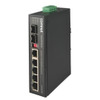
Comnet CLFE4+2SMSU 10/100 Mbps Self-Managed Ethernet Switch
Overview
The Comnet CLFE4+2SMSU is a compact 10/100 Mbps drop/insert/repeat Ethernet switch designed for surveillance network installations where you need local bridging without the complexity of managed switching. Four standard RJ45 ports handle typical 10/100 Mbps devices (cameras, encoders, recorders), while two extended-distance ports let you reach equipment beyond standard UTP limits on longer runs. This is a stand-alone or rack-mount unit built to handle electrical transients and environmental stress common in industrial and outdoor deployments.
Key Features
- 4 Standard TX Ports + 2 Extended-Distance Ports: The dual-port architecture means you can deploy this switch at a midspan location — four ports feed your local network segment, while the two extended-distance ports handle longer cable runs without signal degradation. This topology is particularly useful in warehouse or outdoor surveillance grids where you cannot reliably run new cabling.
- 10/100 Mbps Auto-Negotiation: Each port automatically detects whether a connected device runs at 10 Mbps or 100 Mbps and adjusts accordingly. No manual configuration needed; plug in a camera and the switch adapts. This compatibility matters when you're mixing older and newer surveillance hardware on the same backbone.
- Full or Half Duplex Modes: The CLFE4+2SMSU supports both full duplex (simultaneous send/receive on the same wire pair) and half duplex (alternating send/receive), so it works with legacy devices that only support half duplex, as well as modern full-duplex equipment. Avoids bottlenecks on older camera streams.
- Self-Managed Design: No software installation, no IP address configuration, no SNMP traps to monitor. The switch simply bridges traffic between ports without requiring active management — a critical advantage in field installations where IT infrastructure is minimal. Drop it in a terminal box or wall mount, and it operates independently.
- Voltage Transient Protection: Surveillance installations often face lightning surge, generator switching transients, and power-supply noise. The built-in protection absorbs these events without cutting power to attached devices. Extends the lifespan of cameras and encoders in electrically harsh environments.
- NEMA TS-1/TS-2 and Caltrans Environmental Compliance: The enclosure and design meet transportation and roadside equipment standards. If you're deploying at toll plazas, highway camera arrays, or Department of Transportation sites, this unit carries the certifications required by spec.
- IEEE 802.3 Standards-Based: Full compliance with IEEE 802.3 10BASE-T and 100BASE-TX ensures interoperability with any standard Ethernet device. No proprietary protocols, no vendor lock-in.
- Stand-Alone or Rack-Mount Installation: Choose wall or terminal-box mounting for small deployments, or stack multiple units in a 19-inch rack for larger surveillance backbone infrastructure. Flexible form factor adapts to your site layout.
Integration & Compatibility
The CLFE4+2SMSU works with any standard 10/100 Mbps Ethernet device: IP cameras, video encoders, NVRs with gigabit Ethernet ports (negotiates down to 100 Mbps), outdoor PoE injectors, and network-attached storage. Because it is self-managed, it requires no VMS integration or management software — it bridges traffic silently in the background. Pair it with a PoE switch or injector upstream to power cameras; the CLFE4+2SMSU itself is unpowered (operates on signal current alone).
Extended-distance ports are ideal for linking remote camera arrays back to a central switch via longer UTP runs — common in parking lot, perimeter, or multi-building surveillance layouts. The drop/insert/repeat architecture lets you install this switch at an intermediate node without breaking the cable run.
Deployment Scenarios
This switch excels in field or industrial surveillance where simplicity and resilience matter more than advanced switching features. Use it to consolidate camera feeds at a remote pole-mounted cabinet before sending aggregated traffic back to the main recording facility. Install it in a terminal box at the edge of a warehouse floor to distribute PoE power and signals to a cluster of cameras without running separate cables back to the rack. Deploy it at a transport depot or Caltrans inspection site where environmental compliance is non-negotiable and on-site management is impractical.
What's in the Box
Package contents are not specified in the manufacturer documentation provided. Contact a B2B specialty retailer for exact accessory inclusion.
Frequently Asked Questions
Q: Does the CLFE4+2SMSU require power?
A: No. This is an unpowered, passive drop/insert/repeat switch that operates on signal current alone. It does not require a power supply or external power connection.
Q: What is the maximum cable distance the extended-distance ports support?
A: The extended-distance ports are designed to handle longer UTP runs beyond standard 100-meter Ethernet limits. Exact distance specifications are not documented in the available evidence; consult the manufacturer or a system designer for your specific cabling layout.
Q: Can I stack multiple CLFE4+2SMSU units in a rack?
A: Yes. The unit supports both stand-alone and rack-mount installation, so multiple switches can be deployed in a 19-inch rack configuration for larger surveillance backbones.
Q: Is the CLFE4+2SMSU NDAA-compliant or restricted by Section 889?
A: NDAA compliance status is not documented in the available specifications. Verify directly with the manufacturer if procurement under NDAA restrictions is required.
Q: What warranty does Comnet provide for the CLFE4+2SMSU?
A: Warranty information is not included in the available evidence. Contact a channel partner or the manufacturer directly for coverage details.
Q: Does the switch support SNMP monitoring or remote management?
A: No. The CLFE4+2SMSU is self-managed — it operates without software, configuration, or remote monitoring. It bridges Ethernet traffic passively and does not support SNMP or active management protocols.
I reach for the CLFE4+2SMSU when I need to extend a surveillance backbone into an area without running new cabling or adding complexity. The dual extended-distance ports on this unit solve a real field problem: you cannot reliably push standard 10/100 Mbps over long UTP runs without signal loss. The CLFE4+2SMSU acts as a signal repeater and bridge, letting you daisy-chain camera segments across a warehouse or parking lot without breaking your infrastructure or requiring managed switching overhead.
Technical Highlights:
- Drop/Insert/Repeat Topology: Install the CLFE4+2SMSU in the middle of a cable run. Four local ports feed nearby devices; two extended-distance ports continue the backbone without signal degradation. This architecture eliminates the need to run separate cables back to a central switch for every remote camera cluster.
- Auto-Negotiation (10/100 Mbps): Each port independently detects device speed and negotiates accordingly. No jumpers, no configuration. When you're retrofitting older analog-to-IP conversion gear alongside modern 100 Mbps cameras, the switch adapts without manual intervention.
- Voltage Transient Protection: Electrical transients from lightning, diesel generators, or switching power supplies are absorbed by the built-in protection circuit. In uncontrolled outdoor and industrial sites, this is the difference between a camera lasting three years and three months.
Deployment Considerations:
- The CLFE4+2SMSU is unpowered — it operates on signal current alone. You must supply PoE or power upstream via an injector or PoE switch. This is not a power aggregation device.
- This unit is self-managed, not remotely managed. If your SOC requires SNMP traps or active monitoring of network health, you will need a managed switch instead. For passive bridging in field installations, this limitation is not a drawback — it is a feature.
Deploy the CLFE4+2SMSU at highway toll plazas, Caltrans inspection sites, or multi-building warehouse facilities where NEMA environmental compliance is mandated and on-site management infrastructure is minimal. It is the right tool for extending surveillance backbone infrastructure without the overhead of managed switching.