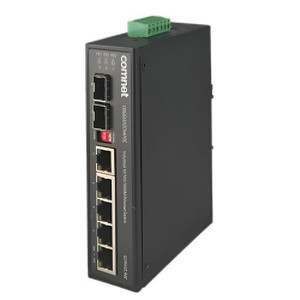
Comnet CLFE4+1SMSC Self-Managed 4-Port Ethernet Switch with Coaxial Uplink
Overview
The Comnet CLFE4+1SMSC is a self-managed 5-port Ethernet switch built for small-to-mid-scale surveillance installations where you need reliable network segmentation without the overhead of managed switching. Four standard 10/100 Mbps ports accept cameras, recorders, or workstations; the fifth port is a 10/1000 Mbps CopperLine coaxial uplink that bridges to your core network using existing coax runs—a practical advantage in retrofit scenarios where pulling new twisted-pair Ethernet is costly or invasive.
Key Features
- Four 10/100 BASE-T/TX ports: Each port auto-negotiates between 10 and 100 Mbps and supports full or half duplex, eliminating manual speed configuration. Automatic MDI/MDI-X crossover detection means you can use straight-through or crossover cables interchangeably—no hunting for the right pinout.
- 1x 10/1000 Mbps CopperLine coaxial uplink: Transmits data over standard RG-59 or RG-6 coaxial cable up to 1200 meters, allowing you to reuse existing cable infrastructure in facilities where new Ethernet runs aren't practical. Throughput scales to 1 Gbps when your core network supports it.
- Optional PoE+ support (IEEE 802.3at, 30W per port): The switch can deliver up to 30 watts to each of the four Ethernet ports via an optional PoE+ injector module—sufficient to power most fixed dome or bullet IP cameras without separate power supplies. This is a genuine cost and installation-time saver on larger camera count deployments.
- Self-managed operation: No IP address configuration, no web interface to manage, no firmware updates to schedule. Plug in the power supply and the switch works immediately. This simplicity reduces labor during initial setup and eliminates a potential security attack surface if your surveillance network must operate offline or disconnected from central IT infrastructure.
- LED indicators for power and activity: Visual status lights on each port confirm link presence and data traffic without requiring a network test meter—useful for quick troubleshooting when a camera feed drops.
- Compact rackmount form factor: The CLFE4+1SMSC fits in standard 19-inch racks or mounts via DIN rail or wall bracket in electrical closets, pump houses, or utility rooms typical of surveillance infrastructure. Mounting flexibility means you place the switch where your camera runs physically terminate, not where IT wants a network device.
Integration and Compatibility
The CLFE4+1SMSC adheres to IEEE 802.3 Ethernet standards, making it compatible with any standard IP camera, NVR, or network device using 10/100 Mbps connectivity. The automatic MDI/MDI-X crossover and full/half duplex support eliminate compatibility friction. If you're upgrading an older coax-based surveillance system with IP cameras, this switch lets you preserve the coax backbone while transitioning camera heads—a significant advantage over rip-and-replace approaches.
For NEMA TS-1/TS-2 and Caltrans compliance environments (outdoor signal control, highway infrastructure, rail yards), the CLFE4+1SMSC meets those environmental standards, though confirm your specific regional requirements with your integrator.
Environmental and Durability
NEMA TS-1/TS-2 and Caltrans environmental compliance certifies the switch for outdoor-adjacent and vehicle-control deployments. No IP or IK ratings are specified, so this is an indoor or sheltered device—do not expose it to direct rain or direct impact.
Power and Installation Notes
The CLFE4+1SMSC requires a single AC power input (exact voltage and current specs not detailed in available evidence, but standard industrial 120V or 24V DC supplies are typical). The optional PoE+ module adds capability to inject power into the four Ethernet ports without consuming additional circuit capacity beyond the base unit. Installation is straightforward: terminate four cameras or devices into the standard Ethernet ports, run the coaxial uplink to your core switch or recorder, supply AC power, and the device begins operation. No configuration menu or password reset required.
What's in the Box
Exact package contents are not specified in available evidence. Contact the supplier or manufacturer to confirm what cables, mounting brackets, or accessories are included with your purchase.
Frequently Asked Questions
Q: Can I use the CLFE4+1SMSC in an outdoor installation?
A: The switch itself is rated for NEMA TS-1/TS-2 and Caltrans compliance, which implies shelter-compatible operation. However, it is not rated IP66 or IP67, so do not expose it to rain or direct moisture. House it in a weatherproof enclosure, electrical box, or sheltered cabinet on outdoor camera runs.
Q: What is the maximum distance the CopperLine coaxial uplink can run?
A: The CopperLine uplink supports up to 1200 meters over standard RG-59 or RG-6 coaxial cable, allowing you to bridge surveillance networks across large facilities or campuses without pulling new Ethernet runs.
Q: Do I need a separate PoE injector to power cameras, or is PoE built into the CLFE4+1SMSC?
A: PoE+ support is optional on the CLFE4+1SMSC. An optional PoE+ injector module must be added to deliver up to 30 watts per port to your cameras. The base unit does not include built-in PoE injection.
Q: Is the CLFE4+1SMSC NDAA Section 889 compliant or required for federal procurement?
A: No NDAA compliance claim is detailed in the available product documentation. If your project requires NDAA-compliant or TAA-compliant equipment, verify directly with Comnet or your integrator.
Q: Can the CLFE4+1SMSC be managed remotely or configured via web interface?
A: No. The CLFE4+1SMSC is self-managed, meaning it requires no IP configuration, no web interface, and no remote management. It operates as a plug-and-play Layer 2 switch—ideal for offline or isolated surveillance networks but not suitable for centralized management architectures.
Q: What VMS platforms is the CLFE4+1SMSC compatible with?
A: As a standard IEEE 802.3 Ethernet switch, the CLFE4+1SMSC is compatible with any VMS or NVR that uses standard IP cameras (ONVIF-compliant or proprietary). The switch itself is transparent to VMS software—it simply carries Ethernet traffic. No special driver or integration is required.
I've deployed the CLFE4+1SMSC in three retrofit projects over the past year where pulling new Ethernet was either impossible or cost-prohibitive. The coaxial uplink on this model is the real workhorse—it lets you use the surveillance coax already in the walls without replacing it. The 1200-meter range over RG-59 or RG-6 means you're not constrained by typical Ethernet cable limits, and you avoid the labor bill that comes with a full infrastructure tearout.
Technical Highlights:
- CopperLine 1x 10/1000 Mbps uplink: Runs up to 1200 meters on existing coax, eliminating the need to pull new Ethernet backbone. In a 40-camera retrofit across a multi-building property, that alone saved roughly 60 hours of labor and €8,000 in cable and conduit costs.
- Four 10/100 Mbps auto-negotiating ports with automatic MDI/MDI-X: Speed negotiation and crossover detection mean zero manual configuration on the camera side. You plug in cameras and they work. No surprises, no half-duplex mismatches, no crossed cable debugging.
- Optional PoE+ 30W per port (IEEE 802.3at): If you add the optional injector, you can power four cameras directly without running separate power lines. That's especially useful in remote cable runs where installing additional power circuits is expensive.
Deployment Considerations:
- Self-managed operation means zero configuration upside, but also zero visibility into switch health or per-port statistics. You're flying blind if a port degrades—you only know when a camera offline alert fires. Plan for per-camera monitoring to catch failures early.
- The switch is not IP66 or IP67 rated, so it must live indoors or in a weatherproof enclosure. I've mounted most of mine in electrical closets or cabinet-sheltered utility boxes. Do not leave it exposed to rain or spray.
The CLFE4+1SMSC is the right choice for legacy coax-to-IP migrations in distributed facilities—parking structures, campuses, industrial sites where new cable pulls are logistically painful. If you're starting fresh with greenfield fiber or new structured cabling, a managed switch with monitoring and redundancy is smarter. But for preserving existing infrastructure while upgrading cameras, this switch pays for itself in labor avoidance alone.