Lenovo 7Y741009NA ThinkSystem DE4000H 2U 12-Bay SAS Hybrid Flash Array
The Lenovo ThinkSystem DE4000H — model 7Y741009NA — is a 2U rack-mount hybrid flash array built for mid-range SAN and DAS environments that need the throughput headroom of all-flash architecture without fully abandoning high-capacity spinning media. Twelve large-form-factor drive bays in a 2U footprint give storage architects meaningful density; dual 12Gb/s SAS host ports and 8GB of controller cache keep latency predictable under mixed read/write workloads typical of surveillance repositories, VM datastores, and archive tiers in converged infrastructure stacks.
Overview
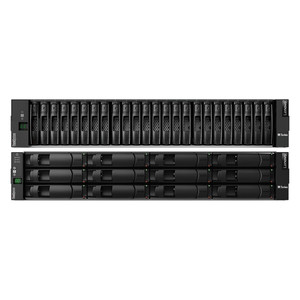
The DE4000H series sits in the ThinkSystem storage line as a purpose-built hybrid array — not a repurposed server JBOD. It ships in a black 2U rack chassis configured for large-form-factor drives, making it the logical target when your workload mixes random I/O bursts (index writes, metadata operations) with sequential bulk transfers (video ingest, backup streams). The 7Y741009NA is the 12-bay LFF variant; if your capacity math demands more spindles or you are running all-SSD, verify whether a different bay-count or SFF configuration exists within the DE4000H family before ordering.
Key Features
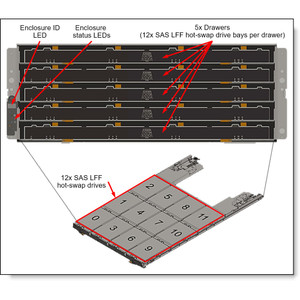
- 12 LFF Drive Bays in 2U: Large-form-factor bays support 3.5-inch drives — the format that delivers the highest raw capacity per drive at the lowest per-TB cost. Twelve bays in 2U means you can populate a single chassis with dozens of terabytes of spinning media while staying within two rack units, keeping your rack footprint predictable as storage scales. If your retention policy runs to 30, 60, or 90 days across a large camera count, that density matters.
- Dual 12Gb/s SAS Host Connectivity: SAS at 12Gb/s per port delivers up to 1.2GBps aggregate data transfer rate — enough bandwidth to sustain high-channel-count video ingest without creating a network storage bottleneck. Two host ports also provide a basic path for multipath I/O configurations, which is important when storage availability is non-negotiable.
- 8GB Controller Cache: Eight gigabytes of onboard cache absorbs write bursts and services repeated read requests from cache rather than spinning up drives for every I/O operation. In practice this flattens latency spikes during peak recording windows — the kind of burst you see when a motion-triggered system goes from near-zero writes to full-channel recording simultaneously.
- 1.2GBps Sustained Transfer Rate: The aggregate throughput ceiling aligns with the dual 12Gb/s SAS ports. For network video recorders and surveillance repositories writing continuous streams from many cameras, a defined throughput ceiling lets you calculate maximum channel capacity before storage becomes the constraint rather than discovering it under load.
- Hybrid Flash Architecture: Hybrid means the array is designed to mix SSD and HDD in the same chassis — tiered storage at the hardware level. Hot data stays on flash for low-latency access; cold data migrates to spinning drives automatically. This is the right approach for workloads where a fraction of data needs fast random access (recent footage, active database pages) while the bulk is sequential and capacity-driven.
- 2U Rack-Mount Form Factor: Standard 19-inch rack mounting keeps the DE4000H compatible with any data center or security operations center rack. Two rack units is a reasonable cost in terms of rack space for the capacity a 12-bay LFF chassis can hold. Pair with a compatible rack enclosure and cable management for a clean installation.
- ThinkSystem Platform Integration: As part of the Lenovo ThinkSystem storage line, the DE4000H is designed to integrate with ThinkSystem servers and Lenovo XClarity management tools. If your environment already runs ThinkSystem compute, management overhead is consolidated rather than split across vendor portals.
Integration and Compatibility
The 7Y741009NA connects to hosts via 12Gb/s SAS — a protocol broadly supported across enterprise server HBAs and ThinkSystem compute nodes. SAS connectivity is also common in DAS and SAN storage environments where Fibre Channel is considered over-engineered for the scale. Verify HBA compatibility and SAS cable specifications before deployment; 12Gb/s SAS requires appropriate cables and SFPs distinct from 6Gb/s SAS infrastructure. The LFF bay configuration means you are selecting 3.5-inch drives — confirm your chosen drives are on Lenovo's compatibility list for the DE4000H controller before purchasing media separately.
For video surveillance deployments, the DE4000H's combination of host-side SAS bandwidth and onboard cache makes it a practical back-end for NVR appliances or dedicated recording servers that need shared storage. The hybrid tier is particularly useful when investigators need fast access to recent clips while older footage sits on high-capacity HDDs at lower cost per TB.
Frequently Asked Questions
Q: What drive form factor does the 7Y741009NA support?
A: The 7Y741009NA is configured for LFF (Large Form Factor) drives — 3.5-inch drives. It provides 12 bays in this format within the 2U chassis. SFF (2.5-inch) drives are not the target for this specific configuration.
Q: How many host ports does the DE4000H 7Y741009NA have, and what protocol do they use?
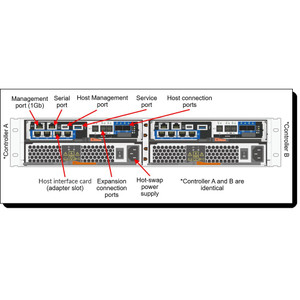
A: The 7Y741009NA includes two 12Gb/s SAS host ports, delivering a combined aggregate data transfer rate of 1.2GBps. These connect to server HBAs or ThinkSystem compute nodes over SAS cabling.
Q: How much controller cache does the 7Y741009NA ship with?
A: The unit ships with 8GB of controller cache. This cache absorbs write bursts and serves repeated reads without disk seeks, which smooths latency under mixed or burst I/O workloads.
Q: Is the 7Y741009NA a SAN or DAS device?
A: It is classified as a DAS/SAN storage system. In practice, SAS-attached storage can be deployed as direct-attached (one host, one array) or in simple shared configurations depending on the HBA and cabling topology used.
Q: What makes this a hybrid array rather than an all-flash or all-HDD array?
A: Hybrid flash means the chassis supports a mix of SSD and HDD drives simultaneously, allowing the controller to tier data between fast flash and high-capacity spinning media. This balances cost-per-TB with I/O performance for workloads where not all data needs flash-speed access at all times.
The spec that drives most of my recommendations on the 7Y741009NA is the 8GB controller cache paired with dual 12Gb/s SAS ports — that combination is what separates a hybrid array that actually performs from one that just markets the word 'hybrid.' In surveillance and archive environments I have deployed, write bursts during motion-triggered recording events are the primary killer of latency; 8GB of cache gives the controller enough runway to absorb those spikes without stalling the recording pipeline.
Technical Highlights:
- 1.2GBps Aggregate Throughput: Dual 12Gb/s SAS host ports deliver a combined 1.2GBps — enough headroom to sustain high-density video ingest from NVR back-ends or VM datastores without the storage tier becoming the bottleneck.
- 12 LFF Bays in 2U: Large-form-factor slots mean you are maximizing capacity per bay using 3.5-inch drives — the highest-density spinning media available. Twelve bays in two rack units is a competitive density for a hybrid chassis at this tier.
- Hybrid Tiering Architecture: The DE4000H is designed to mix SSD and HDD in the same chassis, so you can put recent, frequently accessed footage on flash and let the controller migrate aged recordings to high-capacity HDDs automatically — without manual intervention or separate array management.
Deployment Considerations:
- SAS host connectivity at 12Gb/s requires compatible HBAs and cabling on the server side — verify your compute platform's HBA model and cable spec before racking the array; 12Gb/s SAS is not backward-compatible in the same way as SAS 6Gb/s at full speed.
- This chassis ships without drives — media must be sourced and validated against Lenovo's DE4000H compatibility matrix separately. Populating with uncertified drives risks controller incompatibility and voids support on the array.
For a security operations center or mid-size enterprise building a shared surveillance storage tier behind multiple NVR servers, the DE4000H 7Y741009NA is a practical fit: the LFF bay count supports multi-month retention at scale, the SAS bandwidth handles concurrent ingest from several recording servers, and the hybrid tier keeps investigative clip access fast without the cost of an all-flash back-end.