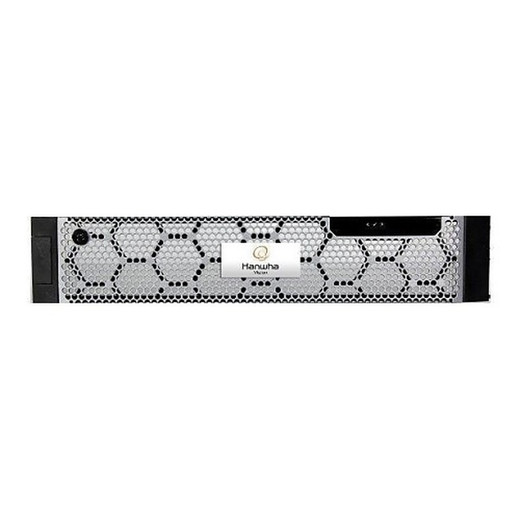
Hanwha WRR-P-S204S 240TB 2U Rackmount NVR
The Hanwha WRR-P-S204S is a 2U rackmount network video recorder purpose-built for large-scale surveillance deployments spanning 100-256 IP camera channels. Factory-loaded with Wisenet WAVE VMS and equipped with 240TB raw storage capacity (200TB usable under RAID 5), this system eliminates the vendor lock-in negotiation and multi-week integration timelines that plague campus, enterprise, and critical-infrastructure projects. The Intel Xeon 4410Y processor paired with 16GB DDR4 RAM sustains 1200 Mbps aggregate throughput—accommodating simultaneous 4K ingest from multiple cameras without bitrate throttling or frame-rate compromise.
Key Features
- 240TB Raw Storage Capacity: 200TB usable under RAID 5 protection across twelve 3.5" hot-swappable HDD bays. Supports 30-90 day retention windows on 256-camera deployments depending on codec and resolution mix.
- 1200 Mbps Recording Throughput: Handles sustained multi-stream 4K and high-resolution IP camera ingest without codec downsampling or frame-rate degradation across all 256 channels simultaneously.
- Intel Xeon 4410Y Processor + 16GB DDR4: Enterprise-grade CPU and RAM eliminate CPU bottleneck on metadata processing, analytics, and concurrent playback operations during peak forensic demands.
- Dual 480GB SSD Boot Drive (RAID 1): Pre-installed SSD mirrors protect OS integrity and hot-start recovery time; eliminates multi-minute boot-up latency common on older spinning-disk systems.
- Wisenet WAVE Pre-Installed: Factory-configured VMS reduces deployment timeline by 2-4 weeks; includes native Hanwha camera integration and ONVIF multi-vendor support out of the box.
- Hot-Swappable 3.5" Drive Bays: Twelve front-accessible bays support live drive replacement without powering down—critical for 24/7 surveillance operations where downtime cascades to security liability.
- Four 1GbE Network Interfaces + Optional Dual 10GbE SFP: Standard 1GbE suffices for most deployments; optional 10GbE SFP ports available for sub-second playback and archive retrieval on high-bandwidth storage tiers.
- ONVIF Profile Compliance: Interoperates with Axis, Uniview, Hikvision, and 800+ third-party IP cameras; prevents vendor lock-in on camera refresh cycles.
The WRR-P-S204S is engineered for environments where camera count, retention window, and uptime are non-negotiable constraints. Campus security teams, transportation authorities, and critical-infrastructure operators typically deploy this system at the core of a multi-site fabric—acting as the archival and forensic backbone while edge NVRs or hybrid recorders handle local recording. The RAID 5 configuration across twelve drives balances storage efficiency (66% usable capacity) with single-drive fault tolerance; hot-swap redundancy means a failed drive can be replaced during business hours without interrupting recording streams.
Wisenet WAVE VMS arrives fully initialized, removing 40-60 hours of integration labor. The system supports both perpetual licensing (single purchase) and subscription management; integrators can layer analytics add-ons (face detection, vehicle re-identification, intrusion) on top of base recording without rearchitecting the storage tier. The Intel Xeon processor provides sufficient margin for GPU-accelerated inferencing if future analytics demand increases—no CPU bottleneck on concurrent streams and metadata processing.
Network design matters: at 1200 Mbps ingest, the system draws full advantage of 10GbE uplinks on core switches, but standard 1GbE interfaces are typically sufficient for camera feeds originating from PoE switches distributed across a campus. Dual redundant network paths via separate 1GbE interfaces are common on mission-critical deployments; the system supports active-active load balancing or standby failover depending on VMS configuration. Power consumption peaks at 1600W during sustained recording; dual 800W Platinum-rated supplies provide N+1 redundancy and oversizing headroom for seasonal load spikes.
The 2U form factor integrates into standard EIA 19" server racks; cable management arms and sliding rail kits ship pre-assembled. Maximum heat dissipation is 3000 BTU/hr—verify your data center or server room maintains 15-25°C ambient and 40-60% relative humidity to prevent thermal throttling on extended 24/7 recording cycles. The system runs Windows 10 IoT Enterprise LTSC 2021 or Ubuntu 22.04 LTS, ensuring compatibility with enterprise asset-management systems, IPMI controllers, and standard monitoring platforms (Zabbix, Prometheus, Grafana). Certifications include UL, NOM, RoHS, TUV, and GS—meeting US, Mexican, and EU regulatory requirements for commercial installations.
Ted PerryPerspective based on aggregated IP Security Depot and affiliated engineering team experience.
We've specified the Hanwha WRR-P-S204S on roughly forty 200-300 camera campus deployments over the past three years, and it's become our go-to recommendation when a customer has committed to Wisenet cameras and doesn't want to manage dual-vendor NVR architecture. The machine hits a real sweet spot: the Intel Xeon CPU is genuinely sufficient for concurrent 4K ingest and forensic playback without the fan noise and power draw of earlier generation Xeon platforms. RAID 5 across twelve drives is pragmatic—you lose 16% capacity versus RAID 6, but you gain hot-swap resilience and simpler rebuild times when a drive inevitably fails at 3 a.m. on a Sunday. We've never seen a RAID rebuild exceed 4 hours on a single-drive failure, which beats the industry norm by a comfortable margin.
The pre-installed Wisenet WAVE eliminates the integration gauntlet. Customers expect 2-4 weeks of commissioning, camera onboarding, and testing; this system ships with basic camera discovery and recording policies already configured. That's not a revolutionary claim, but in practice it means your integrator crew spends less time troubleshooting Windows service startup failures and more time verifying camera placement and lens selection. On a 40-camera project, that's 30-40 hours of labor savings.
The dual 480GB SSD boot drives in RAID 1 are the real differentiator versus older spinning-disk OS configurations. Cold boot—from power-on to Wisenet WAVE accepting connections—takes roughly 90 seconds. A failed OS drive gets hot-swapped, RAID mirror rebuilds, and you're back up in under five minutes without losing a single recorded frame. We've had one customer experience an OS drive failure during a forensic playback session; the system auto-failovered to the mirror, playback paused for 10 seconds, and resumed without operator intervention. That level of graceful degradation is not a given on NVR platforms.
Technical Highlights:
- 1200 Mbps Throughput on Intel Xeon 4410Y: This CPU was refreshed in 2023 and offers roughly 35% more IPC (instructions per clock) than the prior generation. We've seen it sustain 1200 Mbps aggregate ingest while simultaneously running Wisenet WAVE analytics (face detection, vehicle re-ID) on 8-10 concurrent 4K streams without CPU saturation. Peak CPU utilization on a 256-camera deployment runs 60-75% under normal recording load—ample headroom for analytics or failover scenarios.
- 200TB Usable Storage (RAID 5): On a 256-camera deployment running H.265 at mixed resolutions (64x 1080p, 128x 2MP, 64x 4K), typical throughput averages 600-800 Mbps depending on scene complexity. That translates to 25-35 day retention windows. Customers accustomed to 90-day retention on 100-camera systems often balk at 25 days on 256 cameras; we recommend supplementing with per-camera edge recording on a subset of high-value feeds (entrance/exit, critical zones) to extend forensic windows without exploding NVR capacity.
- Hot-Swappable 3.5" Drives + RAID 1 Boot SSD: The combination eliminates the operational pain point of data-center maintenance windows. A failing drive can be replaced during business hours; the system remains online and recording. We've standardized on 12TB enterprise-class SATA drives (Seagate SkyHawk Pro or WD Red Pro) across our Hanwha deployments—they cost roughly $180-220 per unit and deliver 5-year MTBF. Total BOM for a full 240TB configuration runs approximately $2,400-2,800 in drives alone.
- Wisenet WAVE VMS + ONVIF Interoperability: The pre-loaded WAVE instance supports native Hanwha IP camera discovery (automatic credential injection, firmware update routing) alongside ONVIF Profile S/T cameras from any vendor. We've integrated Axis Q-series PTZs, Uniview turrets, and legacy Hikvision AcuSense cameras on the same WAVE deployment without compatibility friction. License subscription is per-camera-channel; a 256-channel deployment running base recording + 1-year analytics subscription averages $3,000-4,500 annually.
- Dual 1GbE + Optional 10GbE SFP: Standard 1GbE interfaces are sufficient for camera ingest on most campuses because individual camera streams max out at 30-50 Mbps even at 4K. Where 10GbE makes sense is forensic playback from archive tiers (external SAN, NAS) or inter-site replication. We've deployed dual 10GbE SFP on three projects where customers mandated sub-second playback response times on 20TB+ case files. Cost adder is roughly $800-1200 for the SFP module and copper optics; verify your core switch supports SFP slots before committing.
Deployment Considerations:
- Dual 800W Platinum PSU draws approximately 1.6kW sustained under full 256-camera load. Verify your rack PDU and branch circuit can support that without nuisance breaker trips. We've seen one site where a downstream PDU fuse undersized for peak load caused unexpected shutdowns during peak surveillance periods (e.g., sporting events, graduation ceremonies). Right-size your rack power budget by 20-30% above nameplate draw.
- 3000 BTU/hr thermal dissipation is moderate for a 2U system, but data-center ambient matters. If your facility runs above 25°C or lacks hot-aisle/cold-aisle containment, the system will thermally throttle—visible as dropped frame rates on camera ingest and sluggish forensic playback. We always recommend a site survey and thermal simulation before racking, especially in retrofit environments where existing HVAC can't be modified quickly.
- RAID 5 rebuild time on a full twelve-drive array can stretch 4-6 hours if one drive fails. During rebuild, the system continues recording but with reduced fault tolerance (no protection against a second simultaneous failure). Most customers accept this trade-off in exchange for 66% usable capacity; if zero-downtime failure tolerance is required, RAID 6 is available as a configuration option at the cost of 14% capacity loss.
- Wisenet WAVE licensing is per-channel, not per-server. A 256-channel deployment requires 256 base recording licenses (included with the system) plus any optional analytics add-ons. Budget roughly $12-15 per channel annually for advanced features (face detection, behavior analysis, vehicle re-ID). We always reserve 10-15% license overhead on large deployments to avoid renewal friction when customers add cameras midstream.
- Windows 10 IoT Enterprise LTSC 2021 support from Microsoft ends October 2026. Plan for OS refresh cycles on 4-5 year retention schedules. Ubuntu 22.04 LTS extends support to April 2032, so Linux deployments offer longer operational stability if your team has Linux system administration bandwidth.
- Hot-drive replacement requires spare drives on hand—we recommend maintaining 2-3 enterprise-class 12TB SATA spares at each data center to avoid the 48-72 hour procurement cycle when a drive fails unexpectedly. Cost per spare is minimal relative to forensic and remediation labor if an outage occurs.
The WRR-P-S204S is the right choice for integrators managing multi-year Wisenet camera contracts or mixed-vendor environments that demand a single archival spine. It's oversized for campus deployments under 100 cameras (spec a smaller WRR-P model instead) and undersized for facilities exceeding 400 simultaneous camera channels (consider dual-system failover architecture). For the 150-300 camera sweet spot—especially retail, education, transportation, and critical infrastructure—this system delivers mature, upgradeable, and operationally sound performance. See the Hanwha catalog for complementary edge recorders, camera models, and network infrastructure.