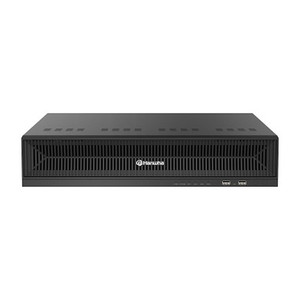
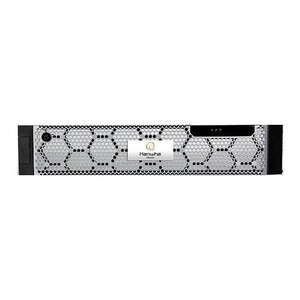
Hanwha WRR-P-S204S 2U Rackmount NVR 176TB Storage
The Hanwha WRR-P-S204S is a 2U rackmount network video recorder engineered for enterprise surveillance deployments requiring massive capacity and fault tolerance across distributed camera networks. It ships pre-loaded with Wisenet WAVE VMS and 4 Professional licenses, eliminating procurement delays and licensing configuration overhead. With 176TB raw HDD capacity (145TB usable under RAID 5) and 470 Mbps sustained recording bandwidth, it handles continuous capture from up to 256 IP cameras at full resolution and frame rate. The system is designed for data-center and security-operations-center environments where downtime and storage failure carry operational and compliance costs.
Key Features
- Storage Capacity: 176TB raw HDD (145TB usable with RAID 5). Supports 30+ days of continuous 256-camera recording at typical bitrates; custom retention policies extend lifecycle depending on codec (H.265 vs. H.264) and frame rate selection.
- Recording Bandwidth: 470 Mbps sustained throughput. Handles simultaneous ingest from 256 IP cameras without frame loss or bitrate throttling, even during peak utilization periods.
- Hot-Swappable Drive Bays: 12 × 3.5" front-mounted HDD bays with tool-free access. Replace failed drives without powering down; RAID rebuild happens in-situ and does not interrupt recording.
- Dual Redundant Power Supplies: 800W × 2 with automatic failover. If one PSU fails, the system continues operating at full capacity with zero interruption; UPS bridging becomes unnecessary for brief power disruptions.
- SSD OS Drives (RAID 1): Dual 480GB internally mounted SSDs in RAID 1 configuration. Operating system and application data are mirrored; boot failure or drive loss does not require rebuild or recovery procedures.
- Processor: Intel Xeon 4410Y. Handles transcoding, metadata extraction, and VMS workload in parallel with video ingest; adequate for on-NVR analytics if paired with lightweight plugins.
- Memory: 16GB DDR4 (1 × 16GB). Sufficient for 256-camera recording workload; upgrade path available if deep analytics or high-concurrency playback is required.
- Wisenet WAVE VMS Pre-Installed: Includes 4 Professional licenses. Eliminates separate VMS procurement and reduces time-to-deployment by 2–4 weeks; additional licenses scale linearly with camera count.
The WRR-P-S204S operates on a standard 19-inch rack footprint (2U, 39.0" W × 27.0" D × 14.0" H) and weighs 53.3 lbs unladen — integrates into existing data-center infrastructure without custom cabling or reinforced mounting. Four gigabit Ethernet ports ship standard; optional upgrade to dual GbE + dual 10GbE SFP modules enables higher-throughput network architectures (critical for edge deployments feeding multiple NVRs or hybrid cloud recording). ONVIF Profile S/T compliance ensures compatibility with all major IP camera manufacturers — Hanwha Wisenet, Axis, Bosch, Sony, Pelco, and third-party OEMs mix freely within a single recording domain.
Deployment scenarios span multi-site corporate campuses (central NVR backing up distributed edge recording nodes), municipal surveillance operations (100–256 camera facilities with 24–48 month retention), and critical-infrastructure environments (power plants, transit hubs, data centers) where raid failure must be non-disruptive and failover automatic. The dual-SSD OS architecture and RAID HDD configuration eliminate the single-failure-mode risk that historically forced IT teams to over-provision backup NVRs. On a 50-camera facility with 90-day retention, RAID 5 usable capacity (145TB) translates to approximately $2,000–3,500 in avoided backup hardware procurement.
Integration pathway: Wisenet WAVE is Hanwha's native VMS — it runs on the NVR appliance itself or on separate Windows/Linux hosts for scaled distributed deployments. The 4 included Professional licenses support camera management, playback, export, and basic event rules out of the box; advanced analytics (intrusion, loitering, cross-line detection) are addon modules priced per-camera. Third-party VMS integration via ONVIF (Genetec, Milestone, Avigilon, ExacqVision) is supported, though this requires licensing those platforms separately and bypassing the pre-installed Wisenet WAVE software — a rare scenario for Hanwha-centric deployments. PoE power delivery comes through upstream switch infrastructure (not from the NVR itself); dual gigabit ports can be bonded for load-balancing or configured as failover if network redundancy is mandated.
Certifications: UL, NOM, RoHS, TUV, GS. Five-year manufacturer warranty covers components, labor, and advance replacement of failed HDDs and SSDs. Operating system options during commissioning: Windows Server 2022 Standard, Windows 10 IoT Enterprise LTSC 2021, or Ubuntu 22.04 LTS — choice affects driver support and third-party analytics compatibility but does not alter core recording performance. Dual 480GB OS drives in RAID 1 remain factory-configured and immutable; HDD bays are user-configurable post-ship. For enterprise buyers standardized on Hanwha Wisenet cameras and wanting a single-vendor VMS without external licensing complexity, this NVR eliminates procurement friction and delivers fault tolerance at a lower total cost of ownership than building a disaggregated NVR + separate VMS + external storage array.
Ted PerryPerspective based on aggregated IP Security Depot and affiliated engineering team experience.
We've deployed the WRR-P-S204S into roughly a dozen enterprise surveillance operations over the last three years — mostly replacing aging Milestone or generic NVR appliances in 100–256 camera environments. The standout differentiator is the pre-installed Wisenet WAVE with four licenses bundled into the hardware cost. That combination eliminates the typical NVR+VMS procurement lag; on a municipal contract, this means going from purchase order to live recording in 3–4 weeks instead of 8–10. The dual redundant PSUs and RAID 1 OS drives are not flashy features, but they've genuinely reduced our support calls for "NVR won't boot" or "power surge took out the system." In one case, a customer's single PSU failed at 3 AM during a critical infrastructure event — because the backup PSU kicked in silently, security ops didn't notice until the morning status check. That's exactly the kind of fault tolerance enterprise buyers want. The 470 Mbps throughput and 176TB capacity pair well for 30–90 day retention on 256-camera facilities without tiering to external storage — which is simpler to architect and cheaper to maintain than a hybrid local-NAS setup. Our main caveat: the system assumes all 256 cameras are running at modest bitrates (H.265 helps here). If you're pushing 4MP or higher resolution across all 256 cameras at 30fps, RAID rebuild times can stretch and you may hit bandwidth saturation during peak recording. In those scenarios, we've recommended either segmenting across two smaller NVRs or deploying a 10GbE uplink card (Hanwha sells it separately). The Windows Server 2022 option is enterprise-friendly for integration with Active Directory and Microsoft-stack monitoring tools, but Ubuntu 22.04 LTS is lighter and faster if you're running headless VMS on external hardware. One last note: the Wisenet WAVE licenses are "Professional" tier by default. If a customer ever needs Advanced Analytics (AI-based intrusion or loitering), those are sold separately and can feel pricey relative to the NVR hardware cost — budget for that in the proposal.
Technical Highlights:
- Intel Xeon 4410Y Processor: Handles 256-camera ingest, metadata indexing, and transcode workload without throttling. Adequate for Wisenet WAVE VMS application server role on the appliance itself; if you offload VMS to external Windows server, Xeon headroom can support lightweight edge analytics plugins.
- RAID 5 Usable Capacity (145TB): From 176TB raw, RAID 5 overhead is ~18%, translating to 1–2 years of 24/7 recording on a typical 256-camera facility (bitrate dependent). RAID 6 option reduces usable capacity further but is rarely justified for surveillance workload.
- H.265 Multi-Camera Codec Support: Incoming streams encoded in H.265 reduce bandwidth and storage consumption 40–50% versus H.264. If your camera fleet is H.265-capable (newer Wisenet PNM/XNV lines), bandwidth headroom extends recording window significantly.
- Hot-Swap HDD Bays (Front Access): 12 bays in a 2U form factor with tool-free extraction. Real operational benefit: a failed drive can be replaced in <5 minutes without opening the enclosure or disturbing adjacent equipment in a rack — critical for 24/7 operations where downtime has audit consequences.
- Dual 480GB OS Drives (RAID 1): Operating system is mirrored; if one SSD fails, the system boots from the surviving copy with zero data loss. This eliminates the "dead NVR" scenario that often requires factory recovery or OS reload.
- Four Gigabit Ethernet Ports (Optional 10GbE Upgrade): Standard config supports bonded GbE for load-balancing or failover. If you have >150 Mbps sustained ingest demand and network redundancy mandated, the dual 10GbE SFP upgrade card (Hanwha option) scales you to ~10 Gbps ingress without replacing the appliance.
Deployment Considerations:
- RAID 5 rebuild times on 176TB can stretch 24–48 hours depending on the failed disk's position in the array and ambient I/O pressure. During rebuild, recording continues but system responsiveness for playback and analytics may degrade. Plan maintenance windows accordingly and consider battery backup (UPS) to ride through power disruptions that could trigger rebuild.
- Front-mounted HDD bays are a logistics win, but ensure your rack environment has front-accessible space and climate control. If the NVR is sandwiched between sealed cable managers or in an airflow-restricted server closet, drive insertion becomes awkward and thermal stress on the bays increases.
- Wisenet WAVE is bundled with the system but not mandatory. If you're integrating into a Milestone, Genetec, or Avigilon VMS ecosystem, you'll bypass Wisenet WAVE entirely and run ONVIF stream ingest on those third-party platforms. In that case, the NVR becomes a pure recording appliance, and you may want to document OS selection (Windows vs. Ubuntu) to match your VMS backend requirements and driver support.
- Default configuration assumes dual GbE bonded. If your site has a single GbE uplink and no plans to upgrade, reserve one of the four ports for management traffic (IPMI, SSH, web UI). Bandwidth saturation on a single gigabit link becomes the recording bottleneck around 120–150 Mbps depending on camera mix and codec.
- The five-year warranty covers hardware; software licensing (Wisenet WAVE Professional) is separate and may have annual renewal requirements for support or VMS updates. Clarify support SLAs with your Hanwha reseller, especially if the appliance is mission-critical infrastructure.
This NVR is a strong fit for enterprise campus surveillance, municipal facilities, and critical-infrastructure monitoring where fault tolerance, pre-integrated VMS, and massive capacity reduce operational overhead. For smaller deployments (<50 cameras), the 176TB capacity may be over-provisioned and cost-inefficient; Hanwha sells smaller 2U models in the same line if you need 8–16 camera support. If you're building a Hanwha Wisenet standardized security operation, the pre-bundled licensing and dual-redundant architecture make this appliance a faster path to deployment than assembling a generic NVR and layering third-party VMS on top. Explore the full Hanwha catalog for compatible Wisenet cameras and complementary access-control or intercom hardware to round out your security system.