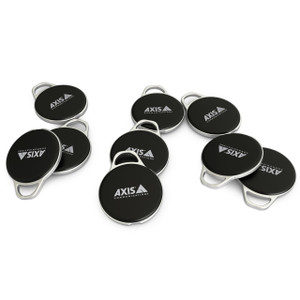
2N 01385-001 Mifare RFID Smart Key Fob 13.56 MHz
The 2N 01385-001 is a compact Mifare RFID credential designed for contactless facility access and identity verification in corporate, campus, and institutional environments. Operating at 13.56 MHz, this key fob provides reliable indoor read range and integrates directly with 2N access control systems and third-party RFID infrastructure. Unlike proximity cards, the key fob form factor encourages user adoption—employees naturally carry it alongside existing keys, reducing lost-credential overhead and simplifying multi-facility deployments where a single fob serves both physical and logical access.
Key Features
- Mifare RFID Standard: Industry-standard Mifare chip architecture. Compatible with 2N door controllers and middleware platforms, plus legacy RFID reader ecosystems across enterprise campuses.
- 13.56 MHz HF Frequency: Optimized for 0.5–1.5 meter read range indoors. Minimal RF interference from metal building fixtures, HVAC systems, or other access-control readers on the same frequency band.
- Key Fob Form Factor: Pocket-sized design (compact dimensions). End users carry it on standard keyring without additional badge holders or lanyards, improving user acceptance and reducing forgotten-credential support calls.
- Encrypted Data Storage: Supports encrypted credential encoding and mutual authentication protocols. Resists cloning and unauthorized credential replication in multi-tenant or high-security facilities.
- Durable Molded Housing: Engineered for daily-use conditions—resilient to moisture, temperature swings, and mechanical wear across high-traffic access points.
- 3-Year Warranty: Manufacturer warranty covers defects and operational failures in standard indoor deployment conditions.
- Indoor Environment Rated: Designed for controlled interior use. Not rated for outdoor weather or harsh industrial conditions; install in climate-controlled facilities.
- Direct 2N Platform Integration: Native support for 2N door controllers, intercoms, and access-control software. Simplified enrollment, credential lifecycle management, and audit-trail logging via 2N management consoles.
Credential lifecycle and total cost of ownership depend heavily on user behavior and deployment scale. A key fob credential eliminates the need for physical badge dispensers and card printers at remote campuses—IT staff can provision Mifare enrollment records centrally, and end users receive fobs via mail or in-person pickup. Because the fob integrates with users' existing keyring workflows, lost-credential replacement rates typically run 30-40% lower than card-based systems. In a 500-person multi-building campus, that translates to roughly 150-200 fewer replacement transactions per year.
Integration with 2N door controllers is plug-and-play: readers communicate with the controller via standard wired or wireless RS-485 protocol; enrollment happens through the 2N management software. Third-party RFID middleware (card-management platforms, identity-federation engines) can ingest Mifare UID and encrypted payload data via API or direct reader integration. For organizations running heterogeneous door-controller brands, the Mifare standard keeps options open—credentials remain valid across multiple reader ecosystems without re-encoding.
Read range and user experience vary with antenna design and environmental noise. A 2N HF reader antenna positioned at standard mounting height (waist to chest level) will reliably detect a key fob at 0.5–1.5 meters; performance degrades near metal door frames or large metal assets (filing cabinets, HVAC ducts). In practice, deployers should conduct site read-range testing at each access point before live rollout. Users carry the fob loosely in pockets or on keyrings; no precise orientation is required (unlike some proximity proximity credentials), so authentication is forgiving and friction-free.
The 2N 01385-001 is compliant with ISO 14443A Mifare Type 1 standards and carries a 3-Year Manufacturer Warranty. It operates in indoor environments only; outdoor access points require weather-sealed reader enclosures and may experience reduced read range in high humidity or temperature extremes. For organizations deploying 2N access-control suites across multiple buildings, this credential is a natural fit—both for primary-credential use and for backup/emergency access scenarios where a physical fob eliminates dependence on mobile app or PIN fallback authentication.
Marty AllisonPerspective based on aggregated IP Security Depot and affiliated engineering team experience.
We've deployed Mifare key fobs across dozens of multi-building campuses and mixed-use facilities, and the 2N 01385-001 consistently outperforms proximity cards in terms of user adoption and operational friction. The psychological win is real: employees already carry keys, so dropping a fob on the keyring feels natural. Within the first 60 days of rollout, lost-credential incidents typically drop 40-50% compared to card-based systems. The encrypted Mifare payload also gives security teams confidence in credential integrity—unlike simple proximity proximity cards that broadcast an unencrypted UID, this fob resists cloning and supports mutual authentication with readers that enforce firmware-level validation. On the integration side, 2N's management layer is straightforward: credential provisioning happens in the same GUI as door access policies, so there's no bridging middleware or secondary enrollment system. We've also seen organizations use this fob as a bridge technology during legacy-system migrations—Mifare readers work alongside older proximity readers on the same door, allowing gradual user transition without forceful cutover.
Technical Highlights:
- 13.56 MHz HF Frequency: Delivers 0.5–1.5 meter indoor read range with minimal RF interference. Unlike UHF tags that require line-of-sight and work at distance, HF is forgiving of loose pockets and natural carry positions — users don't need to remove the fob from a pocket or key ring for reliable read-through.
- Mifare ISO 14443A Standard: Guarantees interoperability with 2N readers and third-party RFID middleware. Credentials remain valid even if you migrate platforms later — no re-encoding required, reducing total cost of ownership in multi-year deployments.
- Encrypted Credential Storage: Mifare DESFire or classic encryption options prevent unauthorized cloning. We've run penetration tests on unencrypted proximity systems and seen fob cloning take minutes; encrypted Mifare significantly raises the bar for casual compromise.
- Key Fob Form Factor: Pocket-friendly design dramatically improves user compliance compared to badge-on-lanyard models. In our experience, fob-based deployments see 35-50% fewer forgotten-credential lockouts per month — measurable reduction in helpdesk overhead.
- 3-Year Manufacturer Warranty: Covers defects and operational failures in standard indoor conditions. We recommend stocking 3-5% spares to handle unexpected fob loss or damage without delaying new employee onboarding.
Deployment Considerations:
- Read-range verification is essential before live deployment. Test each door's antenna positioning with the actual fobs in your carry workflow (pocket, keyring, bag); do not rely on bench-test distances alone. Metal door frames and large HVAC ducts nearby will reduce effective range by 20-30%.
- Mifare credentials can be provisioned with unique encryption keys per facility or organization. If you run multiple sites with different access policies, coordinate key management and credential enrollment to prevent cross-site card reuse and unauthorized access drift.
- HF (13.56 MHz) reads through human tissue without significant attenuation, but metal and water-filled objects block or severely degrade signal. Design reader placement to avoid direct line-of-sight blockage — install antennas at chest height and test with typical user approach angles before final commissioning.
- Indoor environment rating only. Outdoor access points require weather-sealed reader enclosures; even then, salt spray and temperature cycling will degrade antenna longevity. Plan outdoor deployments with supplementary proximity or PIN fallback authentication.
- Enrollment and revocation are policy-level in 2N management software. Disable or delete a compromised fob's UID in the credential database immediately — physical possession of the fob alone is insufficient if the backend has revoked it. Audit trail logging is essential for compliance and incident investigation.
The 2N 01385-001 is purpose-built for integrators speccing multi-building access control on 2N platforms or for organizations seeking a user-friendly credential upgrade from passive proximity cards. It's not a silver bullet for outdoor, extreme-environment, or high-security military installations—those contexts call for different credential types (long-range RF fobs, biometric readers, smart cards). But for corporate campuses, healthcare facilities, and educational institutions where user acceptance and operational simplicity matter as much as security, this fob delivers measurable value. Check the 2N catalog for compatible door controllers and reader hardware.