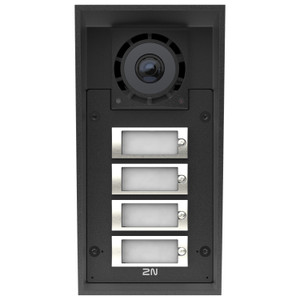
2N 03365-001 IP Force 2.0 Audio Intercom Keypad
The 2N 03365-001 is a purpose-built audio-only intercom endpoint designed for IP-based access control and voice communication in multi-tenant buildings, campuses, loading docks, and perimeter security installations. This model eliminates camera complexity while delivering professional-grade audio clarity—a deliberate tradeoff when your primary requirement is voice authentication and immediate call routing rather than visual identification.
Key Features
- Two-way audio with integrated microphone and speaker: Built-in transducers handle simultaneous bidirectional communication, eliminating the need for external amplifiers or separate audio hardware at the entry point. This simplifies rough-in wiring during retrofit installations and reduces component count on the wall plate.
- ARTPEC-8 dedicated audio processor: Real-time encoding and decoding with sub-100ms latency ensures response times are immediate—critical when tenants or security personnel need to authenticate or verify a visitor without perceptible delay. Stale audio defeats the purpose of intercom-based access control.
- Advanced noise suppression filtering: Active algorithms remove wind, traffic, HVAC, and loading-dock ambient noise from both inbound and outbound streams. In outdoor perimeter applications, the called party actually hears clear speech rather than a wall of background noise, reducing misunderstandings and repeat calls.
- SIP (Session Initiation Protocol) endpoint: Connects directly to standard VoIP PBX systems and IP telephony platforms without proprietary gateways or translation layers. If your organization runs Asterisk, FreePBX, or a commercial IP-PBX, the 03365-001 speaks the same language, reducing integration cost and ongoing support overhead. Check your VoIP infrastructure documentation to confirm SIP server availability before deployment.
- Hardened authentication and credential handling: Second-generation design incorporates defensive measures against common intercom attack vectors (credential replay, unauthorized call rerouting). For facilities subject to physical security audits or compliance frameworks, this is a real requirement, not a nice-to-have.
- Industrial-grade keypad mechanics: Rated for high-cycle access control use—thousands of button presses over years of daily operation. Consumer-grade intercoms develop sticky buttons and membrane creep; this keypad is built for institutional wear patterns.
Audio-Only Design Rationale
The absence of a camera reduces capital cost, bandwidth consumption, and storage overhead compared to video intercom systems. You trade visual identification for faster deployment and lower total cost of ownership. This is the correct choice if your facility already deploys perimeter cameras covering entry points, or if your access control policy relies on PIN or credential verification rather than visual face matching. In multi-tenant residential buildings, audio-only intercoms also reduce privacy concerns around camera surveillance at entry vestibules.
Power and Integration
The 03365-001 draws power exclusively via PoE (Power over Ethernet), eliminating the need for separate 12VDC or 24VDC supplies and the associated conduit complexity. Typical current draw is low enough that standard 802.3af PoE switches will support multiple units per port budget without strain. Install requires only a standard Ethernet run and a wall-mounted faceplate—no separate power drops to engineer.
Deployment Scenarios
Apartment building entry vestibules—residents call a security desk or management office. Campus perimeter gates—visitors authenticate with a PIN, then speak to a gate operator. Loading dock voice stations—drivers press a button to announce arrival without needing an internal phone extension. Reception desk call boxes—guests announce themselves and are routed to the appropriate extension. In each scenario, the keypad simplifies wiring, reduces visual clutter, and integrates seamlessly into existing PoE infrastructure and IP intercom deployments.
Outdoor Capability
Industrial-grade enclosure and weatherproof connectors support both indoor and outdoor mounting. Consult the manufacturer datasheet for exact IP and IK ratings and confirmed temperature operating range before specifying for extreme climates or high-vibration environments (e.g., industrial gate applications with frequent heavy vehicle passage).
Frequently Asked Questions
Q: Does the 2N 03365-001 work with my existing IP-PBX?
A: Yes, provided your PBX supports SIP endpoints. The 03365-001 uses standard Session Initiation Protocol, so compatibility with Asterisk, FreePBX, and commercial platforms (Avaya, Cisco, Polycom-based systems) is standard. Confirm SIP server configuration and port access with your VoIP administrator before deployment.
Q: Can I mount the 03365-001 outdoors?
A: Yes. Industrial construction and weatherproof connectors support outdoor installation. Verify the exact IP/IK ratings and temperature operating range in the manufacturer datasheet for your specific climate or environmental stressors.
Q: What's the power requirement for the 03365-001?
A: The unit draws power via standard PoE (Power over Ethernet). Current draw is low, so 802.3af switches will support multiple units without specialized power budgeting. No separate 12V or 24V supply required.
Q: How does the ARTPEC-8 processor benefit audio quality?
A: The dedicated audio processor handles real-time encoding/decoding with sub-100ms latency and active noise suppression. This ensures immediate response and clear voice communication even in noisy environments like loading docks or busy perimeter gates.
Q: Is the 03365-001 (often searched as 03365 001) suitable for residential apartment buildings?
A: Yes. Audio-only design reduces privacy concerns compared to video intercoms, simplifies wiring, and integrates directly into existing PBX systems. This is a common choice for multi-tenant residential entry vestibules.
Q: Can I integrate the 03365-001 with my existing video intercom system?
A: Yes, via SIP. If your video intercom platform supports SIP integration and your PBX handles call routing to multiple endpoint types, the 03365-001 can coexist with video units. Test call routing and failover scenarios in your specific system before production deployment.
Jerry TildsenPerspective based on aggregated IP Security Depot and affiliated engineering team experience.
The 2N 03365-001 is a pragmatic choice when you need IP intercom functionality without the bandwidth and storage overhead of video. The ARTPEC-8 processor and sub-100ms latency matter in access control scenarios—delay in audio response creates user confusion and support callbacks. The 03365-001 avoids that entirely.
Technical Highlights:
- ARTPEC-8 processor with sub-100ms latency: Real-time encoding/decoding ensures no perceptible delay in voice communication—critical when a gate operator needs immediate confirmation from a visitor or when a resident needs to authenticate entry within seconds. Delayed audio breaks the trust model of intercom-based access.
- Active noise suppression filtering: Removes wind, traffic, and HVAC noise from both directions. In outdoor loading docks or busy campus gates, this means the called party hears intelligible speech, not a wall of ambient noise. Reduces repeat calls and clarification requests.
- SIP endpoint architecture: Direct integration into standard VoIP PBX systems without proprietary gateways. If your organization already manages Asterisk, FreePBX, or a commercial IP-PBX, the 03365-001 is a native endpoint. No separate translation layer to maintain or troubleshoot.
Deployment Considerations:
- Confirm SIP server availability and port access with your VoIP administrator before ordering. Audio-only means you're relying entirely on voice authentication—if your facility requires visual identification, add a separate perimeter camera at the same location.
- PoE power is required; 802.3af is sufficient for the 03365-001, but verify that your switch has available ports and power budget before scaling to multiple units.
The 03365-001 is the right model for residential apartment buildings with privacy concerns about lobby cameras, campus gates where voice authentication is sufficient, and loading docks where driver identity is verified by credential or verbal confirmation. Skip it if you need visual identification or if your facility lacks IP-PBX infrastructure.