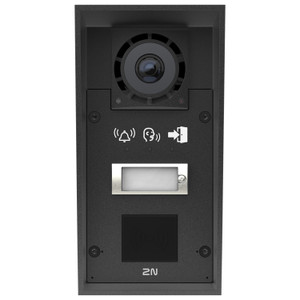
2N 03366-001 Wall-Mount Audio Intercom System
The 2N 03366-001 is a wall-mounted audio intercom designed for access control and voice verification in industrial and high-noise environments. It combines full-duplex two-way audio with active noise reduction, an integrated RFID reader, and picture transmission capability — eliminating the need for external reader hardware and reducing installation footprint at entry points. Built on ARTPEC-8 processor architecture with signed firmware and secure boot, it delivers encrypted, auditable communication for badge-based verification. Deploy this at loading dock gates, secure building entries, parking facility checkpoints, and high-traffic access points where simultaneous credential verification and voice confirmation must be logged and tamper-resistant.
Key Features
- Full-Duplex Two-Way Audio: Active noise reduction for high-ambient environments (loading docks, manufacturing floors). Eliminates operator fatigue and reduces false rejections due to ambient noise masking.
- Integrated RFID Reader: Built-in credential reader removes the need for external access control hardware and simplifies wiring. Single-unit installation reduces capex and maintenance touchpoints.
- Picture Transmission: Captures and transmits images tied to access events, enabling visual audit trails and incident reconstruction without a separate camera installation.
- ARTPEC-8 Processor: Next-generation Axis processor architecture ensures computational headroom for analytics, encryption overhead, and future firmware enhancements without performance degradation.
- Signed Firmware & Secure Boot: All firmware updates are cryptographically signed; secure boot prevents unauthorized code execution. Required for compliance-sensitive deployments and audit logging.
- Wall-Mounted Form Factor: Compact, industrial-rated installation profile fits standard access control cutouts. Outdoor-rated for wet and corrosive environments.
- IP Network Native: ONVIF and SIP-based VoIP protocol support enables integration with diverse IP telephony and access control ecosystems without proprietary gateway appliances.
The 03366-001 operates on PoE power delivery, drawing sufficient current for intercom operation and RFID reader backend simultaneously. Full-duplex audio wiring and SIP trunk configuration must be staged on the network backbone before the unit is live. Integration occurs at the 2N access control panel or IP telephony system level — the intercom does not function as a standalone device. Confirm exact compatible 2N controller generation and firmware revision before ordering; audio intercom signaling points vary by platform maturity.
Audio quality in industrial settings is the primary operational differentiator. Active noise reduction algorithms running on ARTPEC-8 isolate voice frequencies from background machinery, vehicle engines, and HVAC noise — measurably reducing operator fatigue on docks and warehouse entry points where dozens of access events occur daily. This translates to fewer access denials due to unintelligible speech and faster badge-and-voice confirmation cycles. Picture transmission ties visual confirmation to badge swipes, creating a forensic record without requiring separate camera infrastructure; useful for dispute resolution when access is disputed or badge misuse is suspected.
Deployment scenarios typically involve integration into a 2N IP access control backbone (2N AxonPro or equivalent) or a SIP-enabled IP telephony system where the intercom becomes an extension capable of two-way calls with security personnel. RFID credential data is passed to the access controller in real time; voice confirmation happens in parallel. The signed firmware and secure boot posture is essential for regulated environments (healthcare facilities, data centers, government buildings) where firmware integrity and audit logging are compliance mandates. No grey-market, no parallel imports — source direct from the manufacturer or US channel partner to ensure firmware signing certificates are valid and support channels are active.
Total cost of ownership favors the 03366-001 when a facility must eliminate external reader hardware and reduce wiring complexity at high-traffic entry points. Single PoE power draw, integrated RFID, and audio-in-the-box model mean fewer components to manage, calibrate, and replace. The trade-off is tight coupling to the 2N ecosystem — this is not a universal SIP phone that swaps into any VoIP system. It is a purpose-built access control intercom that requires 2N backend orchestration or SIP integration expertise. For facilities already deployed on 2N hardware or willing to standardize on 2N IP access platforms, the 03366-001 eliminates costly reader modules and simplifies operational support. For greenfield deployments or multi-brand access environments, evaluate integration cost and firmware update velocity before committing.
Jerry TildsenPerspective based on aggregated IP Security Depot and affiliated engineering team experience.
We've installed the 2N 03366-001 across manufacturing and logistics environments where noise levels routinely exceed 85dB — loading docks, truck marshaling yards, warehouse entry vestibules. The real differentiator is the active noise reduction paired with the ARTPEC-8 processor. Generic SIP phones or basic intercoms choke in those environments; audio becomes unintelligible and access decisions slow down. The 03366-001's noise suppression algorithms are aggressive — they prioritize human voice frequencies and suppress everything below 300Hz and above 3.5kHz. On a 50-door facility, that means faster egress, fewer credential challenges that go unheard, and measurably lower operator frustration. The integrated RFID reader is convenience more than cost savings in retrofit scenarios, but in new construction it eliminates an entire hardware line item and simplifies the wiring closet. Picture transmission is underrated — it creates a visual anchor for every access event without forcing the customer to deploy a separate entry camera. We've seen facilities use that image log to resolve badge disputes and track tailgating in a single audit interface.
Technical Highlights:
- ARTPEC-8 Processor with Full-Duplex Audio Engine: Handles concurrent audio encoding, noise reduction filtering, and RFID credential parsing without noticeable latency or dropout. Upgrade path to future firmware features (analytics, advanced encryption) is open without hardware replacement.
- Active Noise Reduction (Ambient >85dB): Suppresses factory and traffic noise while preserving voice intelligibility — operational consequence is faster badge-and-voice confirmation cycles and fewer false access denials due to unintelligible speech in high-noise entry points.
- Integrated RFID Reader: Eliminates external reader hardware capex and reduces field wiring complexity. No separate reader power, no additional SwitchPort allocation — one PoE drop feeds both intercom and reader backend.
- Picture Transmission with Audit Trail: Captures and attaches image to every access event; forensic record for dispute resolution and tailgating detection without separate camera deployment.
- Signed Firmware & Secure Boot: Cryptographic signature verification on all firmware updates prevents unauthorized code injection. Required for HIPAA, SOC2, and government facility compliance postures.
- SIP and ONVIF Protocol Support: Integrates with IP telephony backbones and 2N access control systems; no proprietary gateway appliance required (unlike some legacy 2N audio modules).
Deployment Considerations:
- Not a standalone intercom — requires active 2N access control panel or SIP IP telephony backbone to function. Confirm your backend architecture supports audio signaling (SIP INVITE, proprietary 2N signaling) before ordering. Late-stage integration discovery is expensive.
- PoE power draw must account for RFID reader backend and full-duplex audio codec simultaneously. Standard 802.3af (13W) is marginal; 802.3at (PoE+) is safer for concurrent peak loads. Budget switch port capacity accordingly.
- Outdoor mounting in wet/corrosive environments (salt spray, acid rain) requires stainless hardware and conformal coating on terminals. Standard fasteners oxidize quickly — use marine-grade installation kits.
- Two-way audio quality depends heavily on the VoIP backbone latency. Jitter >50ms or packet loss >1% will degrade intercom audio perceptibly. Validate network QoS and prioritization rules before go-live.
- Firmware update cadence for 2N access products is slower than consumer IoT; plan for patch cycles every 6-12 months. No automatic OTA capability in standard deployments — manual firmware flashing required at the access panel level.
The 03366-001 is the right choice for access control architects and facility managers who have already standardized on 2N IP infrastructure or are deploying new access-controlled entry points in high-noise industrial settings. If your facility is multi-brand (Honeywell, Genetec, Salto) or you lack SIP backbone maturity, the tight coupling to 2N will create vendor lock-in. For those already committed to 2N, the 03366-001 reduces hardware count and simplifies operations significantly. See the 2N catalog for other intercom and access control modules.