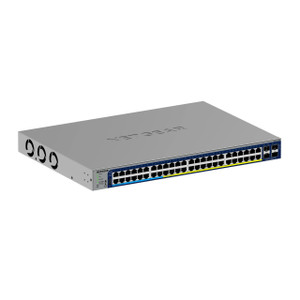
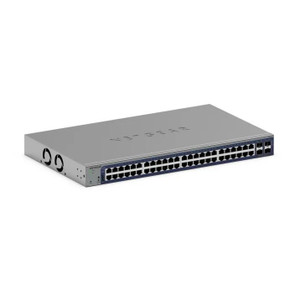
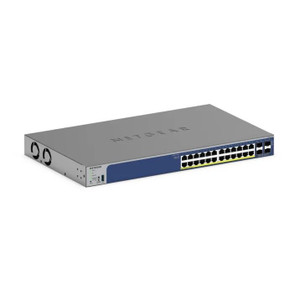
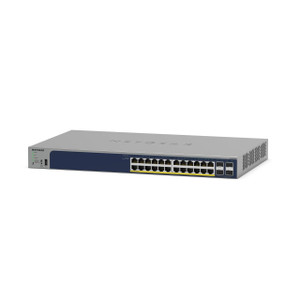
NETGEAR GS728TXUP-300NAS 24-Port PoE++ Smart Switch with 10G SFP+
The NETGEAR GS728TXUP-300NAS is a 24-port Gigabit Ethernet PoE++ smart switch designed for medium to large IP surveillance installations requiring centralized power delivery across multiple camera tiers. The switch supplies 720W of 802.3bt PoE++ power distributed across all 24 Gigabit ports, eliminating the need for external PoE injectors when deploying PTZ cameras, dual-sensor systems, thermal modules, or camera-mounted edge analytics appliances. Two 10G SFP+ uplink ports aggregate video traffic to your NVR or VMS at non-blocking throughput, preventing backhaul congestion that degrades frame rate on high-bitrate streams. Smart management capabilities—per-port QoS, VLAN isolation, IGMP snooping—allow you to partition camera networks from office infrastructure and apply traffic prioritization rules by zone or camera class, reducing broadcast noise and improving overall system responsiveness.
Key Features
- PoE++ Power Budget: 720W total 802.3bt PoE++ power. Supplies enough current for 20+ cameras drawing 30W–95W each without stacking inline injectors or undersizing wire gauge.
- 24 Gigabit Ethernet Ports: 1 Gbps copper RJ45 on each port; hot-swappable PoE negotiation per device. Backward compatible with 802.3af (PoE) and 802.3at (PoE+) endpoints.
- Dual 10G SFP+ Uplinks: Two 10 Gigabit SFP+ slots for fiber or direct-attach copper trunking to upstream aggregation layer. Non-blocking fabric prevents uplink saturation on large camera counts.
- Smart Management: VLAN tagging (802.1Q), per-port QoS (traffic shaping), IGMP snooping for multicast isolation. No license fee; configuration via web GUI or Telnet CLI.
- 1U Rack Form Factor: 19-inch rackmount design; 100–240V AC input (IEC-320 C14 connector). Single power supply; no N+1 redundancy option on this model.
- Switching Fabric: 56 Gbps non-blocking backplane; sufficient for 20x simultaneous full-bitrate H.265 streams across the 24 ports without internal bottleneck.
- Port Density & Cost-Per-Port: 24 PoE ports on a single 1U unit reduces rack footprint and total deployment cost versus stacking two 12-port switches.
- Thermal Management: Integrated cooling designed for typical indoor 5–35°C range; maintains safe junction temperatures under sustained 24/7 PoE delivery at full load.
The GS728TXUP-300NAS solves a core problem in mid-scale surveillance: a single power plane that doesn't require per-camera power budgeting or external injector chains. On a 500-camera parking-lot or perimeter deployment using 40W PTZ domes, you'd need 3–4 of these switches across your camera zones. Each switch becomes a self-contained power island, simplifying cabling logistics and reducing single-point failure risk. The 10G uplinks are the leverage point—instead of four separate 1G uplinks per switch (each consuming a port and bandwidth), you get a single logical pair that can be bonded or split across two network paths, depending on your VMS architecture.
Management integration is straightforward for integrators familiar with VLAN and QoS basics. IGMP snooping is a feature that often goes unused in smaller shops, but on a switch carrying 24 cameras running multicast analytics metadata streams, it prevents unnecessary broadcast replication and keeps the backhaul clean. Many integrators mistakenly run all cameras in a flat broadcast domain; this switch rewards proper VLAN segmentation with measurable improvements in frame rate consistency and NVR CPU load. Pair it with a managed uplink switch (Cisco Catalyst, Arista, or NETGEAR's own core line) and you inherit enterprise-grade traffic engineering at the surveillance tier.
Power delivery is the headline specification—720W is not marketing exaggeration. At 24 ports × 30W average draw, you're nearing saturation; at 24 × 60W (dual-sensor or high-wattage PTZ), you hit ceiling. Verify your circuit capacity before racking: a full 720W load requires approximately 6A @ 120V or 3A @ 240V input current (accounting for ~95% PSU efficiency). Data center and enterprise racks typically have 20–30A branch circuits, so redundancy is available, but you cannot plug two of these switches into the same 15A office outlet. Heat dissipation is also non-trivial—expect 50–80W thermal load when driving 400–500W of PoE simultaneously; ensure 2-inch clear airflow front and rear in the rack.
ONVIF Profile S compliance means the switch itself is transport-agnostic—it moves traffic from any ONVIF-conformant IP camera (Axis, Hikvision, Dahua, Bosch, Hanwha, etc.) without vendor lock-in. The 10G SFP+ uplinks accept any standard LC-duplex transceiver module (10GBASE-SR, 10GBASE-LR, or direct-attach copper), so you're not trapped into proprietary optics. Many integrators overlook this freedom and pay 3x the cost for branded modules; this switch opens the door to competitive transceiver sourcing. Fiber uplinks are also forward-compatible: if you migrate to 25G or 40G in 3–5 years, you can upgrade the uplink tier without replacing the 24-port base.
The NETGEAR GS728TXUP-300NAS is a no-frills workhorse for integrators building reliable, scalable camera networks without vendor ecosystem lock-in. It sits in the sweet spot between entry-level unmanaged PoE switches (which lack VLAN and QoS controls) and enterprise-class core switches (which overprovision for typical surveillance loads and carry premium price tags). For system architects building 200–500-camera regional deployments with multiple buildings or zones, this switch becomes a standard building block. It is not a fit for small <50-camera jobs where a single 8-port PoE+ injector-switch combo solves the problem at lower cost. It is also not appropriate for deployments exceeding 1,000 cameras without additional aggregation—one of these switches serves as a good access-layer unit, but you'll need core-layer redundancy and load balancing above it.
Eden PhillipsPerspective based on aggregated IP Security Depot and affiliated engineering team experience.
We've deployed the GS728TXUP-300NAS in parking lots, warehouses, and multi-building campuses where centralized power is the critical constraint. The differentiator versus a stack of 8-port or 12-port PoE switches is not raw port count—it's the economics of scale and the discipline you can enforce across a single management domain. With 24 ports on one VLAN-capable unit, you get one management interface, one firmware upgrade cycle, one power cord, and unified traffic visibility instead of juggling four separate appliances. The 720W budget sounds generous until you realize that on a mixed deployment (some 30W fixed domes, some 90W PTZ), you're making real trade-offs. We've seen sites attempt to plug 24 cameras drawing 50W each into this switch (1200W total) and then blame the switch when power negotiation fails. The truth is simpler: know your camera wattages before you buy, sum them, and leave 15% headroom.
The 10G SFP+ uplinks are where this switch earns its price versus cheaper alternatives. On a 500-camera site using H.265 at an average 4 Mbps per stream, your aggregate is 2 Gbps inbound to the NVR. A single 1G uplink would create a bottleneck and force frame rate reduction on later-priority cameras; dual 10G uplinks eliminate that constraint entirely. If your uplink is copper CAT6A (up to 100 meters), you avoid the cost and management burden of fiber altogether. If you're running fiber, the SFP+ slot accepts competitive third-party transceivers—don't fall for vendor pressure to buy NETGEAR-branded optics at premium pricing.
Operationally, VLAN and QoS are features that add value only if you use them. We've visited sites where the switch was flat-configured (all ports in VLAN 1, no QoS rules) because the integrator wasn't comfortable with switching concepts. That's a missed opportunity. By segmenting cameras into VLAN 100, office devices into VLAN 1, and then applying ingress rate-limit rules on office-facing ports, you immunize the camera network from accidental broadcast storms caused by a malfunctioning printer or a DHCP attack. IGMP snooping is also critical if you're running any kind of multicast video—it prevents unnecessary replication of Axis or Bosch analytics metadata to every port.
Technical Highlights:
- 802.3bt PoE++ Compliance: Supports up to 95W per port (IEEE standard), though the 720W total budget means you cannot feed all 24 ports at maximum wattage simultaneously. Real-world deployments average 40–50W per port, leaving safe headroom. The switch negotiates power class dynamically; if a camera requests only 13W, it receives 13W, not 95W.
- 56 Gbps Switching Fabric: Non-blocking architecture ensures no port is starved for bandwidth. On a 16-port load at 100 Mbps each (common for H.264 960p streams), the fabric reserves approximately 1.6 Gbps, leaving ample room for 10G uplink traffic without congestion or frame loss.
- Dual 10G SFP+ with LC-Duplex Standard: Accepts any industry-standard SFP+ transceiver module. This breaks vendor lock-in—you source transceivers from suppliers like Finisar, Mellanox, or generic OEM vendors instead of paying NETGEAR's premium. 10GBASE-SR (multimode fiber, ~300m) costs 25–40% less than equivalent NETGEAR modules, and performs identically.
- VLAN 802.1Q + QoS (802.1p Priority): Allows partition of camera traffic from office networks, preventing a broadcast storm on a single office port from disrupting surveillance. Per-port ingress rate-limiting ensures a malfunctioning device cannot consume more than its fair share of backhaul.
- IGMP Snooping (v2 & v3): For deployments running multicast streams (Axis Companion, Bosch edge analytics, generic RTSP multicast), IGMP snooping prevents unnecessary replication of the same multicast stream to every port. On a 24-port switch with 10 multicast streams, this feature alone can reduce backhaul traffic by 30–50%.
- Single IEC-320 C14 Power Input: No N+1 redundancy on this model—there is only one power supply. For mission-critical sites (hospitals, airports), consider deploying two units in active-active or active-backup mode, with uplink diversity. Entry-level sites or branch offices accept the single-supply risk.
Deployment Considerations:
- Power Budget Math: At 720W total and 24 ports, you're carrying approximately 30W per port on average. A single PTZ camera at 95W and a thermal module at 80W leaves only 545W for 22 other cameras (approximately 24.8W each). Map your camera power draw before purchase. Sites with mixed camera types often find themselves forced to deploy two switches to avoid power exhaustion.
- Thermal Headroom: Under sustained 600W PoE load (typical 24/7 scenario), the switch dissipates approximately 60–70W of heat. Ensure 2-inch clear airflow on front and rear in the rack. Do not install directly above a fan or heat source. In a sealed cabinet without auxiliary cooling, junction temperature can exceed 70°C, reducing MTBF. If racking in a warm environment (>30°C ambient), add a small cabinet-mounted fan.
- Uplink Bandwidth Planning: The 24 Gigabit ports share a maximum of 56 Gbps backplane bandwidth. If all 24 ports transmit at 100% utilization simultaneously (24 Gbps), the 10G uplinks are saturated. In practice, real-world camera traffic averages 5–15 Mbps per stream, so saturation is rare. However, on a site with 20 H.265 cameras at 8 Mbps each (160 Mbps aggregate) plus 4 PTZ at 20 Mbps each (80 Mbps), you are pushing 240 Mbps total—well within 10G capacity, but approaching the point where a single 1G uplink would fail.
- VLAN Trunk Configuration: If cascading multiple GS728TXUP-300NAS units, configure the 10G uplinks as a VLAN trunk (tagged with 802.1Q) to pass all VLAN IDs upstream. Failure to do so results in VLAN isolation between switches—cameras on VLAN 100 on Switch 1 cannot communicate with cameras on VLAN 100 on Switch 2. Use native VLAN (typically VLAN 1) for management traffic if the upstream aggregation point is unmanaged.
- PoE Negotiation Timing: The switch uses IEEE power negotiation to determine each camera's power class. During boot or power-loss recovery, negotiation occurs sequentially, which can delay camera startup by 10–30 seconds total. On sites with coordinated reboot requirements, budget this time. Also, power-loss cascades (all cameras rebooting simultaneously) can stress NVR ingestion and cause frame-rate dips until all cameras reconnect.
- Firmware Updates: NETGEAR releases firmware updates periodically. Unlike more mature platforms, updates sometimes introduce minor quirks (e.g., VLAN tag stripping behavior change). Always test firmware on a staging switch before rolling to production. The web GUI is functional but slow on large configurations—use SSH/Telnet CLI for bulk changes when possible.
The NETGEAR GS728TXUP-300NAS is the right choice for regional integrators and system architects building 300–1000 camera networks where a single-plane power strategy and managed uplink aggregation drive project economics. It is not the choice for <50-camera jobs or for high-availability deployments requiring N+1 power supply redundancy. For more options on PoE switching platforms and upstream aggregation strategies, explore the NETGEAR catalog.