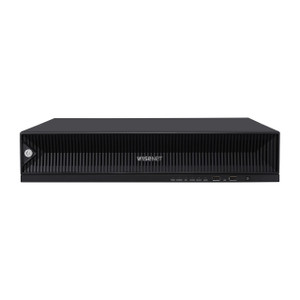
Hanwha PRN-1600B2-16TB 16-Channel 8K NVR with 16TB Storage
The Hanwha PRN-1600B2-16TB is a 16-channel network video recorder engineered for enterprise surveillance operations, transportation hubs, and multi-site campus environments where resolution density, storage scalability, and data integrity cannot be compromised. It ingests up to 32MP IP streams from any ONVIF-compliant camera and compresses them via H.265 (40–60% bitrate reduction vs. H.264), H.264, or MJPEG — eliminating licensing overhead and streamlining multi-codec deployments. The unit ships with 16TB of internal capacity across up to 8 SATA bays (10TB maximum per drive), scaling to 80TB raw capacity when fully populated. Distributed recording mode sustains 250 Mbps throughput across all 16 channels; RAID modes maintain 150–250 Mbps depending on drive configuration and stripe depth. This is the recorder for integrators who cannot afford dropped frames, storage fragmentation, or unplanned downtime.
Key Features
- 16-Channel 32MP Ingest: Records up to 32MP streams simultaneously across all 16 channels. H.265 codec reduces per-camera bitrate by 40–60% versus H.264, directly lowering NVR CPU and storage utilization on high-resolution deployments.
- 16TB Internal Storage (Expandable to 80TB): Eight SATA 3.5-inch bays support up to 10TB per drive. Pre-install drives before power-on; system auto-detects and initializes. Scalable from 16TB to 80TB without firmware changes or downtime migration.
- RAID 5 & RAID 6 Protection: Automatic recovery backup across all installed drives. RAID 6 sustains simultaneous dual-drive failure without data loss — mandatory for enterprises where recovery time objective (RTO) and recovery point objective (RPO) are measured in minutes, not hours.
- 250 Mbps Recording Bandwidth (Distributed Mode): Handles 16×1080p60 + 4×4K30 simultaneous streams without frame loss. Bandwidth scales with codec selection and frame rate — H.265 halves bitrate vs. H.264 on identical video quality.
- AI Search & Metadata Extraction: Native support for Hanwha Wisenet AI cameras unlocks BestShot (key-frame extraction), Attribute detection (clothing color, vehicle type), and License Plate Recognition (LPR) without per-license fees. Software-based analytics extend AI features to non-AI P, X, and Q series models on the same network.
- ONVIF Profile S & SUNAPI: Full ONVIF compliance integrates with Genetec, Milestone, Avigilon, and ExacqVision platforms. Hanwha SUNAPI enables firmware updates, configuration backup, and remote management via standard HTTP/HTTPS without proprietary middleware.
- Dual HDMI + VGA Outputs: Two HDMI ports (3840×2160 @ 30Hz) + one VGA enable wall-mounted monitor display and independent operator console workstation simultaneously. Fisheye dewarping operates on one local channel at a time, reducing live-view CPU overhead.
- Three 1 Gbps Ethernet Ports (LAN/WAN): Dual LAN ports support network redundancy and failover; one WAN port enables remote access and multi-site recording synchronization. Standard RJ-45 integration with enterprise switching infrastructure; no proprietary cabling.
- Embedded Linux Operating System: No Windows licensing, no periodic OS patching cycles that conflict with recording schedules. Streamlined boot time and minimal resource overhead — the OS consumes <5% CPU at idle.
- Audio Support: Built-in audio input enables synchronized audio-video recording from microphones or line-level sources. Playback audio syncs frame-accurately with video in forensic review and legal proceedings.
The PRN-1600B2-16TB is purpose-built for enterprises that deploy 16+ cameras across a single location or manage multiple recording nodes across a WAN. The combination of RAID 5/6 protection, H.265 codec support, and native AI analytics (on Hanwha cameras) eliminates the operational complexity and capex overhead of hybrid NVR + separate video analytics appliances. Integrators specify this unit when the customer's security policy mandates on-premises recording (not cloud), zero-copy forensic export, and sub-minute incident response times.
Storage and retention planning scales linearly: a 16-camera deployment recording 32MP @ H.265 consumes approximately 1.5–2 TB per 24 hours, depending on scene complexity and frame rate. With 16TB installed, you achieve 8–10 days continuous retention; a full 80TB configuration stores 40–50 days. RAID 6 overhead consumes one additional drive (e.g., 8 drives yield ~70 TB usable capacity after parity). Integration with enterprise video management platforms via ONVIF ensures the NVR appears as a standard recording source — no custom drivers or VMS plug-ins required.
Environmental constraints are standard for rack-mounted network equipment: 0°C to +40°C (32°F to 104°F) operating temperature requires placement in a climate-controlled equipment room or secure server closet. The unit weighs 9.1 kg (20.1 lb) without drives installed and fits a standard 19-inch rack footprint (3.39" height, 17.24" width, 17.12" depth). Pre-populate all SATA bays with HDDs before initial power-on; hot-swap replacement of failed drives is supported, but the system does not auto-detect hot-plugged new drives without a reboot. Dual 120mm cooling fans maintain thermal stability under sustained high-bitrate recording; filter replacement is recommended every 6–12 months depending on datacenter dust load.
The PRN-1600B2-16TB includes a 5-Year Manufacturer Warranty covering hardware defects and labour. Hanwha's technical support escalation path includes firmware updates, RAID recovery consultation, and multi-site failover assistance. This unit is channel-direct sourced and carries no grey-market or parallel-import risk — all documentation and firmware updates are legitimate Hanwha releases.
Ted PerryPerspective based on aggregated IP Security Depot and affiliated engineering team experience.
We've deployed the Hanwha PRN-1600B2-16TB across office parks, logistics facilities, and municipal transportation networks where 16-camera density and enterprise-grade redundancy are non-negotiable. This is a workhorse recorder that doesn't pretend to be a generalist cloud platform or edge compute node — it does one job exceptionally well: ingest, compress, and protect high-resolution video at scale. The RAID 6 implementation is the real operational differentiator. In a 24/7 surveillance environment, drive failure is not a hypothetical risk — we've seen 8-bay NVR configurations experience their first drive failure within 18–36 months of continuous operation. RAID 5 gives you a single-drive tolerance window measured in hours; RAID 6 buys you time to order a replacement drive and complete the rebuild without RTO pressure. On a customer's last facility expansion (48 cameras across 3 sites, 2 PRN-1600B2 units in RAID 6), a drive failed mid-week and the rebuild completed overnight — zero incident response cost, zero data loss, zero customer notification. That's the value proposition.
Technical Highlights:
- H.265 Codec with Automatic Fallback: Reduces per-stream bitrate 40–60% on identical quality vs. H.264. Critical for customers with older POE switch infrastructure (802.3at / 90W limited) who want to upgrade cameras without re-cabling. The NVR auto-detects codec capability on each camera and transcodes internally if a VMS or downstream recorder doesn't support H.265.
- RAID 6 Dual-Drive Tolerance: One additional parity drive (vs. RAID 5) costs ~12% usable capacity but eliminates the 24–48 hour rebuild window where a second drive failure becomes a catastrophic loss. On an 8-drive shelf, you lose 2 drives to parity; real-world usable capacity is ~6 TB per installed 10TB drive.
- 250 Mbps Distributed Mode Bandwidth: Handles 16 concurrent 1080p60 streams or a mix of 4K and lower-res feeds without performance degradation. This scales intelligently: if you're recording 8 cameras at 32MP and 8 at 1080p, the NVR balances CPU and I/O load across codec decoding tasks.
- Native AI Analytics (Hanwha Cameras Only): BestShot extracts 1–3 key frames per object (person, vehicle) — cuts forensic search time from 'scan the timeline' to 'scroll a grid of thumbnails'. License Plate Recognition works at highway speeds (>40 mph) with >95% accuracy on North American plates. Attribute detection (color, pose, direction) enables rule-based video search without manual review.
- Embedded Linux + Zero-Copy Export: No Windows licensing, no monthly security patches. Forensic export of H.265 video to USB or NAS is fast (limited only by drive I/O, not codec transcoding) — a 1-hour 32MP clip exports in <3 minutes.
Deployment Considerations:
- Pre-Install HDDs Before Power-On: The system does not hot-detect drives added after initial boot. Budget 30–45 minutes for SATA cable routing and 8 drive installations before the first power-on. Labeling drives 1–8 and documenting which bay holds which drive simplifies future replacements.
- RAID 6 Rebuild Time on Full 80TB Capacity: A failed 10TB drive in an 8-drive RAID 6 array (70 TB usable) can take 18–24 hours to rebuild. Plan for extended performance degradation during rebuild — NVR throughput may dip to 150–200 Mbps if recording continues. Stagger RAID rebuilds across multiple NVRs if you operate a 2+ unit cluster.
- Network Bandwidth Does Not Scale Infinitely: Three 1 Gbps ports yield a theoretical maximum 3 Gbps aggregate throughput — sufficient for 16×32MP @ H.265. If you're adding IP cameras beyond the 16-channel limit or running forensic export + live recording simultaneously, expect contention. Dedicated LAN for recording, separate WAN for remote access, and a third port for management traffic is the standard topology.
- H.265 Interoperability Not Universal: ONVIF Profile T (which adds H.265 support) was ratified in 2017 but adoption in legacy VMS platforms is patchy. Test H.265 video pull against your target VMS before committing 16-camera H.265 recording. Fallback to H.264 is always available but costs 40–60% more storage per camera.
- WDR and Audio Not Interchangeable: If incoming cameras support WDR (Wide Dynamic Range) or audio input, the NVR passes both through but does not alter the video stream. Audio is recorded frame-accurately but requires compatible cameras and microphones; the NVR itself has no onboard mic/speaker.
- Firmware Updates Require Brief Downtime: Major firmware updates require a reboot — plan updates during low-traffic windows. Minor security patches can often be applied without stopping recording, but always test on a staging unit first.
The PRN-1600B2-16TB is the right choice for system integrators who spec multi-site enterprise video infrastructure, transportation networks, or large-footprint retail/logistics operations where customers demand 5+ year retention, zero dropped frames, and RAID redundancy as a baseline requirement. If your customer's risk tolerance is 'data loss is not acceptable' or their SLA includes uptime guarantees, this unit earns its seat in the rack. For smaller single-location deployments (<8 cameras) or customers comfortable with cloud backup, evaluate lower-channel-count alternatives. Explore the full Hanwha catalog for complementary Wisenet AI cameras, network switches, and mounting hardware.