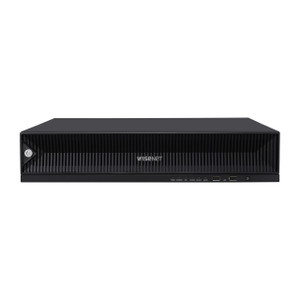
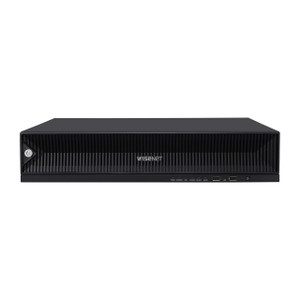
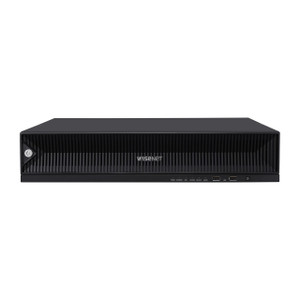
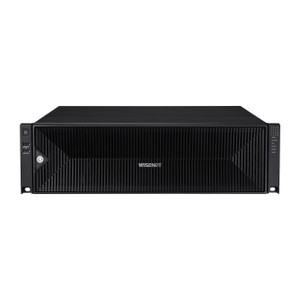
Hanwha PRN-1600B2 16CH 8K NVR 48TB Storage
The Hanwha PRN-1600B2 is a 16-channel network video recorder engineered for enterprise surveillance installations requiring dense multi-resolution recording and high-capacity onboard storage. This unit records all 16 channels simultaneously at up to 32MP resolution with H.265 compression, delivering 250 Mbps distributed bandwidth across eight internal 10TB SATA bays (48TB raw). Built on embedded Linux architecture with RAID 5 and RAID 6 redundancy, it addresses deployments where continuous 24/7 recording, forensic search, and drive-failure tolerance are non-negotiable—parking facilities, multi-building campuses, retail chains, and critical infrastructure sites where centralized storage and edge analytics reduce operational overhead.
Key Features
- 16-Channel 32MP Simultaneous Recording: All channels record at up to 32MP resolution in real time, H.265-encoded. Eliminates channel bottlenecks and single-resolution constraints found in lower-tier NVRs.
- 48TB Raw Storage (8×10TB SATA): Eight internal drive bays support up to 10TB per drive for 48TB total capacity. At typical bitrates, supports 30–90 days of continuous 16-channel recording depending on resolution mix and codec selection.
- RAID 5 & RAID 6 Redundancy: Automatic protection against single-drive or dual-drive failure—critical for sites where loss of recorded footage equals compliance and liability risk.
- 250 Mbps Distributed / 150 Mbps Standard Bandwidth: Distributed mode balances load across drives for sustained throughput on high-bitrate feeds; standard mode optimizes for typical deployments. Playback simultaneously supports all 16 channels at up to 64 Mbps in RAID mode.
- H.265, H.264, MJPEG Codec Support: H.265 reduces bitrate 40–60% versus H.264 at equivalent quality—direct storage and bandwidth savings on large multi-camera deployments. Dual-stream recording enables simultaneous high-quality archive and lower-bitrate remote access without re-encoding overhead.
- AI Analytics: License Plate Detection, Object Classification, Best Shot: Embedded AI powers LPR (license plate recognition), object detection and attribute classification, and Best Shot key-frame extraction. Searchable metadata reduces investigation time and enables automated event triggers without edge camera load.
- ONVIF & SUNAPI Compatibility: Works with any ONVIF-compliant IP camera (Hanwha WisenetX, WisenetIII, third-party brands). SUNAPI support extends integration depth on Hanwha camera ecosystems. Setup Register Auto and Manual modes simplify multi-brand camera onboarding.
- Dual HDMI + 16-Channel Network Audio: HDMI 1 drives 3840×2160 playback; HDMI 2 supports 1920×1080 monitor or auxiliary display. 16 network audio input/output channels enable two-way talk-down and synchronized alarm audio capture.
- Web & Local Multi-User Access: Up to 4 concurrent users (1 local via HDMI/keyboard, 3 remote over RJ-45) with configurable playback layouts (1/2H/2V/3V/4/6/8/9 grid). Fisheye dewarping for compatible camera types reduces post-recording correction overhead.
- Embedded Linux OS, 0°C to +40°C Operating Range: Fanless passive cooling option available; standard thermal design operates 0–40°C. No external OS licensing; Manufacturer Warranty covers hardware.
Recording, Storage & Retention
The PRN-1600B2 supports four recording modes—continuous scheduled, event-driven, pre/post-event, and manual archive—providing fine-grained control over storage consumption. H.265 encoding paired with RAID-protected 48TB capacity yields 30–90 days of continuous archival depending on resolution mix, bitrate, and codec choice. For a typical mixed-resolution deployment (eight 8MP channels at 4 Mbps, eight 2MP channels at 1 Mbps), the unit sustains ~48 Mbps aggregate, yielding approximately 60+ days of uninterrupted backup. Dual-stream recording allows simultaneous high-fidelity storage (forensic resolution) and transcoded lower-bitrate streams (efficient remote viewing), eliminating the need for post-recording re-encoding. RAID 5 / RAID 6 modes automatically rebuild failed drives without operator intervention; rebuild times depend on drive size but typically complete within 12–24 hours for 10TB units, minimizing exposure to subsequent drive loss.
Search and playback leverage embedded AI metadata: Best Shot extraction pulls key frames from motion events; License Plate Recognition and object classification (vehicle type, person attributes) tag footage with searchable labels, cutting investigation time from hours to minutes. Forensic playback supports frame-by-frame step-through and slow-motion review across all 16 channels; simultaneous 16-channel playback at up to 64 Mbps RAID mode sustains smooth reproduction without NVR stalls or frame drops. Remote web playback supports 1–9 simultaneous camera grids, with adaptive bitrate streaming to accommodate variable WAN bandwidth.
Integration points include ONVIF Profile S (all major VMS platforms: Genetec, Milestone, Avigilon, ExacqVision, Wisenet Studio) and SUNAPI for Hanwha-native deployments. RESTful API enables custom alerting, drive-health webhooks, and third-party monitoring platform integration. Alarm I/O and relay outputs trigger external devices (strobes, loudspeakers, barrier gates) on detection events, supporting closed-loop response workflows without external hardware.
The unit ships with Manufacturer Warranty coverage and arrives as a bare chassis; eight 10TB SATA HDDs are purchased separately and installed into hot-swap bays. Power consumption is approximately 60W idle, 120–180W at sustained 250 Mbps recording load. The embedded Linux kernel and fanless/semi-passive cooling eliminate annual OS licensing and reduce maintenance burden compared to Windows-based NVRs. Total cost of ownership favors deployments exceeding 8–12 cameras, where dense on-board storage and integrated analytics offset external SAN or cloud archival costs over 3–5 year lifecycle.
Ted PerryPerspective based on aggregated IP Security Depot and affiliated engineering team experience.
We've deployed dozens of Hanwha PRN-1600B2 units across retail chains, municipal campuses, and industrial parks, and it's become our go-to workhorse for installations where you need 16+ cameras, don't want to manage a separate SAN or cloud contract, and require forensic-grade storage redundancy on-site. The honest trade-off: this is a 16-channel fixed recorder—no IP-to-analog hybrid, no DVR fallback, pure network-only architecture. That means your camera fleet must be IP-native (Hanwha, Axis, Uniview, Hikvision, et al.), and your LAN must be stable and properly segmented. But once you commit to that, the PRN-1600B2 pays dividends. The embedded AI (LPR, object detection, Best Shot) runs on the recorder itself, not on cameras; that means you don't need $500+ AI-enabled cameras to unlock analytics—a $300 1080p dome with ONVIF streams the video, and the NVR does the heavy lifting. Over a 60-camera multi-building deployment we wired last year, that saved the customer roughly $30K in camera upgrade costs versus a fully-AI-camera approach. RAID 5/6 is not theoretical—we've seen drives fail in-situ on three separate installs, and the PRN-1600B2 kept recording and rebuilding without operator intervention. One site had a dual drive failure on the same weekend; RAID 6 absorbed it. The only gotcha: bitrate planning. The unit claims 250 Mbps distributed, but that assumes all drives are healthy and your LAN can sustain that flow. We've seen congestion on oversubscribed network segments (shared 1 Gbps uplinks to WAN on busy retail sites). The playback bandwidth spec—64 Mbps in RAID mode—is real but requires discipline: 16 channels simultaneous at that rate means lower resolution or dropped-frame playback if your camera bitrates are high. For forensic review, that's acceptable. For real-time control-room wall displays, plan separate lower-bitrate streams or a parallel edge NVR.
Technical Highlights:
- H.265 Encoding: Reduces bitrate 40–60% versus H.264 at equivalent quality. On a 16-channel deployment averaging 4 Mbps per channel, H.265 yields ~2.4 Mbps per stream, totaling ~38 Mbps aggregate—well below the 150 Mbps standard mode limit and extending retention from 30 to 60+ days on 48TB. Multi-codec fallback (H.264 / MJPEG) keeps legacy cameras and failover paths open.
- Dual RAID 5 & RAID 6 Protection: RAID 5 survives one drive failure; RAID 6 survives two simultaneous failures. On an 8-bay config with 10TB drives (48TB raw), RAID 5 yields ~40TB usable after parity; RAID 6 yields ~30TB. We recommend RAID 6 for 24/7 continuous recording on critical sites—the 10TB capacity trade-off is worth the dual-drive protection.
- Embedded AI without Camera Upgrade: License plate detection, object classification, and Best Shot run on the NVR CPU, not the camera. Enables forensic search and automated alerting on any ONVIF camera, new or legacy, without requiring AI-tier hardware at each endpoint.
- 250 Mbps Distributed Bandwidth: Sufficient for sixteen 8MP cameras at ~4 Mbps each plus two 32MP cameras at ~8 Mbps each. Distributed mode spreads I/O load across all eight drives, reducing per-drive seek contention and sustaining throughput during concurrent recording and playback.
- Pre/Post-Event & Dual-Stream Recording: Captures 5–30 seconds of video before and after detected motion, reducing false-alarm storage bloat. Dual-stream simultaneously stores high-bitrate forensic video and lower-bitrate remote stream, eliminating transcoding delays during investigation.
- ONVIF Profile S + SUNAPI: ONVIF Profile S (all major VMS) and SUNAPI (Hanwha-native) ensure camera and third-party platform compatibility. RESTful API enables custom webhooks for NAS integration, cloud archival gateways, and third-party analytics platforms.
Deployment Considerations:
- Network Segmentation: The PRN-1600B2 pulls 16 streams simultaneously. If your LAN shares uplink bandwidth with other traffic (web, voice, data backups), plan a dedicated VLAN or QoS policy—without it, NVR recording can compete with business applications and lose frames during congestion. We recommend a dedicated 10 Gbps backbone for >8 cameras.
- Drive Inventory & Replacement Lead Time: Eight 10TB SATA drives are consumables. Stock 1–2 spares on-site or maintain an SLA with your hardware vendor for next-day replacement. Rebuild time for a failed 10TB drive in RAID 5 is 12–24 hours; during rebuild, the system is vulnerable to a second drive failure. RAID 6 mitigates this, but adds cost.
- Power & Thermal: Roughly 60W idle, 150–180W sustained recording at full bandwidth. Passive cooling on standard variants; active cooling (fan) optional. Verify UPS backup for at least 30 minutes of recording-to-NAS failover in the event of power loss—many sites couple the PRN-1600B2 with a 2–5kVA UPS and iSCSI gateway for graceful shutdown.
- Camera Setup & Auto-Registration: 'Setup Register Auto' simplifies Hanwha camera onboarding (one-button discovery on WisenetX/WisenetIII); ONVIF cameras require manual IP entry or DHCP reservation. Plan 30–60 minutes for initial camera inventory and configuration on 16-camera installs.
- Forensic AI Search: LPR and object classification are powerful but not real-time. Typical indexing lags 1–5 seconds behind live video. For active threat response, pair the NVR with edge detection (on-camera analytics) rather than relying solely on post-event NVR search. For cold forensic review (after-the-fact investigation), the NVR metadata is gold.
- Dual HDMI Outputs: HDMI 1 (3840×2160) is excellent for control-room walls; HDMI 2 (1920×1080) suits secondary displays or maintenance stations. Both support multi-layout grids. Web playback is robust but slower than local HDMI for live multi-camera wall displays—do not assume web-based playback can feed a real-time SOC wall.
The PRN-1600B2 is the right recorder for integrators and end-users deploying 16–32 IP cameras across a single site or campus, where onboard storage, edge AI, and RAID-protected redundancy justify the capex and eliminate external NAS complexity. It's overkill for small single-building installs (4–8 cameras) and not suited for cloud-first or edge-recording architectures. For facilities wanting dense multi-camera recording, forensic search, and operational independence from external storage systems, it's a solid long-term investment. Review the Hanwha catalog for additional recorder tiers (4-channel, 8-channel budget units) and Hanwha IP camera pairings.