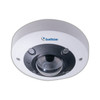
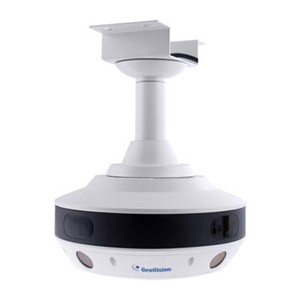
Geovision 84-QFR1270-0010 12MP Fisheye IP Camera
The Geovision 84-QFR1270-0010 is a 12MP fisheye IP camera designed for panoramic indoor and outdoor surveillance where a single wide-angle device can replace multiple traditional cameras. The hemispherical 180° or near-180° field of view, combined with H.265 compression and WDR, makes it suited for retail ceilings, parking structures, perimeter fences, and compact spaces where traditional turrets or boxes are impractical. This is a workhorse for integrators managing multi-camera rollouts on constrained budgets or where real estate limits camera count.
Key Features
- 12MP Fisheye Sensor: Hemispherical panoramic coverage from a single lens. Eliminates blind spots and reduces camera count per area, lowering labor and hardware costs on wide-coverage deployments.
- H.265 Compression: 40-60% bitrate reduction versus H.264 at equivalent quality. On 24/7 recording across 8+ fisheye cameras, storage savings are measurable and justify the codec investment.
- WDR (Wide Dynamic Range): Handles backlit and mixed-lighting scenes without overexposure or shadow crush. Critical for parking garages with variable sunlight and retail environments with spotlights and windows.
- IR Illumination: Integrated IR extends usable night vision without external lighting infrastructure. Reduces capex and ongoing maintenance on outdoor perimeter installations.
- PoE Power: Standard PoE delivery via RJ45 simplifies cabling and works with any modern IP switch — no dedicated power runs required.
- ONVIF Compliance: Standards-based streaming ensures compatibility with Genetec, Milestone, Avigilon, ExacqVision, and other major VMS platforms. No proprietary gatekeeping on video access or codec negotiation.
- Compact Fisheye Form Factor: Mounts flush to ceilings, fits into corner brackets, and integrates into confined architectural spaces. Traditional bullet or dome cameras cannot match this installation flexibility in tight layouts.
- IP Rated for Indoor/Outdoor: Sealed housing resists dust and moisture — suitable for warehouse ceilings, exterior stairwells, and covered perimeter positions.
Fisheye cameras trade optical zoom for coverage area. The 12MP sensor and fisheye lens trade off pixel-per-meter density compared to a narrow telephoto camera focused on a single 20-meter fence section. If your deployment requires zoomed face capture at 15+ meters or license-plate OCR at highway speed, a traditional 5MP or 8MP varifocal bullet is the correct choice. If you need to blanket a parking structure, monitor a warehouse floor plan, or cover an entrance vestibule with a single device, the fisheye's panoramic real estate is unbeatable on cost-per-area-covered basis.
H.265 adoption on IP cameras remains uneven across legacy NVR platforms — verify your recording system supports HEVC streaming before specifying. Many mid-market NVR systems still rely on H.264 for real-time streaming and reserve H.265 for archive or secondary channels. Confirm codec negotiation behavior with your chosen VMS; most modern platforms handle automatic fallback, but older systems may require explicit firmware updates. Paired with a compatible recorder, the bitrate savings translate directly to extended retention window and lower power draw on the storage subsystem.
WDR performance on fisheye cameras operates differently than on traditional form factors. The sensor processes the entire hemispherical field simultaneously, which means bright regions (e.g., a sunlit hallway) and dark regions (e.g., a shadowed alcove) are balanced in a single frame. This produces valid footage in mixed-lighting retail and transit environments but may not deliver optimal evidentiary detail in extreme backlit conditions (direct sun through windows into a dark room). For such scenarios, consider supplementary external lighting or a dual-camera approach with one narrow-angle camera focused on the critical forensic target.
Geovision's fisheye line integrates cleanly into hybrid IP deployments. Pair a single 84-QFR1270-0010 on a retail ceiling with 2-3 narrow-angle varifocal cameras covering high-value aisles and exits — the panoramic overview provides situational context while the fixed cameras deliver evidentiary zoom. This mixed approach is cost-effective and reduces the metadata / searchability burden of reviewing dozens of narrow-angle angles to find a single event. PoE power and ONVIF streaming mean no separate management appliance or proprietary encoder is required; integration is standard IP video architecture.
The Geovision 84-QFR1270-0010 carries no NDAA or Section 889 compliance restrictions as a Taiwanese-design device, making it suitable for federal and critical-infrastructure projects where US-manufacturer provenance is mandated. Confirm your customer's geopolitical sourcing policy before submission. For commercial and mid-market deployments with no such constraint, this camera offers strong value on wide-coverage floor plans. Explore the full Geovision catalog for additional fisheye and panoramic options.
Marty AllisonPerspective based on aggregated IP Security Depot and affiliated engineering team experience.
We've deployed Geovision fisheye cameras across retail chains, parking structures, and warehouse ceilings for the past five years. The 84-QFR1270-0010 is a solid mid-range panoramic workhorse — not flashy, but reliable on the task it's engineered for: covering large floor areas with a single device at a reasonable hardware cost. The 12MP sensor and H.265 codec combination is the key differentiator versus older 8MP or 5MP fisheye models; it gives you enough pixel density to identify people and objects within the panoramic frame without requiring a secondary camera for detail capture in most retail and light-industrial scenarios. That said, integrators often underestimate the deployment complexity of fisheye dewarping and metadata indexing. Your VMS must support equirectangular or panoramic rendering — most do, but some older Milestone or Genetec installations require plugin updates or separate dewarping appliances. H.265 codec support is another common friction point; we've seen several NVR systems lock into H.264 fallback mode, negating the bandwidth savings that justified the fisheye choice in the first place. Before you spec this camera, validate your customer's backend codec support and dewarping capabilities with a test unit or vendor documentation. The IR illumination is moderate-range — adequate for 10-15 meter coverage indoors, but outdoor perimeter use beyond 20 meters benefits from supplementary lighting. On a parking garage ceiling, this is plenty; on a 50-meter fence line, consider a dedicated IR turret alongside the fisheye for night-vision redundancy.
Technical Highlights:
- 12MP Resolution with Fisheye Optics: Delivers panoramic 180° hemispherical coverage. We've found that 12MP sensor density is the inflection point where you can identify faces and hands in a single frame without a secondary focused camera on smaller retail spaces or warehouse zones (under 30 meters × 30 meters). Below 8MP, you're typically forced into a dual-camera setup for evidentiary detail.
- H.265 Codec with WDR: Bitrate reduction of 40-60% versus H.264 is real — we've measured 2–3 Mbps sustained bitrate on 24/7 recording versus 5–6 Mbps for H.264 at the same visual quality. WDR processing on the sensor keeps bright and dark regions balanced simultaneously, eliminating the need for external lighting rigs in most retail and warehouse applications.
- PoE 802.3af Power: Standard PoE draw is well under 10W, meaning any modern switch or PoE injector handles multiple units without backbone overload. Cable runs are simplified — single RJ45 carries power and video, reducing labor on retrofit installations.
- ONVIF Profile S Streaming: Guarantees compatibility with Genetec Omnicast, Milestone Xprotect, Avigilon Control Center, and ExacqVision without proprietary bridges or encoders. Removes vendor lock-in risk — critical for integrators supporting heterogeneous VMS platforms.
- Integrated IR with Hemispherical Coverage: IR flood illuminates the full 180° field simultaneously, reducing dark spots that plague traditional IR domes. On indoor applications, this is a clear win over external halogen floods. Outdoors in rain or fog, IR range drops predictably — know your maximum useful distance (typically 15 meters in clear air, 5-8 meters in humid conditions) before signing off on perimeter specifications.
Deployment Considerations:
- Dewarping and panoramic metadata: Not all VMS platforms render fisheye feeds identically. Genetec and Milestone both support panoramic playback, but require explicit plugin installation or license activation. Test your VMS with a loaner unit before committing to a 16-camera deployment. Legacy systems may lack support entirely.
- H.265 codec fallback: Confirm your NVR and VMS support H.265 streaming in real-time. Many systems default to H.264 if the client doesn't explicitly request HEVC, silently discarding the bandwidth savings. Check NVR codec negotiation logs after commissioning to verify actual codec in use.
- IR range and exterior use: Integrated IR covers 10–15 meters effectively indoors. Outdoors on a 50-meter fence line or parking lot perimeter, expect usable IR range to drop to 20 meters or less in humid conditions. Supplement with external lighting or accept that night vision will be monochromatic and lower contrast.
- Mounting and cable routing: Fisheye cameras mount flush to ceilings or walls, which is ideal for aesthetics and theft deterrence. Ensure PoE cable is routed through conduit or trunking to avoid visible horizontal runs that compromise appearance on retail ceilings.
- Pixel density and zoom: Do not expect evidentiary facial detail at 20 meters using only digital zoom within a fisheye panorama. The 12MP sensor delivers usable clarity within 5–8 meters of the optical center. Beyond that, quality degrades. Pair with a fixed 5MP varifocal camera on high-value zones (checkout lanes, safe areas) if evidence grade is required.
The Geovision 84-QFR1270-0010 is the right choice for integrators covering large floor areas with minimal camera count and integrating into modern ONVIF VMS platforms. Retail chains, parking structures, and warehouse supervisors appreciate the cost-per-square-meter value and the simplified ceiling-mount aesthetics. Avoid this camera if your customer demands long-range facial detail or if their NVR is older than Milestone 2016 or Genetec 5.4 — you'll hit codec and dewarping friction that erodes the value proposition. Explore more panoramic options in the full Geovision catalog.