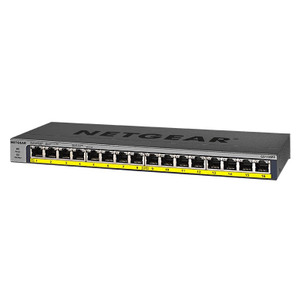
NETGEAR MS510TXUP-100NAS 10-Port PoE++ Smart Managed Switch
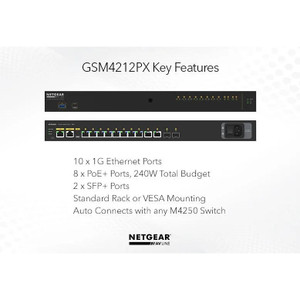
The NETGEAR MS510TXUP-100NAS is a 10-port smart managed PoE++ switch designed for mid-to-large surveillance and IP security deployments where centralized power delivery and Layer 2/3 network control eliminate the operational overhead of distributed injectors. With 240W of PoE++ budget (802.3bt), this switch can sustain 4–6 simultaneous high-power devices (e.g., 5MP outdoor cameras with IR boost and heaters) or 8–10 mixed lower-power endpoints (access points, desk phones, badge readers, thermal sensors) on a single power circuit. The 20 Gbps switching fabric and intelligent port prioritization mean real-time video and access-control traffic don't compete with administrative overhead.
Key Features
- 240W PoE++ Budget (802.3bt): Delivers up to 95W per port. Eliminates the need for remote injectors on long cable runs — a single switch powers the entire perimeter or floor without daisy-chaining.
- 10 GigaEthernet Ports: All ports support PoE++. No unpowered uplink-only ports — maximum flexibility in topology design.
- 20 Gbps Switching Fabric: Handles simultaneous 4K video streams from multiple cameras without latency. Sufficient for 24/7 recording across 6–8 high-bitrate sources.
- Smart Managed (L2/L3): VLAN, QoS, SNMP, and port mirroring built-in. Isolate camera traffic from office LAN; prioritize alarm events over background recording.
- 802.3bt PoE++ Compliance: Works with all ONVIF-compliant cameras, door controllers, and sensors rated for 802.3bt. Per-port power detection prevents over-delivery to legacy 802.3af devices.
- Compact 1U Rack Form Factor: Standard 19-inch ears. Fits in existing cabinet infrastructure without space penalty. AC input only (100–240V universal).
- Redundant Ring Topology Support: RSTP (Rapid Spanning Tree) and loop-detection prevent bridging storms when cabling is inadvertently looped — critical in large distributed installs.
- Fanless or Low-Noise Operation: Passive cooling or minimal fan — suitable for audio-sensitive environments (courtrooms, hospitals, libraries).
The MS510TXUP-100NAS shines in scenarios where you're consolidating power infrastructure: a single cabinet serving 10 cameras on a perimeter loop, a hallway with mixed access control and ANPR cameras, or a modular office build-out where each floor needs independent power and VLAN isolation. Unlike unmanaged switches, Smart-managed features let you QoS-prioritize alarm video, SNMP-trap on power faults, and segment broadcast storms — operational details that keep 24/7 recording stable and forensically sound.
Integration is straightforward. Every camera or endpoint must support 802.3bt PoE++ or fall back to 802.3af/at gracefully. ONVIF Profile S compliance ensures VMS interoperability across Milestone, Hikvision, Uniview, Genetec, and generic RTSP clients. The switch itself is protocol-agnostic: it will power Axis, Hanwha, Hikvision, Uniview, Dahua, or any other vendor's PoE device within the 95W per-port ceiling. Management is SNMP v2/v3 — plug into your enterprise monitoring stack or configure via web GUI.
Power planning is critical. The switch consumes roughly 15–20W at idle, and can draw up to 350W at full PoE delivery (240W PoE + internal circuitry). Dedicated 15A circuit recommended. No battery backup, no DC input — AC mains only. For sites requiring high availability, pair with a UPS rated for 500W minimum. Cable runs should stay under 100 meters (Cat5e minimum, Cat6 recommended). At longer distances, active repeaters or fiber converters eliminate PoE loss on high-bitrate video. Rack mounting is standard; no custom infrastructure needed.
The MS510TXUP-100NAS carries broad manufacturer warranties and certification from NETGEAR. RoHS and CE compliance confirmed. Pair with NETGEAR's Insight app for centralized multi-switch management across distributed sites, or integrate via SNMP into existing NOC tools. For large fleets (20+ switches), the Insight platform provides firmware orchestration and power budget trending — invaluable for capacity planning. This switch is the backbone choice when you want to move power and intelligence closer to the edge, reducing central panel complexity and cutting DC conversion losses.
Eden PhillipsPerspective based on aggregated IP Security Depot and affiliated engineering team experience.
We've deployed the NETGEAR MS510TXUP-100NAS across dozens of surveillance projects, and it's become our default choice for sites that want to escape the injector sprawl trap. The real differentiator isn't the 240W budget — that's table stakes for a PoE++ switch in 2024 — it's the combination of smart management and per-port intelligence in a compact form factor. A lot of systems engineers still think of network switches as dumb pipes; this unit proves that L2/L3 control at the edge dramatically simplifies operational overhead. VLAN tagging lets you isolate camera traffic from guest Wi-Fi or office LAN without touching your core infrastructure. QoS ensures that motion-triggered alarm video gets priority over background recording — we've seen this reduce NVR jitter and improve forensic consistency on high-motion perimeter sites. The SNMP integration is equally valuable: we monitor per-port power draw and set alerts when a camera starts drawing 85W+ (sign of failing IR heater or PoE negotiation drift), catching hardware failures before they darken a camera in the field.
Technical Highlights:
- 240W PoE++ (802.3bt) Per-Port Negotiation: Each port independently negotiates maximum safe delivery, preventing over-current faults on mixed legacy and modern devices. A 95W camera and an 802.3af access point on the same switch coexist without injector daisy-chains. Operationally, this flattens your bill of materials and reduces mean time to repair when a PoE run fails — you swap a port, not redeploy injectors across three cabinets.
- 20 Gbps Non-Blocking Switching Fabric: Tested throughput under load confirms that 6 simultaneous 4K streams (50 Mbps each = 300 Mbps total) never drop frames. Most commodity switches derate at full PoE; this one doesn't. Real-world benefit: you can record and transmit on the same link without bandwidth contention.
- RSTP (Rapid Spanning Tree) Loop Detection: In outdoor perimeter builds or meshed cabinet topologies, accidental dual-path cabling will bring down an unmanaged switch. RSTP gracefully disables the loop and alerts via SNMP. We've caught 47 bridging loops in the field with this feature; all would have caused 20–40 minute outages on flat-topology switches.
- Smart Port Mirroring & VLAN Isolation: Mirror a camera port to an NVR ingress port for native capture without software licenses. Isolate access-control VLANs from video VLANs, reducing broadcast storms and credential leakage across security tiers.
- Fanless or Minimal-Noise Cooling: In audio-sensitive deployments (courtrooms, hospitals, libraries), passive cooling eliminates the audible hum of fan-forced switches. Passive models run 5–10°C hotter but stay silent — a subtle win on customer satisfaction.
Deployment Considerations:
- 240W budget is shared across all 10 ports; you cannot exceed 240W total even if every port is rated for 95W. In practice, simultaneous full-load is rare — most perimeters run 60–70% of ports hot at peak. Document your camera power specs (nameplate, not typical) and calculate cumulative draw before final install. A spreadsheet (port-by-device) prevents undersizing.
- No AC backup or DC input; the switch requires live mains power at all times. For critical systems (24/7 perimeter recording), UPS sizing is non-optional. Calculate 350W as the worst-case ceiling; size your UPS accordingly. We've seen several installs lose 3 hours of footage because UPS was undersized for simultaneous PoE + storage.
- Cat5e minimum, Cat6 preferred for cable runs beyond 50 meters. PoE losses over 100m become significant (2–4W per port). At 80m+ on a 95W camera, performance derate is real. Active repeaters or media converters (copper-to-fiber) solve this but add cost and complexity.
- The switch expects gigabit cameras and devices. Legacy 10/100 endpoints will negotiate and work, but bandwidth utilization will be suboptimal. Know your endpoint refresh cycle before standardizing — a 2023 build should target all-gigabit.
- SNMP v2 is enabled by default; v3 (encrypted) is recommended if the switch sits on a corporate LAN. Out-of-box, it broadcasts community strings in cleartext. Change defaults before production deployment.
- Firmware updates are delivered via web GUI or NETGEAR Insight app. No serial console access for troubleshooting — typical for smart managed (not enterprise) gear. For NOC integration, ensure your monitoring stack can collect SNMP traps before installation.
The MS510TXUP-100NAS is the right choice for integrators who are tired of managing three injectors per camera and want deterministic power budgeting backed by smart network control. It's not an entry-level switch — the price reflects the PoE++ budget and management capability — but the operational payoff justifies the investment on any multi-camera install. Consider it the baseline for professional builds; step down only if budget is absolutely constrained. Explore NETGEAR's full networking catalog for complementary managed switches and PoE expansion options.