Hanwha HV-X540L-28XS-10 10G Layer 3 Stackable Switch
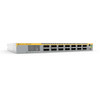
The HV-X540L-28XS-10 (often searched as HV X540L 28XS 10) is a carrier-grade 10 Gigabit Layer 3 stackable switch engineered for high-speed backbone and distribution networks in large-scale surveillance and enterprise deployments. Unlike hybrid switches mixing copper and fiber ports, this platform delivers all-fiber architecture: every one of its 28 ports runs 10 Gigabit speed via SFP/SFP+ transceivers. This eliminates the bandwidth bottleneck that kills performance when you scale beyond 50–100 cameras — a single oversubscribed copper uplink can starve entire camera arrays during peak recording events. With fiber-only design, you maintain consistent sub-millisecond latency and full 10G throughput across the entire fabric, even in high-EMI industrial environments where twisted pair copper introduces noise, reflections, and distance-dependent signal loss.
Key Features
- All-Fiber 10G Port Array: All 28 ports support 10 Gigabit speed — no mixed-speed tiers, no oversubscribed backplane. This matters because a congested uplink can bottleneck dozens of simultaneous camera streams. Fiber topology also extends reach to 10 km (multimode) or 40+ km (single-mode) per standard SFP/SFP+ transceiver, solving long-distance backbone runs between buildings or across warehouse campuses without requiring active repeaters or signal conditioning.
- Layer 3 Routing Protocols (Static, RIP, OSPF, BGP): Native routing support eliminates the need for separate external routers in multi-site deployments. For a 200-camera system spread across three warehouse buildings, you can run OSPF or BGP directly on the HV-X540L-28XS-10 to segment camera VLANs, enforce QoS policies, and load-balance traffic — all without adding dedicated routing appliances or licensing complexity.
- Virtual Chassis Stacking (Up to 41 Units): Deploy one switch per building or aggregation point and manage the entire fabric as a single logical device. Zero inter-switch configuration drift, unified command-line interface, and centralized monitoring reduce operational overhead dramatically compared to managing three independent switches with separate configs, passwords, and firmware versions.
- EPSRing + G.8032 Automatic Protection: Ethernet Protection Switched Ring creates a resilient loop topology where a fiber cut between any two switches triggers automatic failover in milliseconds — no manual intervention, no separate ring-protection appliance. If your primary link between Building A and Building B fails, traffic automatically reroutes through the remaining fiber connections with zero packet loss to recording or live views.
- AMF-Security with Automatic Threat Isolation: Detects and quarantines compromised devices (hijacked camera, rogue PoE injector, infected edge appliance) without manual hand-off. The switch automatically isolates the offending port or VLAN, limiting lateral movement and reducing your exposure window — critical for surveillance networks where a single breached camera could expose credentials, recordings, or system topology.
- ONVIF Compliance & Hanwha Integration: Works seamlessly with any ONVIF-compliant IP camera and optimized for Hanwha network cameras, ensuring vendor flexibility. Native support for Hanwha camera management and analytics integration means you can deploy industry-standard cameras without proprietary gateway appliances or licensing overhead.
Integration & Compatibility
The HV-X540L-28XS-10 integrates with standard SFP and SFP+ transceivers (copper RJ-45 or fiber optic modules), allowing you to mix multimode and single-mode fiber on the same switch as needed. Works with any ONVIF Profile S, T, or G device — cameras, encoders, intercoms, or appliances. Pair this switch with a network video recorder or VMS running on your management VLAN for centralized configuration and monitoring across all 28 ports.
When to Choose This Model
Select the HV-X540L-28XS-10 if you are deploying 100+ cameras across multiple buildings, require inter-building fiber backbone connectivity, need automatic ring protection without manual failover intervention, or operate in high-EMI industrial environments where copper runs are unreliable. If your deployment is a single facility with fewer than 20 cameras and a 1G copper network backbone is acceptable, a standard managed Gigabit switch will suffice and cost significantly less. The fiber-only design also assumes you have in-house fiber termination expertise or a qualified contractor — if you lack that, plan for additional commissioning time and training.
Frequently Asked Questions
Q: Can I use copper RJ-45 connections with the HV-X540L-28XS-10?
A: No — all 28 ports are SFP/SFP+ fiber-only. You must use SFP or SFP+ transceivers. However, you can deploy copper SFP transceivers (1GbE copper SFPs) if you need to downgrade a particular port to 1 Gigabit and use RJ-45 termination, though this defeats the fiber-only architecture benefit and will create a bottleneck on that port.
Q: How many cameras can this switch support?
A: With 28× 10G ports and assuming 10–50 Mbps per camera stream (depending on resolution and frame rate), a single HV-X540L-28XS-10 can handle 100+ simultaneous high-bitrate streams. Stacking up to 41 units via Virtual Chassis scales the fabric to 1,148 ports — suitable for enterprise-scale multi-building surveillance networks.
Q: What is Virtual Chassis stacking, and why does it matter?
A: Virtual Chassis lets you manage up to 41 switches as one logical entity. Instead of configuring three separate switches in three buildings with individual IP addresses, passwords, and firmware versions, you configure one virtual device and push policies to all 41 members simultaneously. This drastically reduces operational touch points and eliminates inter-switch configuration drift.
Q: Does the HV-X540L-28XS-10 support SNMP or syslog for monitoring?
A: Yes — standard SNMP v1/v2/v3 and syslog are supported. Integrate with your network monitoring platform to track port utilization, link status, and thermal alerts across all stacked units.
Q: What happens if a fiber link between two stacked switches fails?
A: EPSRing topology automatically reroutes traffic through the remaining fiber connections in milliseconds. The switch detects the failure, blocks the failed link to prevent loop formation, and resumes normal forwarding on alternate paths — all without manual intervention or loss of service to cameras on the affected buildings.
Q: Can I deploy this switch in a small single-building network?
A: Technically yes, but it is overspecified for that use case. If you have fewer than 20 cameras in one location and your network backbone is primarily 1 Gigabit copper, a standard managed switch with a few 10G uplink ports will be more cost-effective and simpler to deploy and maintain.
Ted PerryPerspective based on aggregated IPSD and affiliated engineering team experience.
The HV-X540L-28XS-10 solves a specific infrastructure problem: traditional copper Gigabit switches cap out around 40–60 cameras before you hit bandwidth saturation on the uplinks or backplane. The moment you push H.265 streams from 100+ cameras at 15–30 fps, frame drops and latency creep in. This all-fiber, Layer 3 architecture removes that ceiling entirely — 28× 10G ports with no oversubscription means you're not trading speed between ports the way you do with a 48-port copper switch sharing a 320 Gbps backplane.
Technical Highlights:
- All-Fiber 10G Architecture: Zero bottleneck between any two ports. A 5MP @ 30 fps stream uses roughly 40–50 Mbps; a 4K @ 15 fps uses 80–120 Mbps. With 28 ports at full 10 Gbps each, you can run 200+ simultaneous high-bitrate streams without dropping a frame. Compare that to a standard copper switch where six cameras on one uplink can starve the entire recording backend.
- OSPF/BGP Routing Native: Running OSPF across three buildings means you segment camera VLANs at the switching layer, not in a separate router. QoS policies enforce per-VLAN bandwidth caps, preventing a runaway analytics server from starving live view traffic. This is not a convenience — it's the difference between a stable, predictable network and one that degrades under load.
- EPSRing with G.8032 Failover: Ring protection detects a broken fiber in milliseconds and reroutes without manual intervention. For a warehouse with cameras on three buildings and one fiber run between each pair, a single cut brings down one link; EPSRing keeps all three sites communicating through the two remaining paths. That's high-availability networking without buying separate ring appliances.
Deployment Considerations:
- Fiber termination is not plug-and-play. You need qualified technicians or contractors familiar with SC, ST, or LC connectors, fusion splicing (if doing new runs), and optical power testing. Factor this into your timeline and budget — a mismatched or poorly cleaved fiber end will silently lose signal and cause intermittent link flaps.
- SFP/SFP+ transceiver cost adds up. Budget $500–2,000 per switch depending on transceiver type (copper SFP, multimode LC, single-mode, etc.). Do not underestimate this. A 41-unit stack needs 41 × 28 = 1,148 transceiver ports; if you're not careful with inventory, you'll have dead ports.
- Virtual Chassis stacking requires compatible hardware and careful firmware coordination across all 41 units. If one unit is running an older firmware version, the stack can fail to form. Plan for a staged firmware update process and test stacking in a lab before production rollout.
Use this switch if you own the fiber infrastructure or have a roadmap to install it, you operate across multiple buildings or campuses, and you're recording 100+ cameras with continuous or high-bitrate compression. It is the right tool for a large surveillance backbone and will scale with minimal management overhead. Skip it if you're building a single-site network with under 20 cameras — a standard managed Gigabit switch and one or two 10G uplinks will serve you far better at a fraction of the cost.