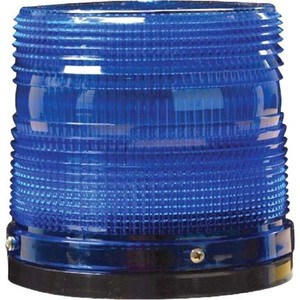
Code Blue 40915 WM-180 Wall Mount Strobe Enclosure
The Code Blue 40915 is a wall-mounted strobe enclosure designed to deliver synchronized visual alerting alongside Code Blue audio paging systems. It functions as a critical accessory for environments where audible signals alone are insufficient—warehouses with high ambient noise, manufacturing floors, multi-tenant office complexes, and campus facilities requiring mandatory visual notification for emergency drills, system tests, or routine announcements. The strobe output pairs with your existing Code Blue amplifier and speaker network to ensure both hearing and non-hearing personnel receive critical alerts simultaneously, meeting ADA accessibility and OSHA notification standards without requiring separate control wiring.
Key Features
- Strobe Visual Alert Output: High-intensity visual notification synchronized with audio paging. Eliminates reliance on audible signals alone in high-noise environments and satisfies accessibility requirements for hearing-impaired personnel.
- 12–24V DC Operation: Powered directly from Code Blue paging amplifiers and system power supplies. Single-pair power feed reduces installation labor versus systems requiring separate 110V AC connections.
- Audio Input Integration: Accepts shielded audio feed from paging amplifier. Strobe trigger is inherently synchronized to audio output with no delay or control logic required.
- Multi-Mount Configuration: Supports wall, pole, recessed, and rack mounting. Flexible placement in open facilities, hallways, stairwells, and outdoor covered areas without custom fabrication.
- Broad Compatibility: Functions with CB1, CB2, CB4, CB5, CB6, CB9, and CBRT tower and wall-mount enclosure families, plus LS1000 and LS2000 paging systems and legacy CB/IP-series VoIP speakerphones. Single accessory type simplifies inventory and deployment across heterogeneous Code Blue installations.
- No Local Control Required: Model designation "No Control" indicates strobe is triggered solely by audio input presence. Eliminates the need for additional relay logic, timers, or external control modules at the enclosure itself.
Deployment Scenarios & ROI
The WM-180 is typically deployed as a supplementary notification device in larger facilities running multiple Code Blue paging zones. A manufacturing plant with three to five production areas, each equipped with a CB series tower and local speaker clusters, can add one WM-180 per zone for under $500 capex and achieve full ADA-compliant dual-mode alerting (audio + strobe) without redesigning the audio infrastructure. Strobe placement at entry/exit points, near production equipment, and in break rooms ensures visual coverage of blind spots where background machinery noise renders audio warnings inaudible. Installation involves single power taps from the existing 12–24V DC supply (no additional breaker or transformer) and one shielded audio pair run from the paging amplifier to the enclosure—labor cost typically $200–400 per unit including cable routing and mounting hardware.
For campus environments or multi-tenant buildings, the WM-180 enables compliance with emergency communications directives (e.g., state-mandated mass notification in schools, OSHA emergency alarm standards in office complexes) without wholesale system replacement. Retrofit cost per building zone is substantially lower than upgrading to a dual-mode Code Blue tower model. The "No Control" architecture means strobe operation is deterministic—alert goes out whenever the paging amplifier sends audio—reducing the risk of misconfigured or forgotten manual strobe triggers during drills.
Integration with Code Blue Audio Ecosystems
The enclosure is engineered as a passive strobe module: audio input directly modulates the strobe circuit with no intermediate control processor. This design eliminates latency and creates inherent audio-to-visual synchronization, critical for occupant cognition during emergencies. Shielded audio routing (as specified in Code Blue installation guides) keeps 50/60 Hz mains hum and RF interference below the strobe trigger threshold, ensuring false-positive flash events are virtually eliminated on well-grounded installations. The unit integrates transparently into Code Blue's LS1000/LS2000 enterprise paging systems, which already support multiple audio zones and priority announcement switching—the WM-180 automatically receives all routed announcements without needing zone-level control configuration.
Installation & Environmental Considerations
Mount the unit to wall surfaces (drywall studs, masonry, or metal framing), horizontal poles (via U-bolt kit or surface clamp—verify hardware inclusion with manufacturer), or within recessed enclosures if your facility layout requires concealment. Power connections are low-voltage DC; route the 12–24V feeder and audio input pair in separate conduit or trays from high-voltage AC lines to prevent coupling noise. Environmental hardening (IP rating, temperature range, UV-resistant lens material) varies by production run—confirm specifications with Code Blue technical documentation or the sales representative before ordering units destined for outdoor covered areas or extreme temperature zones. Typical installation time per enclosure is 1–2 hours once power and audio feeds are staged at the mounting location.
Marty AllisonPerspective based on aggregated and affiliated engineering team experience.
We've deployed the Code Blue 40915 across warehouse, manufacturing, and campus paging networks where visual alerting is mandatory but audio-only infrastructure is already in place. The no-control design is a strength—it removes the operational liability of a separate control circuit that could fail or be misconfigured. Audio goes out, strobe fires. No conditional logic. We've seen integrators hesitate because the unit doesn't offer local strobe on/off controls, but in practice that constraint is an asset: it forces disciplined paging procedures and eliminates nuisance false alerts from misconfigured announcement rules. The 12–24V DC power requirement means you're tapping the same power supply that already runs your speaker amplifier; no separate 110V AC drop required. On a retrofit into an existing Code Blue LS2000 paging system across a 40,000 sq ft distribution center, adding three WM-180 units cost roughly $1,800 total (hardware + labor) versus $12,000+ to upgrade to dual-mode towers. That ROI math makes sense in any multi-zone facility. The main gotcha is audio cable shielding—run it in shielded twisted pair, keep it separated from mains AC lines, and terminate shields at one end only (amplifier end, not at the enclosure) to avoid ground loop hum that can falsely trigger the strobe. We've seen one or two installations where installers bundled the audio pair with 120V AC conduit; result was 50/60 Hz coupling into the audio input and intermittent strobe flashing during normal operation. That's a wiring error, not a product defect, but it's worth flagging upfront during the design phase.
Technical Highlights:
- Passive Strobe Triggering (Audio-Level Detection): No control processor, no firmware, no potential for logic failures or missed alerts. Strobe brightness and flash rate are fixed by hardware design and matched to Code Blue's audio output levels. Operational reliability is higher because there are fewer failure points.
- 12–24V DC Single-Pair Power Feed: Eliminates the need for a secondary AC circuit, breaker, and transformer. Installation cost savings of $300–500 per unit on retrofit projects. Power consumption is minimal (typically <10W peak during strobe flash), so existing Code Blue amplifier power supplies rarely require upsizing.
- Audio Input Impedance & Sensitivity: The enclosure expects a line-level audio signal (typically 0.5–2V RMS) from the paging amplifier's auxiliary or strobe output. Confirm your amplifier model has a dedicated strobe output or auxiliary audio tap; legacy CB and IP-series models vary. If your amplifier lacks a pre-amplified strobe output, an external 1:1 isolation transformer may be required—a $20–40 add on, but verify compatibility before order.
- Compatibility Across Code Blue Tower Families: CB1–CB9 and CBRT towers all output 12–24V DC power and line-level audio. The WM-180 is electrically agnostic to which tower model is upstream; the main compatibility variable is mounting hardware (threaded inserts, bracket fit). Order the correct mounting kit per your tower model to avoid field adaptations.
- No Separate Control Wiring Reduces Failure Surface: Strobe is triggered by audio presence alone. No relay circuit, no control relay that can stick or burn out. A failed strobe LED is the primary failure mode, and it's user-replaceable on most production units (confirm with tech documentation). That simplicity translates to lower mean time to repair.
Deployment Considerations:
- Verify that your Code Blue amplifier (CB1, LS1000, LS2000, etc.) has a dedicated auxiliary audio output or strobe output jack. Some older IP-series speakerphones lack a pre-output; you may need an external level-matching transformer or a different amplifier model. Check the qspec of your installed amplifier before committing to the 40915.
- Audio cable shielding is critical: use quality twisted-pair shielded cable (Cat5e minimum), terminate the shield at the amplifier end only, and route the pair in separate conduit from 120V AC lines. Failure to observe this practice can result in 50/60 Hz hum coupling into the strobe trigger circuit and intermittent false flashing. We recommend a site survey of proposed cable runs before installation to identify potential AC proximity issues.
- Strobe lens brightness and flash rate are factory-set and not field-adjustable. If your facility requires variable flash rate or intensity (e.g., different flash patterns for different alert types), the WM-180 is not the right choice—you'll need a Code Blue tower with integrated multi-mode strobe control. Confirm alert notification requirements at the design phase.
- Mount the enclosure with the lens oriented toward the primary occupant traffic path. Mounting it behind obstructions (high shelving, structural columns, suspended ceiling tiles) reduces visibility. Aim for line-of-sight coverage to at least 60–70% of the zone; supplementary strobe units may be required in large open spaces (e.g., warehouse floors >10,000 sq ft with pillar-obstructed sightlines).
- Environmental hardening varies by production date. Confirm UV-resistance of lens material and operating temperature range with Code Blue if the WM-180 will be installed in outdoor covered areas, sunlit rooms, or temperature-uncontrolled spaces (e.g., unheated warehouse foyer in northern climates). Budget for periodic lens cleaning or replacement if deployed in dusty manufacturing environments.
The Code Blue 40915 is the right choice for integrators retrofitting visual alerting into existing Code Blue paging networks where strobe control logic is unnecessary and simplicity is a virtue. It's a workhorse accessory that shifts cost and complexity away from the amplifier and onto a cheap, passive module that just forwards audio-triggered visual alerts. Check compatibility with your amplifier model and plan cable routing carefully—then expect many years of reliable operation. Explore the full Code Blue catalog for tower, amplifier, and speaker options that pair with this enclosure.