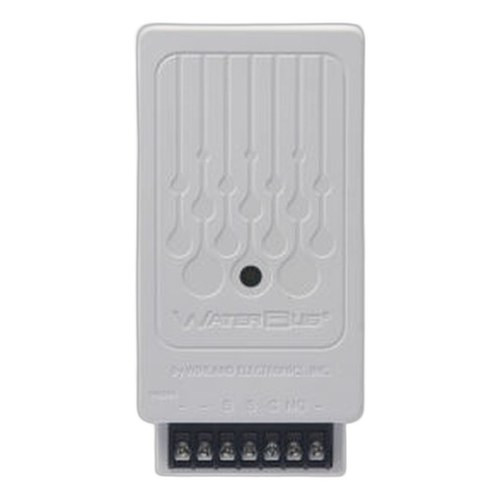
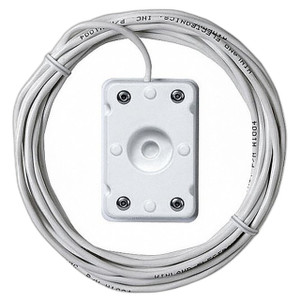
Winland WB-350 Unsupervised Water Sensor
Overview
The Winland WB-350 is an unsupervised water detection sensor designed for environmental monitoring in facilities where water damage prevention is critical. Operating on 9VDC, the WB-350 provides standalone water detection capability without requiring external supervision or continuous network connectivity. This makes it suitable for distributed deployment across multiple monitoring points in data centers, server rooms, mechanical spaces, and other infrastructure environments where water intrusion poses operational risk.
Key Features
- Unsupervised Operation: Functions independently without requiring a supervised control panel or network connection for primary detection
- 9VDC Power Supply: Low-voltage DC operation simplifies installation and integration with existing power infrastructure
- Water Detection Capability: Detects presence of water at sensor probe, enabling rapid response to potential flooding or leaks
- Environmental Sensor Classification: Classified within environmental sensor product category for facility infrastructure monitoring
- Standalone Deployment: Can be positioned at critical points without dependency on central management systems
- Facility Protection: Supports broader environmental monitoring strategy for data centers, server rooms, mechanical spaces, and utility areas
Technical Specifications
The WB-350 operates at 9VDC, making it compatible with low-voltage DC power sources common in facility infrastructure. As an unsupervised sensor, it does not require integration with a central alarm or access control panel to function. The device is engineered for environmental sensing applications where detection of water presence is the primary function.
Integration & Deployment
The WB-350 is designed as a point-detection sensor that can be deployed in multiple locations across a facility. Integrators should position sensors at floor level or in areas prone to water accumulation, such as under HVAC units, near water lines, in cable trays, or in basement areas. The unsupervised architecture means each sensor operates independently; however, organizations may choose to integrate sensor outputs with building management systems or security platforms that accept water detection signals for centralized alerting and logging purposes.
The 9VDC requirement means power can be supplied via standard DC power supplies, battery backup systems, or integration with existing low-voltage infrastructure. This flexibility supports retrofit installations in facilities with established power distribution systems.
Use Cases
Typical deployments include data center environmental monitoring, server room protection, mechanical equipment spaces, and utility areas. Security integrators and facility managers use the WB-350 as part of comprehensive environmental monitoring strategies to detect water leaks before they cause equipment damage or operational downtime.
Ted PerryPerspective based on aggregated IP Security Depot and affiliated engineering team experience.
I've specified the Winland WB-350 in several data center and server room protection projects. The unsupervised architecture is valuable for distributed monitoring where you need detection at multiple points without requiring a central panel at each location. The 9VDC requirement keeps installation straightforward and compatible with standard low-voltage infrastructure.
Technical Highlights:
- Unsupervised Detection: The WB-350 operates independently, making it ideal for point monitoring in facilities where centralized supervision may not be practical or cost-effective
- Low-Voltage DC Power: 9VDC operation integrates cleanly with existing facility power and backup systems, reducing installation complexity
- Environmental Sensor Category: Positioned within environmental monitoring product class, suitable for infrastructure protection applications
Deployment Considerations:
- Position sensors at low points where water would accumulate—under HVAC units, near floor drains, and in cable management areas
- Confirm power availability and plan for battery backup or UPS integration if 24/7 monitoring is required during facility power loss
- For facilities requiring centralized alerting, evaluate integration with building management systems or security platforms that accept dry-contact or signal inputs from water sensors
- Test sensor placement during installation to ensure probe positioning captures water at all critical locations
The WB-350 is a solid choice for organizations implementing layered environmental protection. In retrofit situations, its unsupervised design and low-voltage power requirements make it easier to deploy than sensors requiring network connectivity or complex integration.