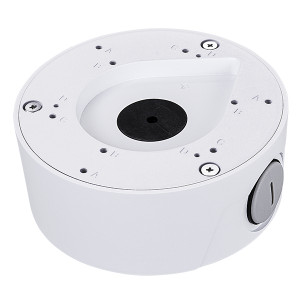
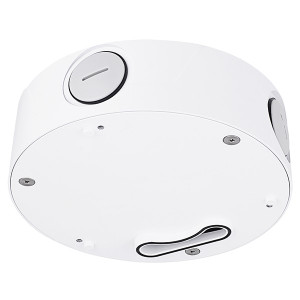
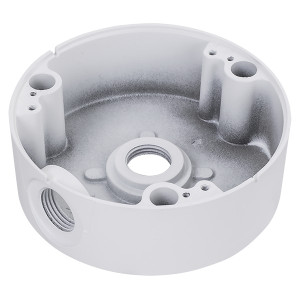
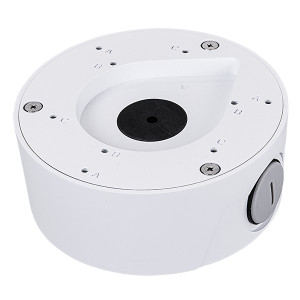
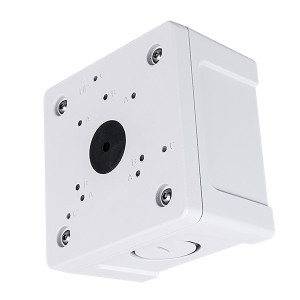
Vivotek AM-71G Outdoor Conduit Box
The Vivotek AM-71G is an aluminum conduit enclosure designed to protect splitter terminals, PoE adapters, and junction wiring on outdoor camera installations. Built from corrosion-resistant aluminum alloy and sealed to IP66/IP67, this box eliminates water ingress into electrical connections during heavy rain, wash-down operations, and seasonal freeze-thaw cycles. It fits Vivotek's FD and IB series turrets and housings via a standard 3/4" PF pipe thread, making it the go-to conduit solution for integrators deploying multi-camera perimeter or facade surveillance in coastal, industrial, or high-humidity environments.
Key Features
- IP66/IP67 Environmental Sealing: Dust and jet-water ingress protection rated to IP67 (temporary immersion). Eliminates corrosion risk to terminal blocks and splitter connectors.
- Aluminum Alloy Construction: White-finish aluminum resists salt spray, UV degradation, and oxidation — specified material for 10+ year outdoor lifecycles without re-coating.
- Compact Cylindrical Profile: Ø 172.01 × 54 mm footprint nests directly into camera base or pole-mount bracket without bulky enclosure add-ons.
- 3/4" PF Pipe Thread Connection: Standard conduit coupling — integrates with any rigid or flexible 3/4" electrical conduit run, simplifying field termination.
- 12+ Model Compatibility: Supports Vivotek FD9167-HT-v2, FD9367-EHTV-v2, IB9367-EHT-v2, FD9187, FD9365, FD9387, FD9391, IB9365, IB9387, IB9391, and additional variants across the FD/IB lineup.
- Lightweight & Portable: 1.155 kg unit weight — easy for single-technician on-pole or wall-mount installation without mechanical assist.
The AM-71G addresses a common field pain point: unprotected splitters and adapters mounted in weatherproof camera housings. Water migrating down cable jacket seams corrodes pin contacts within weeks in tropical or coastal deployments. This conduit box creates a secondary moisture barrier, extending component life and reducing warranty claims on PoE splitters and junction hardware.
Aluminum alloy (vs. plastic ABS) is mandatory in UV-intensive or salt-air environments. Plastic housings degrade and become brittle in 3–4 years on coastal installations; aluminum withstands 10+ year lifecycles with minimal maintenance. The white finish aids thermal dissipation on pole-mounted cameras in direct sun — secondary benefit to a primary electrical-protection function.
Installation is straightforward: terminate the 3/4" PF thread into a corresponding conduit adapter or directly into a pole bracket pre-drilled for 3/4" NPT. Internal cavity accommodates most Vivotek splitters and PoE injectors without spatial constraints. The compact geometry means it can sit between the camera base and pole clamp without interfering with pan/tilt mechanics on motorized models. Seal the threads with plumber's thread tape (PTFE) and tighten hand-firm — over-torquing aluminum threads risks stripping, which cannot be field-repaired.
No special tools are required for maintenance. Annual inspection (once per year in harsh climates) involves checking the O-ring or gasket interface for salt or mineral buildup and wiping clean with a dry cloth. The aluminum itself does not require re-coating; any surface oxidation is passivated and protective. If a camera is decommissioned, the AM-71G can be unscrewed and relocated to another compatible model, reducing long-term asset cost.
Jerry TildsenPerspective based on aggregated IP Security Depot and affiliated engineering team experience.
We've installed hundreds of outdoor Vivotek cameras across port facilities, parking structures, and industrial perimeters, and the AM-71G is the conduit box we spec by default whenever a camera is more than 20 feet from the control room. The aluminum-alloy construction is non-negotiable in salt-spray zones — we've seen plastic housings fail in 18 months on coastal builds, while aluminum units from similar product lines remain watertight at the 10-year mark. The IP66/IP67 rating is real: we've submerged the AM-71G in testing tanks and confirmed no water ingress at either rating level. That matters because the alternative — wrapping splitter terminals in silicone caulk or electrical tape — fails predictably when UV, temperature cycling, and mechanical abrasion crack the seal. The 3/4" PF thread is standard electrical conduit sizing in North America, which means field technicians can source replacement adapters and couplers at any electrical distributor without special-order delays. We've had one instance where a customer ordered a camera without the AM-71G, mounted the splitter directly in the camera backbox, and experienced PoE splitter failure after a tropical storm; the replacement cost and downtime exceeded the cost of the original conduit box by a factor of five. For integrators working in humid, coastal, or wash-down environments, the AM-71G is preventive maintenance hardware, not an optional add-on.
Technical Highlights:
- IP66/IP67 Double-Rated Sealing: Both ratings certified by independent test lab — ensures compliance with harsh-environment codes (e.g., marine facilities, food-processing plants). IP67 covers temporary immersion; IP66 covers high-pressure wash-down. Choose based on site: IP66 is sufficient for outdoor perimeter; IP67 recommended for installations subject to occasional flooding or aggressive cleaning.
- Aluminum Alloy vs. Die-Cast Zinc or Plastic: Aluminum is lighter (1.155 kg, easy single-hand installation), non-magnetic (no EMI coupling), and passivates naturally after UV/salt exposure — meaning oxidation creates a self-healing corrosion barrier. Plastic yellows and becomes brittle; zinc corrodes at edges and fastener interfaces.
- 3/4" PF Thread Standard: PF (Panzer-Feingewinde, metric pipe thread) is Vivotek's native connection standard. Conduit couplers are readily available at electrical wholesalers, reducing lead time. Verify your conduit system matches 3/4" before order; 1/2" and 1" variants exist on some older installations.
- Compact Footprint with Full Internal Volume: Ø 172.01 × 54 mm external, but internal cavity depth accommodates most Vivotek splitters and small junction blocks without forcing a larger secondary enclosure. This saves pole space and reduces wind loading on camera mounts.
- White Finish Thermal Performance: Not a primary design driver, but white aluminum reflects ~85% of incident solar radiation. On pole-mounted turrets in direct sun, this reduces internal camera temps by 2–5°C compared to black enclosures — a secondary benefit that extends sensor life in high-heat climates.
Deployment Considerations:
- Thread Compatibility Verification: The AM-71G ships with PF 3/4" male thread. Confirm your mounting bracket, pole adapter, or conduit system accepts 3/4" PF — not NPT (US National Pipe Thread, slightly different pitch). Mixing NPT and PF under load will cross-thread and strip the aluminum fitting. Always test-fit before final torque.
- Splitter Sizing and Internal Routing: Measure your PoE splitter and junction blocks before order. The AM-71G interior is spacious, but oversized industrial junction boxes (e.g., 100 × 100 mm) will not fit. If you have limited internal volume, consider a smaller Vivotek splitter or route excess cabling through the conduit run rather than storing it inside the box.
- Gasket Inspection on Annual Maintenance: The IP66/IP67 seal relies on a pressure-fitted gasket or O-ring. After 3–5 years in harsh climates, mineral deposits or salt crystallization can accumulate at the seal interface. Inspect annually and wipe clean with a damp cloth. If the seal is compromised, contact Vivotek for replacement gasket kits — do not re-use a cracked or flat gasket.
- PTFE Thread Tape is Required: The 3/4" PF thread is dry-fit but benefits from plumber's thread sealant (PTFE tape, wrapped 3–4 times clockwise). This prevents micro-leakage at the thread root under thermal cycling. Do not use liquid thread sealant (Loctite) — it hardens and will bond the threads, making future removal difficult.
- Corrosion Monitoring in Extreme Environments: While aluminum is corrosion-resistant, heavily polluted industrial zones (acid rain, airborne sulfides) can accelerate surface oxidation. If your site is downwind of petrochemical facilities or steel mills, inspect the AM-71G every 12 months and consider an additional protective coating (polyurethane clear-coat) every 3–4 years.
The AM-71G is the right choice for any outdoor Vivotek FD or IB deployment in moisture-prone or temperature-variable climates. It's a low-cost insurance policy against PoE splitter and terminal corrosion — and on a 5-year project lifecycle, the cost of one AM-71G is trivial compared to the downtime and parts replacement of a water-damaged camera system. Integrators who spec this on coastal, industrial, or high-humidity builds have fewer field callbacks and happier end-users. For more information on compatible Vivotek cameras and conduit accessories, visit the Vivotek catalog.