APC by Schneider Electric SUVTP10KF2B4S 10kVA Online Tower UPS
Overview
The SUVTP10KF2B4S is a 10 kVA / 8,000 W online double-conversion tower UPS designed for critical infrastructure environments where power quality, runtime management, and auditable emergency shutdown capabilities are non-negotiable. Supporting input voltages of 120, 208, and 220 V AC, it fits directly into mixed-voltage facilities — data closets, edge compute rooms, surveillance head-end racks, and industrial control environments — without requiring a dedicated transformer. If your load requires clean, continuously conditioned power rather than standby switching, this is the architecture to specify.
Unlike standby or line-interactive designs, online double-conversion means the load runs off the inverter 100% of the time. Incoming utility power charges the battery; the battery feeds the inverter; the inverter powers the load. There is zero transfer time on utility failure — no 4–8 ms switchover that some sensitive electronics, PLCs, or VoIP infrastructure cannot tolerate. For NVR arrays, access control servers, or edge AI appliances that log every power event, this matters.
Key Features
- 10 kVA / 8,000 W Output Capacity: At 10 kVA with an 8 kW real power rating, the SUVTP10KF2B4S carries a 0.8 power factor — industry-standard for modern server and switching loads. Size your load at or below 80% of rated capacity (6,400 W) for thermal headroom and battery longevity on extended outages.
- 93% Operating Efficiency: At 93% efficiency under load, this unit runs cooler and draws less from your facility's circuit than lower-efficiency alternatives. In a 24/7 data environment, the difference between 88% and 93% efficiency compounds into hundreds of dollars annually on a 10 kVA load — worth factoring into total cost of ownership.
- Emergency Power Off (EPO): The EPO interface enables hardwired integration with building safety systems, fire suppression panels, or facility shutdown circuits. When a fire suppression event triggers, EPO cuts power to the protected load immediately — a code requirement in many NEC 645 computer room installations. Do not overlook this during commissioning.
- Ethernet 10 Management Port: The onboard Ethernet management interface (1 port) enables remote monitoring, SNMP integration, and graceful shutdown coordination with connected servers. Pair with APC's network management card ecosystem for UPS-group monitoring across multiple units from a single dashboard.
- Sealed Lead Acid (VRLA) Battery Technology: VRLA batteries are maintenance-free in normal operating conditions and can be installed in any orientation. The 5-hour recharge time to full capacity after a deep discharge is the figure to use when planning maintenance windows — plan sequential load transfers rather than simultaneous restarts post-outage.
- 54 dB Audible Noise Level: At 54 dB, this unit is comparable to a standard office printer in noise output. Acceptable in most dedicated equipment rooms; verify against your facility's noise policy if deploying in open-plan or adjacent-to-occupied spaces.
- Wide Environmental Operating Range: Rated 0–40°C operating temperature and 0–95% relative humidity (non-condensing), with storage down to -50°C and non-operating altitude to 15,000 m. Ships and stores in harsh transit conditions and operates across most climate-controlled indoor facility types without derating.
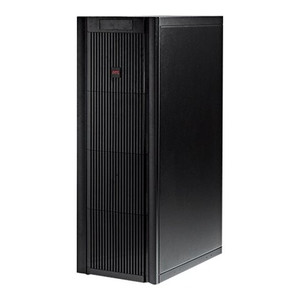
- Tower Form Factor: The tower chassis stands independently without rack rails — straightforward to deploy in floor-standing equipment rooms or alongside existing tower server infrastructure. If rack integration is a future requirement, confirm APC's rail conversion options for this chassis before purchasing.
- Audible Alarm System: Built-in audible alarms provide local notification of battery, overload, or fault conditions — a backup to SNMP alerting when network monitoring is unavailable or a technician is physically on-site.
- Serial Port (1x RS-232): The RS-232 serial port supports legacy graceful-shutdown interfaces for servers and network equipment that predate USB or Ethernet UPS communication. Useful when integrating with older NVR firmware or industrial control systems that still rely on serial power management protocols.
Integration & Compatibility
The multi-voltage AC input (120/208/220 V) makes the SUVTP10KF2B4S viable across North American and select international facility voltage standards without rewiring. The Ethernet management port supports standard SNMP-based UPS monitoring, compatible with most enterprise network management systems. The EPO terminal requires a normally-open or normally-closed dry-contact connection — verify your building safety system's contact type before wiring. For environments running power and UPS infrastructure across multiple circuits, the serial and Ethernet interfaces allow parallel monitoring without proprietary gateway hardware.
Integrators deploying this unit into network video recorder head-end rooms should account for the 5-hour battery recharge window when scheduling maintenance outages. Plan any load-transfer sequence to allow the UPS to reach full charge before the next potential utility event. For larger APC UPS deployments or multi-unit installations, review APC's external battery expansion modules to extend runtime beyond the internal battery capacity.
If your facility requires UPS coordination with network switches or other PoE infrastructure, the SNMP management interface enables automated graceful shutdown sequencing — prioritize non-critical loads first, preserve surveillance and access control servers longest.
Frequently Asked Questions
Q: What is the difference between the 10 kVA rating and the 8,000 W output — which number do I use to size my load?
A: Use the 8,000 W (real power) figure for sizing. The 10 kVA is apparent power; most electronic loads draw real power closer to the watt rating. Keep your connected load at or below 80% of 8,000 W (approximately 6,400 W) to maintain thermal headroom and optimize battery runtime.
Q: Does the SUVTP10KF2B4S support zero-transfer-time switching during a utility outage?
A: Yes. As an online double-conversion UPS, the load runs off the inverter continuously — there is no transfer time on utility failure. Utility power charges the battery, which feeds the inverter at all times, so a utility drop has no detectable impact on connected equipment.
Q: What input voltages does the SUVTP10KF2B4S accept?
A: The unit accepts 120, 208, and 220 V AC input, making it compatible with standard North American single-phase (120V), split-phase (208V), and select international facility voltages without requiring an external transformer.
Q: How does the Emergency Power Off (EPO) feature work on the SUVTP10KF2B4S?
A: The EPO interface accepts a dry-contact signal (normally-open or normally-closed — verify your facility panel's contact type) from a building safety system, fire suppression panel, or manual EPO switch. When the contact triggers, the UPS cuts output power to the connected load immediately. This is commonly required under NEC 645 for computer room installations.
Q: How long does the battery take to recharge after a full discharge?
A: The internal VRLA battery recharges to full capacity in approximately 5 hours after a full discharge. Factor this into maintenance scheduling — avoid planned outages or load transfers that would leave the battery partially charged if another utility event is possible within that window.
Q: Can the SUVTP10KF2B4S be monitored remotely via SNMP?
A: Yes. The onboard Ethernet management port supports SNMP-based remote monitoring and can integrate with enterprise network management systems. The RS-232 serial port provides a secondary interface for legacy graceful-shutdown applications or serial-based power management on older equipment.
The SUVTP10KF2B4S sits at a useful intersection for enterprise security and AV integrators: 10 kVA of online double-conversion capacity in a standalone tower chassis, with both Ethernet management and a hardwired EPO terminal. That combination means you can drop this into a dedicated equipment room, tie the EPO into the building fire panel on day one, and manage it remotely via SNMP without running a separate serial gateway. The 93% operating efficiency is the spec I'd highlight to a facilities manager — at 10 kVA, the gap between 88% and 93% efficiency is real money on the monthly power bill.
Technical Highlights:
- Online Double-Conversion Architecture: Zero-millisecond transfer time on utility failure — the load runs off the inverter continuously at all times, not just during outages. Critical for NVR arrays, access control servers, and edge appliances that log every power event.
- 93% Efficiency at Load: Lower heat output and reduced facility power draw versus lower-efficiency alternatives — compounding savings in 24/7 deployments where the UPS never powers down.
- EPO Dry-Contact Interface: Hardwired NEC 645 compliance path — connects directly to building fire suppression or safety shutdown circuits without additional relay hardware. Verify contact type (NO vs NC) against your panel before wiring.
Deployment Considerations:
- The 5-hour VRLA recharge window is the operational constraint to plan around — if your facility has recurring short outages (utility grid instability, scheduled generator tests), ensure the battery reaches full charge between events before restoring full load.
- The single AC outlet listed in specs warrants clarification before specifying for multi-device loads — confirm output receptacle configuration matches your distribution strip or PDU requirements before delivery.
This unit is well-matched to a dedicated NVR head-end room or edge data closet where online double-conversion quality, EPO compliance, and remote SNMP management all need to coexist in a single tower footprint — particularly in facilities where NEC 645 computer room compliance is already a requirement and the EPO terminal saves a separate relay module.