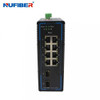
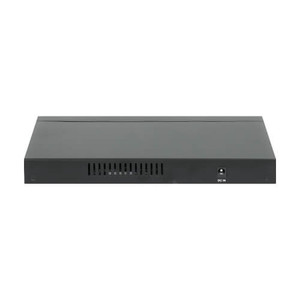
Comnet CNFE6+2USPOE-S 8-Port Self-Managed PoE Switch
Overview
The Comnet CNFE6+2USPOE-S is a compact 8-port managed Ethernet switch purpose-built for distributed surveillance installations where you need to combine PoE-powered cameras on standard copper cabling with fiber-optic extension to distant equipment rooms or rooftop cabinets. Six copper ports deliver IEEE 802.3af power over Ethernet (up to 30W per port) at 10/100 Mbps, while two single-mode fiber ports handle 100 Mbps full-duplex communication at longer distances without electrical noise or ground-loop risk. The switch supports automatic 10/100 Mbps negotiation and automatic MDI/MDI-X crossover, eliminating manual port configuration on the job site.
Key Features
- 6 PoE Copper Ports (IEEE 802.3af): Each port supplies up to 30W, enough for most fixed IP cameras, PTZ heads, and access control readers. Standard cat5e or cat6 cabling; no separate power injectors needed at the camera end, which cuts installation time and reduces field troubleshooting points.
- 2 Single-Mode Fiber Ports (100 Mbps): Fiber eliminates ground loops and electromagnetic interference—critical in industrial facilities, outdoor long-runs, and installations sharing cable trays with high-voltage equipment. Single-mode fiber reaches distances up to 40 km (with appropriate optics), making remote equipment rooms and stadium perimeter installations practical without active repeaters.
- Automatic Negotiation (10/100 Mbps, Full/Half Duplex): The switch detects connected equipment speed and duplex automatically, so a legacy 10 Mbps sensor or a modern 100 Mbps camera both work without jumper settings or firmware tweaks. No configuration-induced downtime.
- Automatic MDI/MDI-X Crossover: Straight-through or crossover cables both work on every port. Integrators don't need to maintain separate cable types or recall which ports require crossover—swap a camera or upgrade a device without re-crimping.
- Compact Mounting (Wall, Rack, DIN-rail): Fits in electrical enclosures, vertical wall mounts, or 19-inch racks. Three mounting options in a single unit reduce the need for auxiliary brackets and simplify retrofit into existing infrastructure.
- LED Status Indicators: Power, activity, and PoE status LEDs on each port provide at-a-glance verification that cameras are powered and transmitting, eliminating the need for a management interface or VMS dashboard for basic troubleshooting during commissioning.
Integration & Compatibility
The CNFE6+2USPOE-S complies with NEMA TS-1/TS-2 and IEEE 802.3 standards, ensuring interoperability with any ONVIF-compliant IP camera, NVR, or encoder. The self-managed architecture requires no software, SNMP configuration, or cloud login—plug in power and Ethernet, and the switch immediately passes traffic. This makes it ideal for remote sites where IT support is minimal or for air-gapped surveillance networks. Fiber ports accept standard LC or SC connectors (verify module type at purchase); the switch pairs seamlessly with multimode-to-singlemode media converters if your existing fiber plant runs multimode or if you're extending from a copper-based core switch.
What's in the Box
Exact package contents are not specified in available documentation. Contact the vendor or refer to your purchase confirmation for a complete list of included cables, mounting hardware, and fiber adapters.
Frequently Asked Questions
Q: Can I power 24 VDC devices (older analog cameras or sensors) from the CNFE6+2USPOE-S?
A: No. The PoE ports supply IEEE 802.3af power (48 VDC, max 30W), not 24 VDC. Use a separate 24 VDC power supply or PoE splitter if you need to run legacy DC devices alongside IP cameras.
Q: What is the maximum cable run length on the copper ports?
A: IEEE 802.3af PoE is rated to 100 meters (330 feet) of cat5e or better. Beyond that distance, insertion loss and power drop become problematic; use fiber ports or a second PoE injector at a midspan repeater.
Q: Do I need a management interface or VMS to configure the CNFE6+2USPOE-S?
A: No. The CNFE6+2USPOE-S is self-managed—it forwards traffic and provides PoE automatically on startup. Plug in power and start connecting cameras. No SNMP, no web interface, no configuration steps.
Q: Can I mix multimode and single-mode fiber on the same switch?
A: The CNFE6+2USPOE-S fiber ports are single-mode only. If your facility uses multimode fiber, you'll need a multimode-to-single-mode media converter (or a fiber module swap, depending on the switch design). Verify exact fiber module type before purchase.
Q: What is the warranty on the CNFE6+2USPOE-S?
A: Warranty terms are not specified in available documentation. Check your purchase agreement or contact the vendor for coverage details and any extended-warranty options.
Q: How much power does the CNFE6+2USPOE-S itself consume?
A: Switch chassis power draw is not specified in available documentation. For a remote installation powered by a UPS or solar system, contact the vendor for exact idle and maximum current draw.
The Comnet CNFE6+2USPOE-S solves a real problem in surveillance deployment: how to consolidate power delivery and data transport when your cameras are scattered across a multi-building campus or when you need to cross long distances without active repeaters. The combination of 6 PoE copper ports and 2 single-mode fiber ports is not common in unmanaged switches, and that specificity makes it the right tool for hybrid wired installations where copper runs short distances to clusters of cameras while fiber bridges to a central NVR or monitoring station.
Technical Highlights:
- IEEE 802.3af up to 30W per port: Enough for full-feature IP cameras (5–15W typical), access control readers (12–18W), and compact PTZ heads. You avoid the cost and complexity of external PoE injectors for eight separate camera drops.
- Single-mode fiber at 100 Mbps full duplex: No ground-loop risk, no EMI from industrial machinery or radio equipment. If you've fought intermittent video dropouts in a factory or power-plant environment before, fiber eliminates that source. Reaches tens of kilometers with the right optics.
- Automatic negotiation and MDI/MDI-X: Integrators can cable devices on-site without worrying about speed mismatches or crossover configurations. Reduces configuration calls and field troubleshooting time—critical for remote or unmanned sites.
Deployment Considerations:
- The CNFE6+2USPOE-S is self-managed only; it does not support SNMP, syslog, or IP-based management. If your network operations center expects SNMP traps or detailed port statistics, this switch won't integrate into a monitored environment without a dedicated management agent or aggregator upstream.
- Fiber module compatibility and connector type (LC vs. SC) must be verified at purchase time. If your existing fiber plant uses multimode or a different connector standard, you'll need conversion equipment, which adds latency and cost to the project.
This switch is purpose-built for integrators deploying edge-based surveillance in industrial, outdoor, or multi-site environments where you need the simplicity of plug-and-play switching, the power delivery of PoE, and the distance reach of fiber in one chassis. If you're running a campus perimeter with remote camera clusters fed by a single fiber trunk to a central control room, the CNFE6+2USPOE-S eliminates the need for separate PoE injectors, fiber converters, and managed switch complexity on the edge—exactly the scenario this model was designed for.