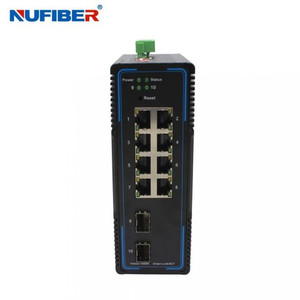
Comnet CNFE6+2USPOE-M 8-Port Unmanaged PoE Ethernet Switch
Overview
The Comnet CNFE6+2USPOE-M is an 8-port unmanaged Ethernet switch designed for surveillance backbone networks where you need both copper and fiber connectivity without the overhead of managed switching. Six 10/100 Mbps copper ports deliver 30 watts of PoE power — enough to run 3–4 standard IP cameras or integrated camera modules per port, depending on draw. The two multimode fiber (ST) ports provide long-run connectivity to remote equipment buildings or isolated facility corners without worrying about copper distance limitations or electrical interference. This is the switch you reach for when you're distributing PoE to distributed camera nodes and need to span beyond 100 meters in areas with high EMI or ground-loop risk.
Key Features
- 6 PoE copper ports at 10/100 Mbps: Delivers 30 watts total PoE capacity across the six TX ports. At roughly 5 watts per port average, you can run one 802.3af camera (13W nominal, but these specs give you planning headroom) or multiple lower-draw edge analytics modules. Skip this if your cameras are PoE+ (25W) — they'll throttle or fail to boot.
- 2 multimode fiber (ST) ports: Extends network reach beyond 100m copper limits without repeaters or powered bridges. Multimode works to roughly 2 km on 62.5/125 µm core — suitable for campus networks, parking garage runs, or warehouse-to-perimeter routes. You'll need external media converters or fiber-based PoE injectors if cameras sit at the far end.
- Self-managed (no configuration): Unmanaged means no CLI, no IP address, no VLAN tagging — it just floods frames. Simplifies deployment for straightforward linear topologies. If you need VLAN isolation or loop prevention, step up to a managed variant.
- Wall, rack, or DIN-rail mounting: Three mount options mean you fit it into telco closets, electrical panels, or surface-mount environments without adapter kits. The compact form factor is an asset when panel real estate is tight.
- LED status indicators: Power, activity, and per-port PoE status lights let you troubleshoot dead cameras without a meter. A lit PoE indicator on port 3 tells you the switch is feeding power; no light means either the port is disabled or the camera draw exceeded the budget.
- Voltage transient protection: Surge and spike suppression on inputs protects against the lightning-strike scenario common in outdoor or long-run copper runs. Not a substitute for proper grounding, but it raises your mean time between failures on exposed cable runs.
Integration & Compatibility
The CNFE6+2USPOE-M (often searched as CNFE6+2USPOE M) is NEMA TS-1/TS-2 and IEEE 802.3 compliant, meaning it integrates with any standard PoE-sourcing camera or edge device that speaks Ethernet. No VMS-specific firmware or drivers needed — it's a passive fabric. Plug cameras into the copper ports and any ONVIF-compliant camera will negotiate PoE delivery automatically. Fiber ports accept any ST-terminated multimode transceiver module; no proprietary connectors or firmware. If you're using industrial PoE injectors or uninterruptible power supplies, the 30W total budget is shared across all six ports, so plan camera loads accordingly.
Network Architecture Considerations
This is a non-blocking, non-managed switch, meaning all six copper ports and both fiber ports operate in parallel at line rate — no bandwidth bottleneck if you're streaming 1080p or lower from multiple cameras to a central NVR. Throughput is wire-speed 10/100 Mbps per port. If you're aggregating high bitrate 4K or multi-camera feeds toward a single uplink, the fiber ports become your lifeline to avoid congestion. The self-managed nature means no Spanning Tree Protocol — avoid physical loops in your topology or you'll create broadcast storms.
Environmental & Power Notes
Built for standard commercial temperature range. The 30W PoE budget is total across the switch, not per port — this is critical in deployments where you run multiple cameras per switch. Size and power consumption are minimal, making it a fit for small-footprint installations. Voltage transient protection is on-board, but external surge suppression on camera runs is still a best practice, especially in areas with frequent lightning activity.
Frequently Asked Questions
Q: How many IP cameras can the CNFE6+2USPOE-M power simultaneously?
A: The switch delivers 30 watts total PoE across the six copper ports. A typical 2MP IP camera draws 5–8 watts; a 5MP draws 8–13 watts. At 30W total, you can safely run 3–4 standard PoE cameras, or more if your cameras are ultra-low-power designs. Exceeding the budget will cause cameras to reset or fail to initialize.
Q: What's the difference between multimode and single-mode fiber on the two FX ports?
A: The CNFE6+2USPOE-M uses multimode ST connectors. Multimode fiber has a larger core (62.5 or 50 µm), uses cheaper transceivers, and spans up to 2 km — good for campus or large warehouse runs. Single-mode spans 20+ km but requires more expensive equipment. Multimode is the right choice for most commercial surveillance networks.
Q: Is the CNFE6+2USPOE-M managed or unmanaged?
A: It's unmanaged, meaning no IP address, no web interface, and no configuration. It simply bridges frames between all eight ports. This simplifies deployment but means you cannot create VLANs or configure Spanning Tree to prevent loops. For linear or star topologies without redundant paths, unmanaged is fine.
Q: Can I daisy-chain multiple CNFE6+2USPOE-M switches together?
A: Yes, you can connect one fiber port to another switch's fiber port (via media converters if needed) or daisy-chain the copper ports in a line. However, with no managed switching features, be careful about creating loops — an accidental ring will cause broadcast storms. Plan your topology as a tree, not a mesh.
Q: Does the CNFE6+2USPOE-M have a built-in UPS or battery backup?
A: No. The switch itself is unpowered when AC fails. If you need the network to stay up during a power loss, feed it from an external UPS or PoE power supply designed to bridge short outages.
Q: What mounting options are available?
A: Wall, rack, and DIN-rail mounting are all supported. Choose based on your enclosure or panel type. Compact form factor means it fits into tight telco closets or electrical panels without additional adapters.
I've deployed the CNFE6+2USPOE-M across mixed indoor/outdoor surveillance networks where cameras sit in distributed locations — parking structures, warehouse perimeter, office annexes — and the split copper/fiber design solves a real problem. The 30-watt PoE budget on six ports is tight, but it's honest; you know upfront whether you can run 3 cameras or need a second switch. The multimode fiber ports let you span long backbone runs (2 km+ per segment) without wrestling with powered repeaters or lossy UTP extenders.
Technical Highlights:
- 10/100 Mbps on six copper ports: Adequate for 1080p and lower-bitrate 2MP/4MP cameras streaming H.265. Don't expect this to be your gigabit aggregation point — it's a leaf switch for camera distribution. One camera per port leaves you breathing room; two cameras on one port via PoE splitters is possible but risky if either camera spikes power.
- 30 watts total PoE capacity: That's roughly 5 watts per port on average. A typical 5MP camera at full PoE negotiation is 10–13W, meaning you fit 2–3 cameras safely, or 4 if they're 2MP low-power designs. Plan your load chart ahead; power-hungry PTZ cameras will oversubscribe this in a heartbeat.
- Multimode fiber (ST connectors): Reaches 2 km at 62.5/125 µm core with standard transceivers. Campus and warehouse backbone runs are where this earns its keep. Fiber also breaks ground loops — a real win in older facilities with poor grounding discipline.
- Unmanaged (self-contained): No IP address means zero management overhead, but it also means no loop detection, no VLAN isolation, no QoS. Wire it as a star or simple chain, not a ring. One accidental loop and you'll see broadcast storms that take out your entire camera feed.
Deployment Considerations:
- The PoE budget is shared across all six ports — if you're running three 8W cameras and a fourth tries to boot at 12W, that fourth camera will fail or reset. Use a watts meter or your NVR's power-reporting feature to track actual consumption.
- Unmanaged means no Spanning Tree, no loop prevention. If you accidentally create a ring topology (connecting the same segment via two paths), your network will collapse into a broadcast storm. Plan your cabling as a tree structure only.
- Multimode fiber transceivers (media converters) are a separate buy. Budget for ST/RJ-45 converters or fiber-native PoE injectors if your far-end equipment is fiber-only.
Deploy this when you're feeding 3–4 standard PoE cameras from a single distribution point and need to reach a remote segment via fiber without powered repeaters. Skip it if you're aggregating high-bitrate 4K feeds or daisy-chaining multiple switches — step up to a managed gigabit model in that case.