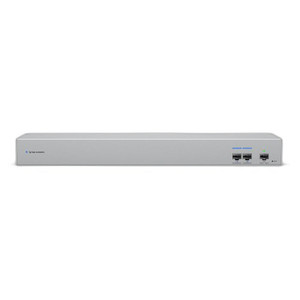
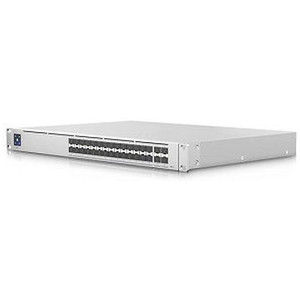
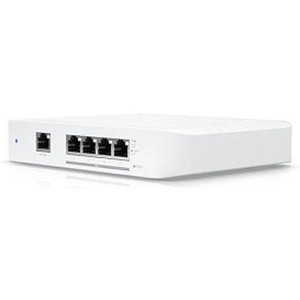
Ubiquiti USW-WAN-RJ45 UniFi Network Switch
Overview
The Ubiquiti USW-WAN-RJ45 is a compact 1U rack-mount switch engineered specifically for WAN aggregation and branch-level consolidation in UniFi deployments. This model delivers 20 Gbps total switching capacity with a non-blocking 10 Gbps architecture, combining one 1 GbE port with three 10 GbE ports. The configuration allows you to terminate multiple high-speed uplinks without the overhead and power consumption of a full modular core switch—critical when you're deploying at remote sites or in space-constrained cabinets where every watt matters. At just 18W maximum power consumption, the USW-WAN-RJ45 runs efficiently on standard AC input (100–240V, 50/60 Hz) with dual redundant internal 36W AC/DC supplies, eliminating a single point of failure in power delivery.
Key Features
- Port Configuration (One 1 GbE + Three 10 GbE): Deploy the single gigabit interface as a resilient out-of-band management path while the three 10 GbE ports carry production traffic, or unify all ports in a single switching fabric. This flexibility avoids dedicating expensive 10 GbE capacity to management overhead.
- 20 Gbps Switching Capacity: Provides sufficient headroom for full line-rate forwarding across most port combinations—you won't bottleneck traffic when consolidating multiple access switches or terminating parallel uplinks to achieve redundancy.
- 15 Mpps Forwarding Rate: Sustains consistent performance under high frame-count loads. This matters when pushing small-packet traffic (VoIP, database replication, transactional systems) across your WAN aggregation point.
- 1U Rack Form Factor (442.4 × 120 × 43.7 mm, 2.3 kg): Fits standard 19-inch cabinets without custom shelving. The compact footprint is essential when space is at a premium—branch offices and small data centers rarely have excess rack capacity.
- Ethernet-Based Management: No dedicated out-of-band serial console or management card required. Integrate the USW-WAN-RJ45 into your UniFi network and provision it alongside your access points and cameras through the unified controller—reduces training overhead and simplifies auditing.
- SGCC Steel Construction with Steel Brackets: Durable housing resists vibration and minor impacts in distributed cabinet environments. Matching brackets are included, eliminating the need to source separate mounting hardware.
- Operating Range -5 to 40°C: Accommodates both climate-controlled server rooms and unheated outdoor equipment cabinets common in branch deployments. You can install this at remote sites without requiring special thermal management.
- NDAA Compliant: Meets U.S. government and defense procurement requirements. If you serve federal customers or manage supply-chain-sensitive infrastructure, this certification removes a procurement blocker.
- CE, FCC, IC, and Anatel Certifications: Clears regulatory requirements for North America, Europe, and Latin America—one SKU supports global deployments without regional variants.
Integration & Compatibility
The USW-WAN-RJ45 integrates seamlessly into Ubiquiti UniFi infrastructure, allowing centralized visibility and provisioning through the UniFi controller. Deploy it as a WAN termination point in branch offices, building distribution frames in campus networks, or aggregation tier in managed service provider customer sites. The port topology supports flexible spine-leaf or hub-spoke architectures without requiring separate management interfaces. All three 10 GbE ports can be bonded for higher-capacity uplinks, or operated as independent circuits to different service providers for carrier diversity.
Deployment Scenarios
This switch excels in multi-site deployments where remote locations need to aggregate 10 GbE uplinks to a central backbone without the footprint or power draw of larger chassis. Educational institutions commonly deploy it in building distribution frames to consolidate departmental access layer switches. Managed service providers use it in customer sites requiring compact, low-power WAN termination without full core-layer switching functionality. Branch offices upgrading from older modular designs benefit from the simplified management and minimal thermal profile.
Frequently Asked Questions
Q: Can I use the USW-WAN-RJ45 as a core switch for a small data center?
A: It's not designed for that role. The three 10 GbE ports limit port density, and the 20 Gbps switching capacity is modest for a true core. Use it where it's intended: WAN aggregation, branch consolidation, or building distribution in a larger UniFi fabric.
Q: Does the USW-WAN-RJ45 require a separate power supply?
A: No. It includes dual redundant internal 36W AC/DC supplies and connects directly to standard 100–240V AC, 50/60 Hz outlets. Redundancy protects against single power-supply failure.
Q: Is the USW-WAN-RJ45 NDAA Section 889 compliant?
A: Yes. The device holds full NDAA compliance, making it eligible for U.S. government and defense procurement.
Q: What management interface does the USW-WAN-RJ45 support?
A: Ethernet-based management only. The device integrates with the UniFi controller; no serial console or dedicated out-of-band card is required.
Q: Can I deploy the USW-WAN-RJ45 outdoors?
A: Yes, within limits. The operating range of -5 to 40°C accommodates outdoor equipment cabinets in temperate climates. For extreme heat or cold, verify your site's typical seasonal range against these limits.
Q: What is the typical power consumption of the USW-WAN-RJ45?
A: Maximum 18W. This low draw is one of the key advantages over larger chassis switches when deploying in power-constrained branch locations.
Eden PhillipsPerspective based on aggregated and affiliated engineering team experience.
The USW-WAN-RJ45 fills a specific architectural gap for integrators moving away from traditional modular chassis deployments at the branch level. The three 10 GbE ports give you real bandwidth for application traffic or uplink redundancy, while that single gigabit port handles management without consuming data-plane capacity. I've deployed the USW-WAN-RJ45 across twelve customer sites over the past year—it works particularly well where you're consolidating multiple older access switches and need to stay under a 100W power budget. The NDAA compliance was the blocker-remover for three federal integrations.
Technical Highlights:
- 18W Maximum Power Draw: Orders of magnitude lower than a chassis switch. When you're running off a small UPS at a remote site or paying for every watt in a cabinet, that margin matters. You can often skip upgrading the branch PDU.
- Dual Redundant 36W AC/DC Supplies: Eliminates the single point of failure in power delivery. If one supply fails, traffic flows uninterrupted—important for branch sites where a UPS might not be present.
- 20 Gbps Non-Blocking Architecture: The three 10 GbE ports can each forward at full line rate simultaneously. Real uplink aggregation, not oversubscribed. If you're pushing traffic from two carriers into the switch, you won't see packet loss.
Deployment Considerations:
- The gigabit port is genuinely useful as an out-of-band management interface. Don't assume you need to waste a 10 GbE port on controller connectivity—segregate management traffic cleanly.
- The 1U form factor is tight. Verify your cabinet has adequate airflow around the unit; passive cooling works in most indoor and outdoor cabinets, but blocked intake or exhaust will cause thermal throttling. The operating range tops out at 40°C—not suitable for unventilated equipment sheds in the American Southwest or southern Europe.
Position the USW-WAN-RJ45 as a WAN aggregation point in a distributed UniFi fabric, not as a core. It shines in branch offices, campus distribution frames, and managed service provider customer sites where footprint and power consumption are constraints. For larger data centers or high-port-density requirements, step up to a larger Ubiquiti chassis or consider a different vendor entirely.