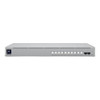
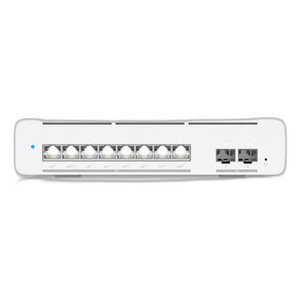
Ubiquiti USW-PRO-XG-10-POE 10GbE PoE Network Switch
Overview
The Ubiquiti USW-PRO-XG-10-POE is a compact, enterprise-grade 10 Gigabit managed switch built for high-density power-over-Ethernet deployments in UniFi-based infrastructure networks. This 1U rack-mount switch delivers ten 10GbE PoE+++ ports plus dual SFP+ fiber uplinks, switching 240 Gbps with non-blocking 120 Gbps throughput across all ports simultaneously. The design addresses a specific deployment gap: when you need to power and transport data to multiple high-draw devices—cameras, access points, wireless controllers—at 10G speeds without auxiliary power distribution, the USW-PRO-XG-10-POE is built for that role.
Key Features
- Ten 10GbE PoE+++ ports: Each port delivers up to 90W of power, eliminating the need for separate power injectors or external PSUs on individual devices. This matters in camera deployments where a single cable run carries both 4K video and sufficient power to operate motorized lenses, heaters, and IR illuminators simultaneously.
- 400W total PoE output budget: You can run multiple high-power devices concurrently—for example, six cameras at 60W each, plus smaller loads on remaining ports—without oversubscribing the switch's power envelope. Real-world deployments routinely max this out in warehouse, campus, and multi-building scenarios.
- Two SFP+ uplink ports (10G/1G): Fiber connections extend reach beyond Ethernet cable limits (100m) and isolate noisy electrical environments. In data centers and multi-floor campuses, these carry aggregated traffic from the access layer up to core switches or bypass copper runs entirely.
- 240 Gbps switching fabric: Non-blocking architecture ensures no port contention. All ten 10GbE ports can forward at line rate simultaneously—critical when aggregating video from dozens of cameras or handling bursty wireless controller traffic.
- 1,000 VLAN support: Network segmentation isolates camera traffic, access-control systems, wireless controllers, and management channels onto separate logical networks. This enforces security policies without requiring multiple physical switches.
- 550W internal AC/DC supply, universal 100–240V input: A single power cord handles worldwide deployments. The 65W switch-only draw (before PoE output) is modest, leaving 400W exclusively for connected devices.
- NDAA Section 889 compliance: Meets U.S. government procurement rules for defense and federal deployments. CE, FCC, IC, and Anatel certifications cover enterprise, EU, and Brazilian markets.
- UniFi Controller integration: Centralized management, firmware updates, and traffic monitoring across all UniFi network gear—switches, wireless, and Dream Machines—from a single pane of glass. No CLI gymnastics required for typical deployments.
- 1U rackmount form factor (442.4 × 285 × 44 mm), 4.6 kg: Fits standard 19-inch racks alongside core switches and patch panels. Included mounting brackets integrate directly without adapter hardware.
- -5 to 40°C operating range: Handles unheated network closets and equipment rooms, but not direct outdoor exposure. If you need below-freezing operation, plan for heated enclosures.
Deployment Scenarios
In campus security networks, the USW-PRO-XG-10-POE functions as a building or floor backbone. A single switch in each major structure consolidates PoE-powered IP cameras, door controllers, environmental sensors, and wireless access points, then uplinks via fiber to a central core. This topology reduces copper runs and power distribution complexity compared to daisy-chaining smaller switches.
For warehouse automation and industrial environments, the 400W PoE budget supports networks of powered barcode scanners, wireless controllers, and environmental monitoring devices without external power infrastructure. The SGCC steel enclosure resists moisture and dust typical of these settings.
Data center edge and service provider aggregation roles benefit from the dual SFP+ uplinks, which extend beyond copper reach and provide vendor-agnostic fiber flexibility. Multi-tenant or multi-building environments can isolate traffic via VLANs while maintaining a single managed device.
Integration and Compatibility
Management is Ethernet-based, fully integrated with the UniFi Controller running on a Windows/Mac/Linux host or UniFi Dream Machine. Network monitoring, PoE budget tracking, and VLAN configuration occur through the same interface used for UniFi access points and wireless controllers. Standard SNMP and syslog export data to external monitoring tools if required.
SFP+ uplinks require compatible optical transceivers (SFP+ DAC or LC-duplex modules); purchase these separately based on distance and transceiver type. Common 10G or 1G optics from major vendors (Mellanox, Finisar, Brocade-compatible) work reliably.
Installation requires a dedicated AC outlet or PDU circuit rated for 550W peak draw. Plan fiber uplink routes during network design; running single-mode or multi-mode fiber to core infrastructure eliminates future copper upgrade constraints.
Frequently Asked Questions
Q: Can the USW-PRO-XG-10-POE deliver 90W to every port simultaneously?
A: No. Each port supports up to 90W in isolation, but the total budget is 400W across all ten ports. You can run 4–5 high-power devices (cameras with heaters, motorized lenses) at 60–90W each, plus lower-power loads on remaining ports. Plan your deployment by summing actual device wattages, not maximum per-port ratings.
Q: Does this switch require a separate management VLAN or dedicated network connection?
A: No. The USW-PRO-XG-10-POE integrates directly with UniFi Controller via standard Ethernet and auto-discovers. A single network with DHCP or static IP assignment is sufficient for initial provisioning. Advanced deployments can isolate management traffic on a dedicated VLAN after discovery.
Q: What's the maximum fiber distance for the SFP+ uplinks?
A: Single-mode fiber supports 10 km (10,000 m) at 10G; multi-mode supports 300 m at 10G. Transceiver type and fiber grade determine actual reach. Confirm transceiver specs during ordering. Standard SFP+ DAC (direct-attach copper) also works for runs up to 7 m without optics.
Q: Is the USW-PRO-XG-10-POE NDAA-compliant, and what does that mean for procurement?
A: Yes. NDAA Section 889 compliance confirms the device meets U.S. government restrictions on certain Chinese components and manufacturing. This facilitates federal, military, and defense contractor procurement without additional security reviews.
Q: Can I mix 1G and 10G devices on the same switch?
A: Yes. All ten RJ45 ports are 10GbE-capable, but they auto-negotiate down to 1G if a 1G device (older camera, controller) is connected. No performance penalty—the device simply operates at its native speed. SFP+ ports similarly support both 10G and 1G transceivers.
Q: What's the power consumption when no PoE devices are connected?
A: Approximately 65W for the switch itself. Add 0–400W depending on connected PoE load. Peak total draw is around 465W (65W + 400W PoE output). A standard 500W PDU circuit is sufficient; 600W is safer for sustained operation with margin.
Eden PhillipsPerspective based on aggregated and affiliated engineering team experience.
The USW-PRO-XG-10-POE fills a real gap in the Ubiquiti switching lineup. When you need to deploy powered cameras, access controllers, and wireless gear at 10G scale without running auxiliary PDU circuits and power injectors, this switch simplifies the topology significantly. The 400W PoE budget is practical—not theoretical—and the non-blocking 120 Gbps throughput ensures no port contention even under heavy video traffic load. If you're already committed to UniFi infrastructure, the integration is seamless.
Technical Highlights:
- 400W PoE output across all ten 10GbE ports: Eliminates daisy-chaining smaller switches or external PoE splitters. A warehouse with 6–8 cameras, controllers, and environmental sensors can run entirely from this single unit, reducing cable runs and failure points.
- 240 Gbps switching, 120 Gbps non-blocking: All ports operate at line rate simultaneously. In busy surveillance networks recording 4K from multiple cameras plus real-time access-control traffic, you don't hit bandwidth bottlenecks at the switch.
- Dual SFP+ uplinks (10G/1G): Fiber reaches beyond 100m Ethernet limits. In multi-building campuses or data-center aggregation, fiber eliminates EMI issues and scales to long-haul distances without intermediate switch hops.
- NDAA compliance: Federal and defense buyers can source this without additional security reviews. The certification also signals Ubiquiti's commitment to supply-chain transparency, which matters in regulated environments.
Deployment Considerations:
- PoE budget math is non-negotiable: The 400W total is a hard ceiling. If you're running eight 60W cameras plus other loads, you're already at 480W theoretical—over budget. Calculate actual device wattages at the design stage, not after installation. Many installers underestimate heater and motorized-lens draws.
- Fiber transceiver compatibility requires planning: SFP+ ports accept standard optics, but you must specify and budget for transceivers separately. Common mistakes: ordering the switch without confirming transceiver availability, or mixing single-mode and multi-mode fiber unknowingly.
- Temperature range (-5 to 40°C) suits indoors, not direct outdoor exposure: Network closets, cable vaults, and climate-controlled equipment rooms work fine. Unheated rooftop shelters do not. If you need outdoor mounting, place the switch indoors and run fiber to rooftop devices.
The USW-PRO-XG-10-POE is strongest in campus security networks and warehouse automation where you're consolidating multiple powered devices onto a single backbone. It's also a sensible choice for service-provider or multi-tenant aggregation roles where VLAN isolation and fiber uplinks matter. Pass on this model if your devices are legacy 1G or if you need ultra-high PoE density (more than ten ports); Ubiquiti's enterprise line has other options that trade off port count for cost.