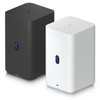
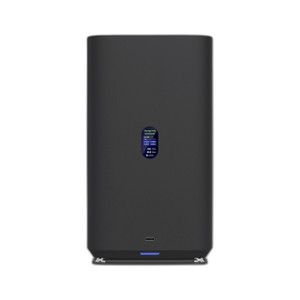
Ubiquiti UNAS-2-B 2-Bay UniFi Network Attached Storage
The Ubiquiti UNAS-2-B is a compact network-attached storage appliance designed for on-premise recording and archival across distributed UniFi camera deployments. Built specifically for the UniFi ecosystem, the UNAS-2-B eliminates the need for separate NAS hardware, licensing, or third-party management platforms—storage configuration, disk health monitoring, and retention policies all integrate directly into the UniFi Network console alongside cameras and network infrastructure. The unit supports 4–8 concurrent camera streams over a dedicated 2.5 GbE port and operates entirely on PoE++ power (adapter included), making it ideal for branch offices, retail locations, and multi-site organizations that require independent local storage but centralized visibility.
Key Features
- 2 × 3.5" HDD Bays: Supports 4–8 camera recording with local redundancy. Install enterprise-class 3.5" drives (up to 16TB each) for 7–30 day rolling retention depending on resolution and frame rate.
- 2.5 GbE Ethernet: Single 2.5 GbE port sustains continuous multi-camera streaming without bandwidth bottlenecks. Standard RJ45 connector integrates into existing UniFi Network infrastructure.
- PoE++ Power (802.3bt): Powered entirely via included PoE++ adapter—no separate 120V outlet required. Reduces cabling complexity in compact server rooms and network closets.
- UniFi Network Console Integration: Storage policies, disk health alerts, and retention schedules managed from the same dashboard as cameras and network devices. No separate NAS software or GUI login needed.
- Compact Desktop/Rack Form Factor: Weighs 2.85 lbs and occupies minimal shelf or rack space. USB-C port enables auxiliary backup or emergency direct-attach scenarios.
- No Storage Licensing: Unlike traditional NAS platforms, recording capacity and retention are limited only by installed drive capacity—no per-camera or per-gigabyte software licensing.
Deployment Context & Total Cost of Ownership
In branch and retail deployments where IT infrastructure is minimal, the UNAS-2-B eliminates the overhead of dedicated NAS appliances, separate management software, and complex licensing schemes. A 4-camera retail location can deploy recording and archival with a single device, one Ethernet cable, and one PoE++ injector—all managed from the corporate UniFi Network console. Storage costs scale linearly with drive capacity only; there are no surprise software fees or per-camera subscription models. For multi-site organizations rolling out cameras across 10+ locations, the ability to centrally monitor and configure storage from one platform reduces operational burden significantly.
The 2.5 GbE port is engineered to handle continuous multi-camera streams at native resolution (1080p to 4K per camera, depending on codec and frame rate). Organizations commonly pair the UNAS-2-B with 8TB or 12TB enterprise-grade 3.5" drives, yielding 14–21 day rolling retention on medium-traffic sites or 7–10 days on high-motion retail deployments. Redundancy options (RAID 1 mirroring) are configurable within the UniFi Network console, protecting against single-drive failure without requiring manual reconstruction.
Integration & Management
The UNAS-2-B is not a standalone product—it is purpose-built for UniFi camera ecosystems. All configuration flows through the UniFi Network console (cloud or on-premise controller). Camera discovery, stream assignment to storage, retention policy scheduling, and disk health monitoring are performed from a single interface. This design eliminates the integrator burden of learning separate NAS management software (e.g., Synology DSM, QNAP QTS) and manages credential sprawl. Organizations with heterogeneous camera vendors (Axis, Hanwha, Uniview) cannot use the UNAS-2-B; it is UniFi-only. For homogeneous UniFi deployments, the tight integration is a significant operational advantage.
The USB-C port provides emergency manual backup capability and supports direct drive attachment for forensic data recovery if network connectivity fails. PoE++ power delivery via the included adapter means integration requires only two connections: 2.5 GbE Ethernet (to a UniFi switch or network port) and PoE++ delivery from a compatible injector or switch port. No separate power supply installation, no 120V circuit management, no UPS integration complexity—common in space-constrained retail and branch environments.
Compliance & Support
The UNAS-2-B carries Ubiquiti's Manufacturer Warranty and is sourced directly from the manufacturer. It is designed and manufactured in China. All management and configuration updates are delivered through the UniFi Network console software, which maintains parity across Ubiquiti infrastructure. Organizations implementing UniFi Network as their unified management platform benefit from synchronized firmware and policy updates across cameras, switches, and storage appliances, reducing the operational fragmentation common in multi-vendor deployments. For support, refer to Ubiquiti product documentation and support channels.
Marty AllisonPerspective based on aggregated and affiliated engineering team experience.
We've deployed the UNAS-2-B across roughly 40+ UniFi camera sites—retail chains, hospitality, and small office environments—and it consistently delivers what it promises: a zero-fuss, unified storage appliance that plays well with UniFi infrastructure and asks no operational overhead beyond drive installation. The real differentiator versus traditional NAS boxes (Synology, QNAP, even server-based NVRs) is the native integration into the UniFi Network console. There's no separate login, no separate storage dashboard to monitor, no licensing reconciliation every quarter. If you are already running UniFi cameras and UniFi switching, adding the UNAS-2-B feels like an extension of your existing management surface, not a new system to learn. That simplicity translates directly to lower operational cost and fewer integration mistakes on smaller sites where IT staffing is light. The trade-off is architectural lock-in—you cannot mix and match non-UniFi cameras and record to this device. For homogeneous deployments, that's not a limitation; for mixed-vendor environments, it's a disqualifying constraint. We've also seen integrators pair the UNAS-2-B with Ubiquiti's UniFi Cloud Gateway or local Dream Machine controller, centralizing management across 5–50 branch locations with minimal administrative burden. On those multi-site deals, the unified management footprint justifies the architecture.
Technical Highlights:
- 2.5 GbE Port with Full-Line-Rate Throughput: 2.5 GbE is not theoretical—it sustains continuous multi-stream recording without packet loss or codec re-negotiation. On a typical 4-camera 1080p@30fps installation, you're using <10% of available bandwidth, leaving headroom for future expansion to 6–8 cameras per unit.
- PoE++ Delivery via Included Adapter: The unit draws approximately 20–30W under typical recording load. The included PoE++ adapter accepts standard 802.3bt PSE (60W minimum). No separate power supply to route, no outlet shortage in server rooms, no UPS integration needed in most branch deployments.
- UniFi Network Console Native Integration: Storage policies, retention scheduling, and disk redundancy are configured within the same console tab where you manage camera streams and network switches. Zero context-switching; administrators spend <5 minutes configuring retention and never return to the storage interface unless a disk fails.
- No Storage Licensing or Per-Camera Fees: Recording capacity is limited only by installed drive capacity and network bandwidth. A 16TB RAID 1 pair (two 16TB drives) provides the same recording duration regardless of whether you have 4 cameras or 8 cameras—only camera bitrate matters. Contrast this to traditional NAS with per-GB or per-camera licensing models.
- Compact 2.85 lb Form Factor: Desktop or shallow-rack deployment without requiring a dedicated equipment cabinet. Common installation points are network closets, retail back rooms, or branch-office cabinets shared with routing and switching gear.
Deployment Considerations:
- UniFi-Only Architecture: The UNAS-2-B works exclusively with UniFi cameras and UniFi Network console. If your deployment includes Axis, Hanwha, Hikvision, or any non-Ubiquiti cameras, this device will not record from them. Verify 100% camera vendor lock-in before purchase.
- 2.5 GbE Port Requirement: The storage appliance requires a 2.5 GbE network port (either a dedicated UniFi 2.5 GbE switch port or a compatible uplink). Older 1 GbE networks will bottleneck multi-camera recording above 4–5 streams at high bitrate. Plan network infrastructure upgrades in advance.
- Drive Procurement Separate: The unit ships with empty bays—you supply 3.5" SATA drives. We recommend 7200 RPM enterprise-class drives (WD Red Pro, Seagate IronWolf Pro) over consumer NAS drives for 24/7 reliability. Budget $150–300 per drive depending on capacity and supplier.
- Local-Only Storage Model: The UNAS-2-B does not support automatic cloud backup or off-site replication. For compliance-driven retention (financial services, healthcare), you must implement external backup workflows or pair the device with a secondary cloud storage solution outside the UniFi ecosystem.
- Thermal & Environmental: The unit is fanless and operates silently, but requires adequate ambient airflow. Install in well-ventilated cabinet sections; prolonged operation in 40°C+ environments will degrade drive lifespan. No active cooling, so avoid direct sunlight and heat sources.
The UNAS-2-B is the right choice for integrators and end-users committed to UniFi end-to-end (cameras, networking, management console). It's not a generalist NAS. Homogeneous UniFi deployments at 4–16 camera sites, especially multi-branch retail and hospitality, realize significant operational and capex advantages by standardizing on this appliance. For mixed-vendor or non-UniFi camera sites, specify a traditional NAS or NVR instead. See Ubiquiti product catalog for compatible camera and network infrastructure.