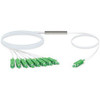
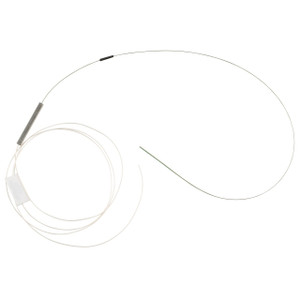
Ubiquiti UF-SPLITTER-8 Passive Optical Splitter
Overview
The Ubiquiti UF-SPLITTER-8 is a passive optical splitter engineered for fiber-based network deployments within the UISP accessory ecosystem. This component distributes a single fiber run across eight distinct output ports without requiring external power, active management, or network administration—characteristics that significantly reduce operational complexity and cost at intermediate distribution points. The UF-SPLITTER-8 (often searched as UF SPLITTER 8) operates as a transparent optical element, meaning it introduces no latency, no configuration overhead, and no single points of failure related to power or control logic. For integrators building fiber-to-the-premise (FTTP) networks, distributed antenna systems (DAS), or multi-building campus fiber infrastructure, this passive approach translates to lower total cost of ownership and faster field deployment.
Key Features
- Eight-port passive distribution: A single feeder fiber splits into eight output paths, reducing the number of separate fiber runs required from a central office or aggregation point. Fewer runs mean lower trenching, conduit, and labor costs—a tangible savings in large-scale deployments.
- Zero external power requirement: No power supply, no UPS, no cooling, and no battery backup needed at the splitter location. This eliminates a major operational liability in remote sites, utility cabinets, or conduit runs where power availability is limited or expensive.
- No management interface or configuration: Plug fiber in, signal splits across all ports automatically. No SSH access, no web UI, no firmware updates—reducing attack surface and operational overhead for security-conscious integrators.
- Compact form factor (0.150 lb): Weighs only 0.15 pounds, permitting easy mounting in wall-mount, rack, or conduit configurations without structural reinforcement. Fits naturally into existing cabinet and duct layouts.
- UISP ecosystem compatibility: Designed specifically for Ubiquiti fiber infrastructure projects, ensuring compatibility with UISP-based optical transceivers, ONUs, and fiber management standards.
- Inherent optical loss characteristic (~10–11 dB per port): Passive splitters introduce predictable insertion loss—approximately 10–11 dB per output port. This is a hard physical fact: buyers must account for this loss during optical budget calculations and transceiver power selection. Higher loss means you cannot split a signal indefinitely; after 3–4 splits in series, optical power becomes insufficient for standard receivers.
Deployment Scenarios
The UF-SPLITTER-8 serves three primary use cases:
- Fiber-to-the-Premise (FTTP) networks: One feeder fiber from a central office splits to reach eight separate subscriber locations. Eliminates the need for eight separate feeder fiber strands, cutting installation costs and physical plant complexity.
- Distributed Antenna Systems (DAS) backhaul: Remote radio units require a backhaul connection; rather than run separate fibers to each unit, a single feeder splits to multiple units via the UF-SPLITTER-8. Reduces backhaul infrastructure cost and simplifies maintenance.
- Multi-building campus and enterprise fiber: Connect separate buildings or segments from a central distribution point without powered intermediate nodes. Passive operation means no cooling or power redundancy concerns at each split point.
Integration and Optical Budget Planning
Integration of the UF-SPLITTER-8 follows standard passive splitter placement: position it between source and destination fiber runs, ensuring proper fiber termination, strain relief, and protective conditioning. Critical planning step: calculate optical power budgets before purchase. Document the splitter's location, port assignments, and expected loss across all eight ports. After installation, verify insertion loss on each port using an optical power meter to confirm the system meets design specifications. If optical budget is insufficient—signal power at the receiver falls below sensitivity threshold—you must either reduce the number of splits, upgrade to higher-power transceivers, or deploy an active amplifier (not included).
Installation and Field Considerations
Installation requires standard fiber termination practices: secure strain relief at all fiber entries, protect fiber from mechanical stress and moisture ingress, maintain bend radius specifications, and organize routing for future access. The lightweight 0.150 lb form factor permits simple mounting. Document all connections before closing the cabinet; future troubleshooting and maintenance depend on clear port labeling and installation records.
Frequently Asked Questions
Q: What is the insertion loss of the UF-SPLITTER-8?
A: Passive optical splitters introduce approximately 10–11 dB of loss per output port. This is a fundamental characteristic of passive splitter technology. You must account for this loss in your optical power budget calculations to ensure transmitted power remains above the receiver's sensitivity threshold.
Q: Does the UF-SPLITTER-8 require power or management?
A: No. The UF-SPLITTER-8 is fully passive—no power supply, UPS, or external management interface required. Signal splitting occurs at the optical layer without any active electronics or configuration.
Q: Can I use the UF-SPLITTER-8 in outdoor or harsh environments?
A: The UF-SPLITTER-8 itself is a passive optical component suitable for mounting in protected enclosures, wall-mount cabinets, or conduit. For outdoor exposure, house it in a weatherproof cabinet or enclosure to protect fiber connections from moisture and temperature extremes.
Q: How many times can I cascade (chain) the UF-SPLITTER-8?
A: Cascading introduces cumulative loss: each splitter adds ~10–11 dB. After 2–3 stages in series, optical power typically becomes insufficient for standard transceivers. Avoid cascading; instead, plan distribution architecture to minimize splits in series.
Q: Is the UF-SPLITTER-8 compatible with non-Ubiquiti transceivers?
A: The UF-SPLITTER-8 is a passive optical component and works with any standard single-mode or multi-mode fiber and any transceiver matched to that fiber type. It is not transceiver-brand-specific; however, verify fiber type (SM vs MM) and wavelength compatibility with your transceivers.
Q: What fiber types does the UF-SPLITTER-8 support?
A: Consult the manufacturer datasheet to confirm single-mode and/or multi-mode fiber compatibility. Passive splitters are generally agnostic to fiber type provided fiber terminations are correct and losses are within your optical budget.
Ted PerryPerspective based on aggregated IP Security Depot and affiliated engineering team experience.
The UF-SPLITTER-8 remains a foundational component in passive fiber distribution. Its zero-power operation and eight-port capacity make it economical for medium-scale FTTP and enterprise fiber builds. The MPN UF-SPLITTER-8 is lightweight (0.150 lb), field-friendly, and integrates seamlessly into UISP-based optical architectures. The critical sizing factor: inherent ~10–11 dB insertion loss per port directly impacts transceiver selection and overall optical budget.
Technical Highlights:
- Eight passive output ports: Reduces feeder fiber count from eight down to one—real cost savings on trenching, conduit, and termination labor in large FTTP and campus deployments.
- ~10–11 dB insertion loss per port: Standard for passive splitters; non-negotiable in optical budget planning. Loss accumulates in series; two cascaded splitters consume ~20–22 dB, leaving little margin for long runs or weak source transceivers.
- Zero external power, management, or configuration: No power supply, no UPS, no SSH console, no firmware updates. Ideal for remote cabinet sites, underground conduit, or utility vaults where power is scarce or cooling is infeasible.
Deployment Considerations:
- Verify optical power budget before purchase: loss at receiver must remain above transceiver sensitivity threshold. Use an optical power meter to validate insertion loss post-installation.
- Avoid cascading beyond 2–3 stages; cumulative loss quickly exceeds practical transceiver sensitivity. Plan splitter topology to minimize series splits.
- Protect fiber terminations from mechanical stress, moisture, and sharp bends. Document port assignments and location for future maintenance.
The UF-SPLITTER-8 is the correct choice for passive fiber distribution in FTTP first-mile backhaul, DAS remote unit aggregation, and multi-building fiber campus networks where power availability is limited and operational simplicity is valued over active amplification or switching.