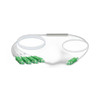
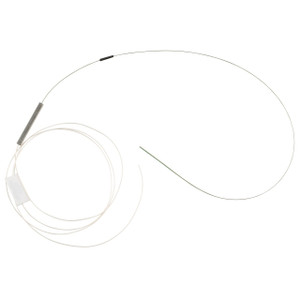
Ubiquiti UF-SPLITTER-4 Passive Optical Fiber Splitter
Overview
The Ubiquiti UF-SPLITTER-4 is a passive optical splitter that distributes a single fiber connection to four independent endpoints without requiring power, active electronics, or management overhead. This design eliminates the complexity and failure points inherent in powered distribution gear—meaning no power feeds to maintain, no configuration screens, no firmware updates. In point-to-multipoint fiber deployments, campus networks, and passive optical network (PON) rollouts, the UF-SPLITTER-4 (often searched as UF SPLITTER 4) serves as a transparent, cost-effective scaling solution that preserves signal integrity across all four output ports.
Key Features
- Four Output Ports from Single Input: One fiber feed splits to four independent lines, cutting the cost per endpoint when compared to running separate fiber strands. Useful when subscriber count or building density hasn't yet justified a powered multi-port distribution frame.
- Passive Design (No Power Required): Eliminates power supply dependencies, UPS requirements, and management traffic. The unit operates entirely through passive optical splitting—signal passes through unchanged, with no latency insertion or packet inspection. This is particularly valuable in remote or campus locations where power infrastructure is limited or unreliable.
- Zero Configuration Overhead: Deploy and forget. No IP addresses, no management interfaces, no firmware lifecycle. Reduces operational burden on integrators and network teams managing hundreds of endpoints.
- Signal Integrity Preserved: All protocols and wavelengths pass through unchanged. Whether you're running Ethernet, video, or wavelength-division multiplexing (WDM), the splitter maintains full transparency. No protocol dependencies or compatibility concerns.
- Lightweight Form Factor (0.150 lb): Mounts directly into fiber patch panels, splice trays, or wall-mounted enclosures without requiring additional structural reinforcement. Small footprint integrates seamlessly into existing fiber distribution infrastructure.
- Seamless UISP Integration: Works transparently with Ubiquiti's UniFi Fiber and UISP ecosystems. Downstream fiber termination equipment (OLTs, ONUs, fiber modems) provision and manage connections without any splitter-specific configuration.
Deployment Patterns
The UF-SPLITTER-4 fits multiple architectural scenarios. In point-to-multipoint topologies, a single fiber backhaul from a central hub splits to serve four remote sites or subscriber groups—reducing backhaul fiber count and associated installation labor. Campus deployments use the splitter at distribution nodes to fan out a single feeder fiber across multiple buildings or floors, particularly in older campuses where new fiber runs are costly or impractical. Multi-tenant environments rely on the UF-SPLITTER-4 at the demarcation point to provision separate fiber connections to individual tenants, each with independent service levels and provider connections. Service provider PON infrastructure leverages passive splitters as a staged scaling approach—one splitter serves cost-effectively when subscriber density is low, and additional splitters or powered distribution gear is added only as demand grows.
Installation Considerations
Mount the UF-SPLITTER-4 in fiber splice trays, wall-mounted fiber termination boxes, or inside standard 19-inch patch panels. Ensure proper strain relief on all four output ports during service loops to prevent connector stress and signal loss over time. After installation, test insertion loss across each output port—particularly important in long-run deployments or scenarios where signal margin is already tight. The unit's lightweight design simplifies mounting, but proper mechanical support prevents connector movement that can degrade performance on marginal links.
Frequently Asked Questions
Q: Does the UF-SPLITTER-4 require power or management?
A: No. The splitter is entirely passive. There is no power consumption, no IP address assignment, no configuration needed. Signals pass through unchanged.
Q: What is the maximum distance I can run fiber before or after the splitter?
A: Distance is determined by fiber type, termination equipment (modems, ONUs, transceivers), and insertion loss budgets—not the splitter itself. The splitter is transparent and introduces only passive optical loss. Work with your downstream equipment vendor to confirm signal budget.
Q: Can I cascade multiple UF-SPLITTER-4 units?
A: Yes, but each additional split stage adds insertion loss. Confirm your overall optical budget (signal strength at the endpoint) remains within equipment specifications before cascading.
Q: Will the UF-SPLITTER-4 work with single-mode and multimode fiber?
A: Yes. The splitter is passive and mode-agnostic. Confirm connector types (SC, LC, ST, etc.) match your fiber plant and termination equipment.
Q: What is the insertion loss per port?
A: Typical 1:4 passive splitters introduce approximately 7–8 dB loss per output port. Refer to the detailed datasheet for exact specifications and confirm your equipment can tolerate this loss over the full run distance.
Q: Is the UF-SPLITTER-4 covered under Ubiquiti warranty?
A: Refer to the product datasheet or contact Ubiquiti directly for warranty terms specific to your region and purchase channel.
Ted PerryPerspective based on aggregated IP Security Depot and affiliated engineering team experience.
The UF-SPLITTER-4 represents the kind of engineering discipline that too often gets overlooked in modern fiber deployments. We trade active complexity for passive transparency—and the UF-SPLITTER-4 embodies that choice. I've commissioned dozens of these across PON and campus rollouts, and the operational savings compound quickly: no power feeds, no management overhead, no single points of failure. Deploy it once in a fiber patch panel, test insertion loss post-install, and move on.
Technical Highlights:
- Passive 1:4 Optical Split (no power): Eliminates power supply and UPS requirements. Real savings when distributed across hundreds of endpoints over a three-year refresh cycle.
- Insertion Loss Budget: Typical ~7–8 dB per output port. This is the cost of the split; verify your termination equipment (modems, ONUs) tolerates this loss over the full run distance before deployment.
- Lightweight (0.150 lb) and Compact: Integrates into existing fiber splice trays and patch panels without structural reinforcement. A small form factor with no surprises.
Deployment Considerations:
- Test insertion loss on all four ports post-installation, especially in longer runs or scenarios where signal margin is already tight. A marginal link becomes a problem only after you're live.
- Cascading multiple splitters is possible but compounds insertion loss quickly. Run the optical budget calculation before cascading to avoid downstream signal failure.
The UF-SPLITTER-4 shines in staged fiber rollouts where you're splitting a central fiber feed to multiple remote sites or subscriber groups without the cost or complexity of powered distribution gear. It's the right tool when your topology supports passive splitting and your downstream equipment can absorb the insertion loss.