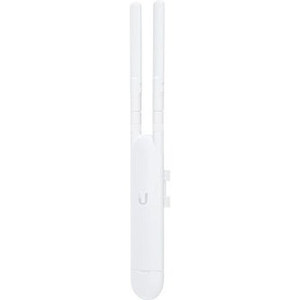
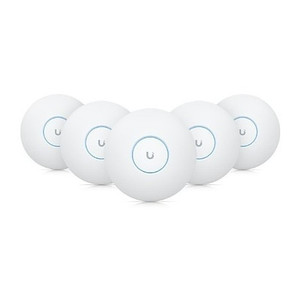
Ubiquiti UAP-AC-HD-US High-Density Outdoor Access Point
Overview
The Ubiquiti UAP-AC-HD-US is a purpose-built external access point engineered for large-scale enterprise and carrier deployments where dense client populations demand sustained bandwidth delivery. Operating on the 802.11ac Wave 2 standard, this unit delivers 2533 Mbps aggregate throughput across dual bands—a meaningful advantage in outdoor or weather-protected environments like campus networks, stadiums, hospitality venues, and industrial facilities where internal APs cannot achieve required coverage density or performance. The external form factor is designed for mounting on structural elements common in these environments, with a 3.95 lb weight that permits installation on existing supports without reinforcement in most scenarios. When deployed as part of a unified access point strategy, the UAP-AC-HD-US scales horizontally across large territories while maintaining seamless roaming for mobile clients.
Key Features
- 802.11ac Wave 2 with Multi-User MIMO: Simultaneous multi-user MIMO increases spectral efficiency in high-client-density zones. Translation: more clients can transmit and receive simultaneously without waiting their turn, which directly reduces latency and improves throughput fairness when you're pushing dozens of devices through a single AP—critical in outdoor event venues or warehouse floors where traditional interference management isn't an option.
- 2533 Mbps Aggregate Throughput: This is the sum of 5 GHz and 2.4 GHz bands combined. In real deployments, expect roughly 50–70% of this theoretical maximum depending on client device capabilities and RF conditions, but that still translates to genuine multi-gigabit capacity on the backhaul—enough to handle sustained streaming, voice, and data across high-client counts without saturation.
- PoE+ Power Delivery: Draws up to 90W via PoE+ (802.3at+), eliminating the need for a separate power outlet at the mounting location. This simplifies infrastructure planning and reduces installation labor—you run one CAT6A cable to the AP, and you're done. Budget CAT6A or better for runs exceeding 100 meters to maintain PoE+ voltage headroom.
- Dual-Band Design with Simultaneous Operation: Both 5 GHz and 2.4 GHz bands operate at the same time. The 5 GHz band handles high-throughput clients, while 2.4 GHz provides coverage for legacy devices and penetration in obstacle-heavy environments. This avoids the "choose one or the other" problem that plagues single-band deployments.
- UniFi Ecosystem Integration: Centralized management via Ubiquiti UniFi controller simplifies provisioning, monitoring, and firmware updates across dozens or hundreds of APs. Standard ONVIF-compliant protocols ensure third-party WLAN management platforms can also ingest data via DNS, DHCP, and RADIUS authentication without proprietary gateways.
- Robust Outdoor Mechanical Design: External housing supports outdoor or weather-protected mounting. Stainless steel or corrosion-resistant hardware is required for coastal or high-humidity environments to prevent degradation of mounting points.
Integration & Compatibility
The UAP-AC-HD-US integrates with Ubiquiti UniFi controllers and third-party WLAN management platforms via standard enterprise protocols. PoE+ power injection requirements must be confirmed against your existing switch infrastructure—verify that your PoE+ ports can supply 90W maximum and that your UPS or power conditioning can handle simultaneous injection across multiple APs. Firmware updates maintain compatibility with evolving security standards and performance patches. The device operates within standard enterprise network architectures without requiring dedicated gateways or proprietary licensing.
Deployment Considerations
This AP functions effectively in outdoor campus networks, large indoor venues, and mixed-use environments. High-traffic zones—conference facilities, data center perimeters, warehouse floors—benefit from the 2533 Mbps capacity. Multiple units deployed in coordination create seamless roaming across large territories. When evaluating whether the UAP-AC-HD-US is the right fit, consider your client density (devices per AP), expected throughput per user, and whether your backhaul infrastructure can sustain the AP's uplink. If you require tri-band operation, 802.11ax (Wi-Fi 6), or advanced per-client analytics, evaluate higher-tier Ubiquiti access point models for comparison.
Frequently Asked Questions
Q: What is the maximum PoE+ power draw for the UAP-AC-HD-US?
A: The UAP-AC-HD-US draws a maximum of 90W via PoE+ (802.3at+). Confirm your switch has available PoE+ capacity on the specific port you plan to use, and verify that your power infrastructure (UPS, PDU) can handle simultaneous injection across all APs in your deployment.
Q: Can the UAP-AC-HD-US be mounted indoors?
A: Yes. The "external" designation refers to the form factor and weatherproofing, not a restriction on indoor use. It performs well in weather-protected interior spaces (data center ceilings, warehouse mezzanines, indoor parking structures) where coverage density is high and you're leveraging the 2533 Mbps throughput.
Q: Is the UAP-AC-HD-US compatible with non-Ubiquiti WLAN controllers?
A: Yes, provided the third-party platform supports standard enterprise protocols (DHCP, RADIUS, DNS). Integration is most straightforward with Ubiquiti UniFi controllers, but ONVIF-compliant management systems can also manage the AP if they implement standard wireless authentication schemes.
Q: What cable type do you recommend for PoE+ delivery over long distances?
A: Use CAT6A or better for runs exceeding 100 meters. Runs under 100 meters can use CAT5e, but CAT6A is preferred to maintain voltage headroom for the full 90W power delivery and avoid voltage drop issues at the AP.
Q: Can multiple UAP-AC-HD-US units coordinate for seamless roaming?
A: Yes. When managed by a UniFi controller, multiple UAP-AC-HD-US units can be configured with the same SSID and security settings to enable seamless roaming. Clients move between APs based on signal strength without dropping connections, which is essential for high-density outdoor deployments like stadiums or large event venues.
Q: Does the UAP-AC-HD-US support band steering?
A: Band steering and other client management features are controlled via the UniFi controller software rather than the AP itself. Configure band steering, airtime fairness, and minimum RSSI thresholds in the controller to optimize client experience across your AP network.
James EverettPerspective based on aggregated IP Security Depot and affiliated engineering team experience.
The UAP-AC-HD-US is a straightforward workhorse for outdoor enterprise WLAN deployments. The 2533 Mbps Wave 2 implementation isn't bleeding-edge, but it's proven and stable in high-client-density scenarios where you need predictable throughput and centralized management. The PoE+ architecture—90W maximum draw—simplifies installation labor and eliminates the need for power conditioning at each mounting point, which is a real win on campus networks or stadiums with dozens of APs.
Technical Highlights:
- 2533 Mbps Aggregate Throughput: Wave 2 multi-user MIMO ensures efficient spectral use when client density is high. Real-world throughput typically runs 50–70% of theoretical max, but that's still plenty of bandwidth to handle sustained traffic across 40–60 concurrent clients without saturation.
- 90W PoE+ Power Budget: Eliminates dedicated power outlets at mount points. CAT6A cabling over 100 meters maintains voltage headroom; CAT5e works for shorter runs but introduces unnecessary risk if you're planning for future scaling.
- Dual-Band Simultaneous Operation: 5 GHz handles capacity, 2.4 GHz provides coverage and legacy device support. No band-switching overhead means clients don't drop when roaming between frequency bands.
Deployment Considerations:
- UniFi controller is essential for centralized management and firmware updates. Third-party platforms work via standard protocols, but you lose visibility and automation if you don't use the UniFi ecosystem.
- Outdoor mounting requires corrosion-resistant hardware (stainless steel or equivalent) in coastal or high-humidity environments. Aluminum mounts will fail in salt spray—this is a common gotcha on seafront deployments.
- Backhaul bandwidth is critical. If your uplink can't handle the AP's throughput, you'll create a bottleneck. For large multi-AP deployments, validate that your wired network infrastructure has sufficient capacity on the backbone.
The UAP-AC-HD-US wins in outdoor event venues, warehouse floors, and campus networks where you prioritize reliability and simplicity over cutting-edge features. If you need 802.11ax, tri-band support, or per-client deep analytics, step up to a higher-tier Ubiquiti model. But for solid, predictable performance in established outdoor infrastructure, the UAP-AC-HD-US (often searched as UAP AC HD US) remains a rational choice.