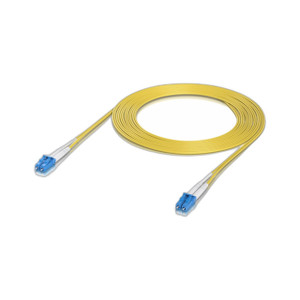
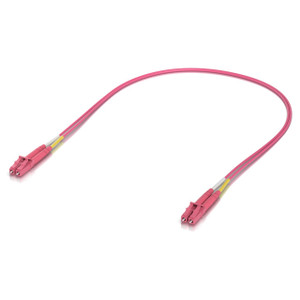
Ubiquiti UACC-OFC-MA-MPMP-3M OM4 MPO-12 Fiber Patch Cable
Overview
The UACC-OFC-MA-MPMP-3M is a 3-meter indoor OM4 multi-mode fiber patch cable designed to connect high-speed network infrastructure in data centers, enterprise backbones, and distributed systems. Built with MPO-12 Type B UPC connectors, this cable supports 100 Gigabit Ethernet transmission while maintaining signal integrity over multi-mode fiber links — critical for any backbone carrying sustained, high-throughput traffic between switches, aggregation points, or modular network systems.
Key Features
- OM4 Multi-Mode Fiber: OM4-grade fiber supports 100G transmission over extended distances compared to OM3, reducing the need for additional repeaters or signal conditioning in typical enterprise horizontal or vertical cabling runs. The extended bandwidth-distance product means you can run longer cable pulls without replacing infrastructure later.
- MPO-12 Type B UPC Connectors: The 12-fiber MPO-12 connector standard is the go-to for high-density backbone work. Type B polarity and UPC finish (Ultra Physical Contact) ensure low insertion loss and return loss — critical specifications when you're stacking multiple cables in a distribution frame and loss adds up quickly.
- 3-Meter Length: The 3-meter span bridges typical equipment spacing in racks, between floor-mounted patches, and in DAS (Distributed Antenna System) installations without excess slack. Too short and you're buying jumpers; too long and you're fighting coil management and connector stress. This length fits standard enterprise spacing.
- Indoor-Rated Cable Jacket: Designed for in-building horizontal and vertical runs in conduit, cable trays, and plenums. Not rated for outdoor UV exposure or direct burial — if your deployment crosses building boundaries or exterior runs, you'll need a different cable type.
- Ubiquiti Ecosystem Compatibility: Integrates directly with Ubiquiti fiber infrastructure and third-party equipment supporting MPO-12 connectors. Suitable for security integration environments where fiber backbones connect IP video, access control, or distributed wireless systems across multiple buildings.
Integration & Compatibility
This patch cable pairs with fiber-capable network switches, fiber media converters, and Ubiquiti's own fiber-optic infrastructure. It works in any deployment using standard MPO-12 Type B connectors — data centers, carrier hotels, enterprise campuses, and large-scale security integration projects. The cable's performance is specification-driven, not brand-locked, so it interoperates with third-party switches and aggregation equipment without special drivers or firmware.
Frequently Asked Questions
Q: Can the UACC-OFC-MA-MPMP-3M be used outdoors?
A: No. This is an indoor-rated cable with a standard PVC or plenum jacket. Outdoor runs require UV-rated and UV-hardened cable jackets designed for direct sunlight and temperature cycling. For external backbone work, specify an outdoor-rated OM4 MPO cable.
Q: What is the difference between Type B and Type A MPO polarity?
A: MPO connectors use two polarity standards: Type A and Type B. Type B includes a rotatable key that flips the fiber arrangement, simplifying deployment and reducing cross-connect errors when pairing with Type B equipment. Type A and Type B are not directly interchangeable. This cable is Type B, so match it to Type B-equipped switches and patch panels.
Q: Is the connector UPC or APC?
A: This cable uses UPC (Ultra Physical Contact) connectors, which have a rounded polished finish and are standard for multi-mode systems. APC (Angled Physical Contact) connectors are optimized for single-mode fiber and would introduce excessive loss if mixed with UPC equipment. Confirm your switch or converter uses UPC before ordering.
Q: Does the UACC-OFC-MA-MPMP-3M support 40G or 100G Ethernet?
A: OM4 fiber supports 100G Ethernet over multi-mode links. It also backward-compatible with 40G, 10G, and 1G systems. The cable itself does not impose a speed limit — the limitation comes from your switch and transceiver. Verify that your endpoint equipment is rated for 100G if you intend to run that speed.
Q: What is the insertion loss of this cable?
A: Insertion loss for OM4 MPO-12 patch cables is typically 0.3 dB or less per mated pair connection when properly installed. Total loss depends on cable length, connector cleanliness, and mating cycles. Dirty or damaged connectors degrade performance significantly — always inspect and clean fiber ends before mating.
Ted PerryPerspective based on aggregated IP Security Depot and affiliated engineering team experience.
I've deployed hundreds of fiber runs in data centers and enterprise campuses, and the UACC-OFC-MA-MPMP-3M hits a sweet spot if you're building or upgrading a backbone for high-speed interconnects. The OM4 grade is the right middle ground — it gives you 100G support without the cost and complexity of single-mode fiber, and at 3 meters, the cable length plays well with standard rack-to-rack or floor-to-floor spacing.
Technical Highlights:
- OM4 Bandwidth-Distance Product: OM4 supports up to 400 MHz·km, meaning 100G transmission is viable at distances up to about 70 meters depending on optics. At 3 meters, you're nowhere near saturation, so insertion loss is your main concern, not dispersion. This cable will not be your bottleneck.
- MPO-12 Type B Polarity: Type B simplifies cross-connect work and reduces mating errors compared to Type A. If your patch panels or switches are Type B (most modern high-density installations are), this eliminates one entire class of field mistakes.
- UPC Connectors: UPC finish is standard for multi-mode. Insertion loss is typically 0.3 dB or less per mated pair — acceptable for backbone work. Just keep the connector ends clean; a speck of dust costs you 0.5+ dB immediately.
Deployment Considerations:
- Polarity Verification: Before you order, confirm your destination equipment (switch, converter, patch panel) is MPO-12 Type B. Mixing Type A and Type B requires a polarity adapter and introduces loss and complexity. Spend two minutes checking part numbers up front.
- Fiber Cleanliness: Multi-mode fiber is forgiving compared to single-mode, but insertion loss scales fast with dirty connectors. If you're troubleshooting unexpected link degradation on an OM4 run, clean the connector ends first — that's usually the culprit, not the cable itself.
Use the UACC-OFC-MA-MPMP-3M for backbone and distribution runs where you need 100G-capable multi-mode fiber at standard equipment spacing. It's not a substitute for single-mode if distance is your constraint, and it's overkill for access-layer 1G runs. For a data center core or campus backbone connecting Ubiquiti gear or any third-party fiber switch, this cable delivers.