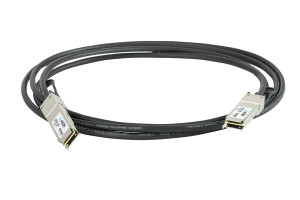
Ubiquiti UACC-DAC-QSFP28-1M 100 Gbps Direct Attach Cable
The UACC-DAC-QSFP28-1M is a passive direct attach cable (DAC) built for 100 Gbps Ethernet links between QSFP28-equipped network infrastructure. This 1-meter copper interconnect eliminates the need for separate transceiver modules—a meaningful cost reduction and latency improvement in short-reach deployments like data center spine-leaf architectures, server-to-switch connections, and network core equipment stacking.
Key Features
- 100 Gbps throughput over 1 meter: Full bandwidth with zero transceiver overhead. Passive design means no power draw and no compatibility negotiation—the cable carries signal end-to-end without active electronics, which eliminates a potential failure point in critical infrastructure.
- Passive copper construction: No active components means lower cost per link than equivalent SFP28 transceiver solutions and no thermal management burden on your switch. In dense rack environments, this matters—fewer power supplies, fewer heat-generating modules, simpler sparing logic.
- QSFP28 connector on both ends: Designed for direct insertion into QSFP28 ports on enterprise switches and routers, high-performance servers, and aggregation hardware. Works with any standards-compliant QSFP28 socket; vendor lock-in is not a concern here.
- 1-meter length optimized for rack-to-rack or chassis-to-chassis links: Long enough to bridge adjacent equipment in a standard 42U rack without cable strain; short enough that signal degradation is negligible. If you need longer distances (10m+), you'll require optical transceivers instead.
- Backward compatibility within the QSFP28 ecosystem: The UACC-DAC-QSFP28-1M integrates into any network architecture using QSFP28 signaling—Ubiquiti switches, third-party data center switches, and modular routing platforms. ONVIF compliance is not applicable here; this is a dumb-pipe interconnect.
- Low-latency transmission: Copper direct attach introduces approximately 1–2 nanoseconds of propagation delay across the 1-meter span—meaningless for Ethernet, but worth noting if you're doing sub-microsecond timing (rare outside HFT labs). For typical enterprise and surveillance network core deployments, latency is negligible compared to switch fabric and software overhead.
Integration & Compatibility
Install this cable between any two QSFP28-equipped devices. Common pairings include Ubiquiti high-performance switches in leaf-spine topologies, direct server-to-storage connections in converged infrastructure environments, and network appliance clustering. No drivers, no firmware, no provisioning required—this is a passive connector. Ensure both endpoints support QSFP28 (not QSFP or QSFP+ variants, which are different pin/speed standards).
When evaluating placement, verify physical space inside your rack. Some patch panels and dense equipment housings leave limited clearance for bulky QSFP28 connectors; test fit before deployment if space is tight.
When to Choose a Different Approach
If your link distance exceeds 5 meters, you cannot use passive DAC. Migrate to QSFP28 optical transceivers (e.g., SR4, PSM4 variants) paired with fiber cabling. For 40 Gbps or slower speeds where equipment already has SFP+ ports, consider lower-cost SFP28 transceivers instead.
Frequently Asked Questions
Q: Does the UACC-DAC-QSFP28-1M work across different switch vendors?
A: Yes. This is a standards-compliant QSFP28 passive cable. It works with any device that has a QSFP28 port, regardless of manufacturer. There are no Ubiquiti-specific handshakes or firmware requirements.
Q: What's the maximum distance for reliable 100 Gbps operation on the UACC-DAC-QSFP28-1M?
A: Passive direct attach cables are IEEE 802.3 compliant up to approximately 3–5 meters depending on electrical characteristics and switch silicon. The UACC-DAC-QSFP28-1M is certified for 1 meter, which provides a strong margin. Beyond that, optical transceivers are required.
Q: Does this cable require any power?
A: No. Passive DAC draws no power. There is no transceiver module, no laser, no electronics inside the cable itself. It is purely copper conduction.
Q: Can I use the UACC-DAC-QSFP28-1M in a surveillance network core?
A: Yes, if your surveillance NVR or network video recorder backend uses QSFP28-equipped switching fabric, this cable can link your storage tier to your compute tier. However, most IP surveillance networks use 1 Gbps or 10 Gbps Ethernet, not 100 Gbps. Verify your equipment specs before ordering.
Q: Is this cable NDAA Section 889 compliant?
A: Ubiquiti publishes NDAA compliance information at the component level. Consult the manufacturer's compliance documentation or your procurement team for the most current posture on this cable.
Ted PerryPerspective based on aggregated IP Security Depot and affiliated engineering team experience.
The UACC-DAC-QSFP28-1M is your go-to for closing 1-meter gaps in high-speed fabric deployments where every switch port matters. The passive architecture means no transceiver negotiation overhead, no thermal margin consumed on the switch, and a straightforward replacement story if the cable fails. In dense spine-leaf topologies, that simplicity compounds across dozens of links.
Technical Highlights:
- 100 Gbps passive copper: Full bandwidth without active electronics—switch a fiber transceiver pair to fiber, and this cable to copper, and you cut optics cost by roughly 3–5x for short distances while keeping signal integrity rock-solid.
- 1-meter optimized length: This is your workhorse for in-rack or adjacent-rack stacking. It's not meant for cross-room backbone; that's why 5–10m limits exist on passive DAC. Know your distance budget before you buy, because going longer forces an optical conversation.
- Standards-compliant QSFP28: IEEE 802.3 passive DAC spec compliance means this cable is vendor-agnostic. Test your switch release notes to be sure QSFP28 DAC support is enabled (most enterprise platforms ship with it enabled by default), but there's no lock-in here.
Deployment Considerations:
- Verify your switch BIOS or firmware version supports passive QSFP28 DAC before deployment. A few legacy switching platforms only supported active optics. Confirm in your hardware compatibility matrix.
- Connector fatigue is real in high-churn environments. QSFP28 sockets are robust but not infinite—if you're regularly hot-swapping cables in test labs, factor in periodic connector cleaning and eventual socket replacement on gear that gets heavy reseating.
Deploy this cable in any enterprise data center, surveillance backend, or high-performance compute cluster where you have QSFP28 switching infrastructure and links stay under 3 meters. It's the transparent plumbing that lets you spend transceiver budget on longer, more critical fiber runs.