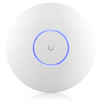
Ubiquiti U6-PRO WiFi 6 Dual-Band Access Point
The Ubiquiti U6-PRO is a dual-band WiFi 6 access point engineered for enterprise and high-density indoor environments where client count and throughput stability matter. It aggregates 5.3 Gbps across the 5 GHz (4.8 Gbps) and 2.4 GHz (573.5 Mbps) bands, and handles 250+ concurrent clients across coverage areas up to 140 m² (1,500 ft²) — critical for warehouse control zones, manufacturing facilities, and multi-tenant office deployments where a single access point must serve dozens of mobile devices and sensors without degradation.
Key Features
- Dual-Band WiFi 6 (802.11ax) with MU-MIMO: 4x4 MU-MIMO on 5 GHz and 2x2 on 2.4 GHz means the U6-PRO transmits to multiple clients simultaneously rather than sequentially — reducing latency for mobile warehouse terminals, IoT sensors, and guest devices competing for bandwidth. This translates directly to faster barcode scans and lower response times in busy automation environments.
- 5.3 Gbps Aggregate Throughput: Supports channel widths up to 160 MHz on 5 GHz, delivering data rates through MCS11 modulation. In real deployments, this headroom absorbs interference, roaming overhead, and security encryption without starving connected clients — especially important when running video surveillance handoff or bulk file transfers alongside wireless POS terminals.
- 8 BSSIDs per Radio: Partition network access into up to 8 separate SSIDs per band. Deploy a guest network isolated from production IoT, segment contractors from warehouse systems, or run dedicated SSIDs for mobile fulfillment devices — all from a single access point. Each SSID can enforce different security policies, QoS rules, and VLAN assignments.
- Advanced Roaming (802.11k, 802.11v, 802.11r): RRM (Radio Resource Management), BSS Transition Management, and Fast Roaming allow client devices to hand off between access points without dropping connections. Critical for mobile warehouse carts, forklift operators with tablets, or maintenance staff moving between zones — no reconnection delays.
- Band Steering and Mesh Support: Automatically nudge dual-band capable clients toward the less congested band, and extend coverage via wireless backhaul to remote warehouse corners without running Ethernet. Reduces manual load balancing and simplifies phased deployment in sprawling facilities.
- IP54 Rating with Stainless Steel Mount: Rated IP54 means the U6-PRO resists dust and splashing water — appropriate for warehouse environments with climate control and light moisture (dock spray, humidity). The included stainless steel mount supports both ceiling and wall installation; confirm mechanical attachment to structural elements before commissioning. Not rated for direct outdoor exposure or humid HVAC returns; IP67 alternatives exist for those use cases.
- PoE+ (802.3at) Powered at 13W Max: Draws 13 watts, well within standard PoE+ supply limits. Run it from any managed PoE+ switch without dedicated power supplies — simplifies cabling and reduces the device footprint at the AP location. One Gigabit Ethernet uplink consolidates both data and power to a single cable run.
- Captive Portal, RADIUS over TLS (RadSec), Dynamic VLAN Assignment: Guest network branding, enterprise authentication, and per-user/per-device VLAN assignment integrate with existing identity infrastructure — useful in shared facilities where IT must segregate tenants or enforce role-based access without manual switch configuration. Client device isolation prevents lateral ARP spoofing and peer-to-peer attacks on guest networks.
- Bluetooth Management: Low-energy BLE enables out-of-band provisioning and location services without consuming WiFi bandwidth — supports UniFi mobile app commissioning and presence detection for occupancy-based lighting or zone-entry logging.
- WiFi Scheduling and Private Pre-Shared Key (PPSK): Enable/disable SSIDs on a schedule (useful for guest networks during business hours only) and assign unique passphrases per client device while sharing a single SSID — simplifies onboarding and revocation without recreating network credentials site-wide.
Integration & Deployment Notes
The U6-PRO integrates with Ubiquiti's UniFi platform, managed via the UniFi Network application (cloud or self-hosted). It supports adoption into existing UniFi controller deployments without firmware conflicts. Standard PoE-enabled network switches with 802.3at output provide both power and uplink connectivity; calculate your site's concurrent client load and throughput demand to size uplink capacity and access point density. For high-density deployments exceeding 200 clients per floor, plan for multiple U6-PRO units or consider larger enterprise WiFi solutions.
Guest network isolation, RADIUS integration, and VLAN-based segmentation require UniFi controller configuration — not automatic. Wireless meshing introduces backhaul overhead; reserve at least 25–30% of available bandwidth for mesh traffic, or prefer wired uplinks where Ethernet runs are available.
What's in the Box
- 1x U6-PRO Access Point
- 1x Professional Mount (Stainless Steel)
Frequently Asked Questions
Q: Can the U6-PRO be used outdoors?
A: The U6-PRO carries an IP54 rating, which protects against splashing water and dust in controlled indoor environments (warehouses, office buildings). It is not designed for direct outdoor exposure, continuous rain, or permanent outdoor mounting. For outdoor deployments, consult outdoor-rated access points in the Ubiquiti lineup.
Q: What is the maximum number of access points I can deploy on a single UniFi controller?
A: UniFi controllers can manage hundreds of access points in a single network; the practical limit depends on controller hardware and network topology rather than software licensing. Standard UniFi Cloud Key or Dream Machine platforms support 50–200 access points per controller before performance degrades. For large multi-site deployments, consider load-balancing across multiple controllers or a commercial UniFi Dream Machine Pro.
Q: Does the U6-PRO support Power over Ethernet Injector or require a PoE+ switch?
A: The U6-PRO requires PoE+ (802.3at, minimum 30W available). A passive PoE injector will not deliver sufficient power. Use a managed PoE+ switch with 802.3at output, or pair it with a certified PoE+ injector rated for at least 30W continuous output. Confirm the injector supports the correct voltage and current before installation.
Q: Can I wall-mount the U6-PRO, or must it be ceiling-mounted?
A: The included stainless steel mount supports both ceiling and wall installation. Wall mounting may reduce vertical coverage and increase dead zones directly behind the unit; ceiling mounting typically provides better azimuthal coverage. Confirm wall construction can support the unit's weight and vibration before fastening.
Q: What is the expected battery backup or failover behavior if PoE power is lost?
A: The U6-PRO has no onboard battery and will power down if the PoE supply is interrupted. For redundancy, deploy multiple U6-PRO units on separate PoE switches, or install UPS backup on your PoE switch. The UniFi controller will detect the offline access point and can trigger alerts or hand off clients to remaining units.
Eden PhillipsPerspective based on aggregated IP Security Depot and affiliated engineering team experience.
The Ubiquiti U6-PRO (often searched as U6 PRO) is a solid choice for warehouse automation and enterprise indoor deployments where you need density, roaming stability, and low administrative overhead. The 5.3 Gbps aggregated throughput and 250+ concurrent client support make this unit a legitimate workhorse for multi-tenant facilities, manufacturing floors, or logistics hubs where dozens of mobile devices and IoT sensors must maintain consistent connectivity without needing a dedicated WiFi 6E upgrade.
Technical Highlights:
- 4x4 MU-MIMO on 5 GHz + 2x2 on 2.4 GHz: This means the U6-PRO can talk to four clients simultaneously on the faster band rather than queuing them — a real difference when your warehouse is running simultaneous barcode scans, video uploads from mobile carts, and guest device traffic. You will see measurable latency drops versus legacy 802.11ac units in congested environments.
- 140 m² (1,500 ft²) coverage per unit at 250+ clients: This is the practical carrying capacity in real deployments. A single U6-PRO will not serve a 300-person warehouse without choking; plan for one AP per 1,200–1,500 sq. ft. if you expect sustained high client counts or bandwidth-heavy operations like real-time location services or video handoff.
- 13W PoE+ draw: This is lean — you can run eight U6-PROs from a single 96W PoE+ switch port cluster without exhausting the budget. No external power supplies, no additional wiring, just one cable per unit. Simplifies installation and reduces maintenance attack surface.
- IP54 rating: Dust and splash tolerance, not submersion. Your warehouse must be climate-controlled and fairly dry (dock areas excluded). If you are mounting this above a misting humidifier or in an open-sided structure, expect condensation issues and premature corrosion.
Deployment Considerations:
- Roaming depends on client device firmware and AP-to-AP signal overlap. A single U6-PRO has no roaming partner — that feature activates when you deploy two or more units in proximity. If you start with one unit and add more later, existing clients may not hand off gracefully until you cycle them offline; test before going live in high-mobility scenarios.
- Wireless mesh backhaul cuts available bandwidth roughly in half on the backhaul path. If your site has intermittent Ethernet runs or only wired connectivity at one corner, the cost of deploying an additional U6-PRO as a mesh repeater is real — expect 40–50% goodput reduction on the meshed unit. Wherever possible, wire APs to PoE switches directly.
- The U6-PRO has no onboard battery and no built-in failover. If your warehouse operation demands zero-downtime WiFi, deploy at least two units and plan UPS backup on your PoE switch. A single AP failure leaves your warehouse dark.
Best-fit scenarios: multi-floor office buildings with mixed corporate and guest traffic, mid-size warehouse automation hubs (under 15,000 sq. ft. per controller), and manufacturing facilities where roaming forklift operators and maintenance tablets need stable handoff. If you are deploying into a high-motion environment (mobile carts, AGVs, hundreds of concurrent IoT devices), start with a density plan of one AP per 1,200–1,500 sq. ft. and test before commissioning.