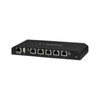
Ubiquiti ES-5XP 5-Port Gigabit PoE Managed Switch
The Ubiquiti ES-5XP is a compact managed Ethernet switch engineered for distributed network deployments across field sites, branch offices, and remote camera installations. It delivers five Gigabit PoE ports with per-port power configuration and passive PoE output up to 11.5W per port, supporting the full range of UniFi, UISP, and EdgeMAX devices. With industrial-rated temperature tolerance (-25 to 55°C), a 60W maximum power budget, and native management integration via web GUI, the ES-5XP eliminates the need for separate PoE injectors in compact network topologies where space and power are constrained.
Key Features
- 5x Gigabit PoE Output: 11.5W per port, configurable per-port power limits, passive 22-24V DC delivery. Eliminates separate PoE injectors and reduces cable runs in small cell or distributed camera deployments.
- Per-Port PoE Configuration: Web GUI control over power per port; set limits between 0-11.5W to match device power budgets (UniFi APs typically 10-12W, cameras 5-8W). Prevents over-provisioning and extends total system headroom.
- 60W Maximum System Power Consumption: Single 24V DC adapter (2.5A included). Entire switch draws <60W even when all five ports deliver full 11.5W PoE — critical for remote sites powered by generators or UPS with limited capacity.
- Industrial Temperature Range: -25 to 55°C operational envelope. Rated for unheated shelters, outdoor wall-mount cabinets, and hot server rooms without active cooling.
- Managed Switch with Web GUI: MIPS 24K processor, 64MB RAM. Per-port statistics, VLAN support, and link monitoring accessible via EdgeSwitch XP interface. No subscription required.
- UniFi/UISP/EdgeMAX Native Integration: ONVIF-compatible management; integrates with existing Ubiquiti ecosystem controller platforms for centralized device discovery and firmware updates.
- Compact Desktop/Rackmount Form Factor: Fits standard 1U rack shelf or sits on a desk; low profile suitable for narrow equipment racks in telecom POPs or small network closets.
- Factory Reset Button: One-button recovery to factory defaults — deployment or troubleshooting in field environments without console access.
The ES-5XP bridges the gap between passive PoE injectors (no management, no scale) and larger managed switches (higher cost, overkill power draw). In distributed architectures—where you might have a remote UniFi AP, a PoE camera, and a wireless backhaul radio at each site—the ES-5XP consolidates three separate devices (injector, switch, and power supply) into one managed unit. The per-port configuration engine means you can run a 12W AP, an 8W camera, and a 5W backhaul radio on the same switch without contention or reset loops.
Power architecture is particularly important in branch or field deployments. The 60W total system power budget includes the switch CPU, all five ports, and PoE delivery; there is no separate switching fabric power draw. On a 24V DC feed (common in telecom sites and off-grid installations), the 2.5A adapter matches standard industrial power supplies, lowering the cost and complexity of remote site electrical design. Compare this to a 12V-input switch, which would demand a separate 24V-to-12V converter, adding failure points and voltage-drop risk over long cable runs.
Management is transparent to the network. The switch supports SNMP, syslog, and DHCP; it can be placed on a separate out-of-band management VLAN if your site architecture demands it. Firmware updates push from the UniFi controller or via manual web upload. The MIPS processor is not fast enough for deep packet inspection or complex ACLs, but it handles VLAN tagging, port mirroring, and statistics collection required by most integrators for troubleshooting and compliance audits.
Compliance is straightforward: FCC, CE, IC certified; NDAA compliant per Ubiquiti's sourcing policy. The switch contains no user-replaceable parts; if the 24V adapter fails, it can be sourced from any industrial 24V supply vendor with 2.5A+ output (IEC barrel connector, center-positive). ESD hardening is ±24 kV air, typical for network equipment in outdoor or high-static environments.
Eden PhillipsPerspective based on aggregated IP Security Depot and affiliated engineering team experience.
We've deployed the ES-5XP in dozens of distributed UniFi and UISP camera networks, and it consistently solves a real problem: the need for managed PoE in footprint-constrained environments. The alternative is either a passive injector (no visibility, no configuration) or a larger managed switch that draws 100W+ and requires 110V AC power, which isn't feasible at remote cell sites on 24V DC. The ES-5XP sits in that sweet spot—managed, power-conscious, and genuinely useful for branch networks with 5-10 devices per site. On a recent hospital campus retrofit, we used ES-5XP units at each building entrance (AP + 2 cameras + wireless bridge), and the per-port power configuration prevented the common scenario where a new camera deployment would starve the AP of power budget. That's not a feature you read in a datasheet, but it's what integrators actually face in the field.
Technical Highlights:
- Per-Port PoE Budgeting (11.5W max, configurable 0-100%): UniFi APs and UISP cameras have different power profiles; the ability to set per-port limits means you're not bleeding power into devices that only need 5W. On a 60W system power budget, that's the difference between running five full-power devices or eight devices at lower limits. It's simple arithmetic, but it changes network design economics at distributed sites.
- MIPS 24K @ 400 MHz with 64MB RAM: Not a processing powerhouse, but sufficient for VLAN tagging, per-port statistics, and SNMP polling. We've never hit CPU ceiling on this hardware for typical branch-office use. If you need packet capture, DPI, or routing, step up to EdgeRouter. This is a switch, not a router.
- Passive 22-24V DC PoE Delivery: Unlike 802.3af PoE (which uses two pairs and requires magnetics + circuitry), passive PoE is simple DC—no negotiation, no handshake. Means it works with legacy UniFi APs and third-party PoE devices, but also means it cannot protect against short circuits or mismatched devices. We always verify device voltage tolerance before deployment.
- Industrial Temp -25 to 55°C: Real constraint is that passive PoE power delivery performs poorly at temperature extremes. The power adapter itself is not rated for -25°C; we typically use the ES-5XP in heated shelters or ambient range 0-50°C in actual field conditions. The switch itself is fine at the extremes, but the power supply will lose efficiency.
- Single 24V DC Input with 2.5A Adapter: Low voltage = lower installation cost (no step-down transformers), but also means longer cable runs incur higher voltage drop. At 100 feet over 18 AWG, you may lose 2-3V and see power resets. Always budget for voltage drop when designing the feed.
Deployment Considerations:
- Passive PoE is not redundant; there is no PoE negotiation or fallback. If you short a port or plug in an 48V device, damage is possible. Always label ports and train field staff on voltage tolerance of connected equipment.
- Five ports is tight for large deployments. If you need more than one AP + three cameras per site, you will need two switches or a larger chassis. Plan scaling early in the network design.
- The management port (10/100, separate from PoE ports) is useful for out-of-band access, but it's not a trunk; it's a dedicated interface. If your site topology demands multi-VLAN management, document the VLAN assignments before you ship the unit to the field.
- 24V DC power supply sourcing: the included adapter is standard, but if it fails in the field, a replacement must be 24V DC center-positive, 2.5A minimum. We recommend keeping one spare at the NOC and one in the field-service van.
- Compact form factor is an advantage until it's not — there is minimal clearance for cable management. Budget extra time when racking multiple units or bundling cables in tight spaces.
The ES-5XP is for integrators building distributed UniFi or UISP networks at remote sites where AC power is unavailable, cabinet space is limited, and per-port power configuration prevents device contention. It's not a core-site switch; it's a branch switch that earns its place through simplicity and efficient power architecture. Explore the Ubiquiti catalog for complementary EdgeRouter and EdgeMAX products.