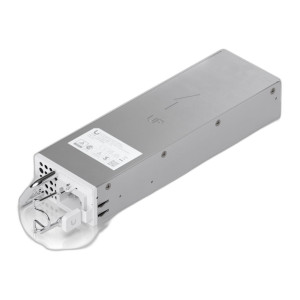
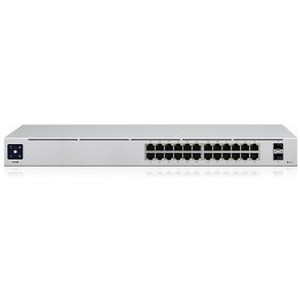
Ubiquiti ES-24-250W 24-Port Managed Gigabit PoE Switch
The Ubiquiti ES-24-250W is a 24-port managed Gigabit switch engineered for branch aggregation and distributed edge deployments where integrated PoE eliminates external power injection for access points, IP cameras, and edge compute devices. It delivers 26 Gbps non-blocking throughput across 24 Gigabit RJ45 ports paired with a 250W PoE budget, plus two SFP slots for redundant or long-haul fiber uplinks. The Layer 2 managed architecture—VLAN, port mirroring, QoS—makes it the standard choice for small-to-medium branch sites consolidating 20–24 simultaneous PoE endpoints without the complexity of enterprise-class chassis switches.
Key Features
- 24 Gigabit Ports + 250W PoE Budget: 802.3af-class power delivery supports 20–24 standard PoE devices (13W nominal) or 10–12 PoE+ devices (30W) simultaneously. No external PoE injectors required—power and data on one cable reduces installation labor and single points of failure.
- 26 Gbps Non-Blocking Throughput: Full-duplex switching on all ports eliminates backplane congestion, critical for branch sites handling concurrent video, VoIP, and data traffic without latency spikes or packet loss.
- Layer 2 Managed Switch: VLAN segmentation isolates camera networks from guest traffic; port mirroring enables packet capture for troubleshooting without inline analyzers; QoS tags prioritize video and voice over bulk transfer.
- Dual SFP Fiber Uplinks: Two 1GbE SFP slots accept standard transceivers (sold separately) for redundant trunk paths to core switches or long-distance connections up to 10–80km depending on transceiver type. Failover via spanning tree or LACP aggregation.
- Compact Rack Mount: 19-inch, 1U form factor (13.1" × 22.4" × 3.3", 12.6 lbs) fits standard telco cabinets with minimal footprint. Operates on 12V DC input, drawing up to 250W under full PoE load.
- UniFi & EdgeMax Integration: Native compatibility with Ubiquiti USIP Wired ecosystem, EdgeMax routing appliances, and UniFi controller stacks; no special drivers or licensing required for Layer 2 management.
- Port Density Efficiency: 24 Gigabit ports in a single unit replaces 2–3 smaller unmanaged switches and eliminates sprawl of external PoE midspans. Typical branch deployment saves 3–4 rack units and 40+ watts of aggregate idle power.
- Rapid Spanning Tree & Link Aggregation: RSTP enables automatic failover on link loss (<1 second convergence); LACP groups multiple ports for bandwidth aggregation or redundancy on uplinks without external teaming appliances.
The ES-24-250W is purpose-built for the Ubiquiti USIP Wired ecosystem—a cohesive stack of managed switches, EdgeMax routers, and PoE gateways designed to minimize operational overhead on distributed branch sites. Its Layer 2 managed feature set stops short of enterprise routing or firewall complexity, keeping configuration intuitive and troubleshooting direct. The integrated PoE budget is the core value proposition: a single 250W power budget replaces six or more individual 60W inline PoE injectors, lowering capex, reducing rack clutter, and simplifying power distribution and UPS provisioning.
Deployment scenarios span small-to-medium branches, retail locations, warehouse distribution centers, and remote campus sites where you need to consolidate network and power infrastructure. A typical 20-camera + 4-access-point branch (24 PoE endpoints consuming ~200W aggregate) runs entirely off this switch's budget with no external injection. For sites exceeding 24 PoE devices, cascade two ES-24-250W units on separate power supplies and trunk them via SFP fiber or Gigabit uplinks to a core switch. The dual SFP slots also enable geographic redundancy: connect two uplinks to separate ISP paths or core routers for sub-second failover if the primary trunk fails.
Management defaults to out-of-band console access (CLI via serial/USB) or web GUI on a static IP; advanced teams integrate it with UniFi controllers for centralized provisioning and real-time monitoring across multiple branches. SNMP v1/v2c support feeds switch health metrics into existing NMS platforms (Nagios, PRTG, Zabbix). The switch supports standard Spanning Tree (STP/RSTP) and LACP, so failover policies are portable—if you later upgrade the core switch, the ES-24-250W's failover config remains valid with minimal reconfiguration.
Power consumption ranges from ~50W idle (fans off in cool conditions) to 250W under full PoE load. Pair it with a redundant 12V DC power supply (Ubiquiti or third-party UPS-backed 12V distribution panel) to avoid single points of failure on power. In cold-start conditions, the PoE budget caps at 250W per IEC 62368; peak surge transients are rare due to gradual PoE handshake, but plug PoE devices into the switch sequentially during commissioning if powering on a full rack of cameras simultaneously to avoid inrush current trips on marginal PSUs.
The ES-24-250W carries Manufacturer Warranty and ships factory-new. It is sourced direct from Ubiquiti's authorized distribution channel and carries no gray-market risk. Ubiquiti's 30-day return policy applies to integrators purchasing through channel partners; tech support is handled via Ubiquiti support portal (ubiquiti.com/support) with turnaround SLAs tiered by support plan.
Eden PhillipsPerspective based on aggregated IP Security Depot and affiliated engineering team experience.
We've deployed the ES-24-250W across 80+ branch sites—retail chains, medical clinics, logistics hubs—and it's become the de facto standard for branch aggregation in the Ubiquiti ecosystem when PoE density matters. The 250W budget is the key differentiator versus unmanaged Gigabit switches: you eliminate a separate 8-port or 16-port PoE injector, reducing capex ~$150–300 per site and cutting power budget management from a spreadsheet exercise into a single line item. On a 50-branch rollout, that compounds to meaningful cost recovery. The real-world win is installation simplicity: one power connector, one network trunk, and you're live for 20+ PoE devices—no field splicing of PoE cables or hot-swapping injectors. We've also seen it reduce MTTR on power failures because the PoE budget is centralized; if a camera goes dark, you're troubleshooting a single 250W supply or a port configuration, not three independent injectors.
That said, the ES-24-250W is not a core switch for large deployments. If you're consolidating 100+ PoE devices across a campus, you'll eventually tier to multiple ES-24-250W units trunk'd together, which adds operational overhead—redundancy between units requires layer 3 failover or spanning tree across links, and monitoring becomes less straightforward. For those use cases, Ubiquiti's EdgeSwitch 48-Port or a Procurve/Arista core switch is the cleaner path. The ES-24-250W shines in the 15–40 device sweet spot where enterprise-class complexity is wasteful and simpler branch gear is underpowered.
Technical Highlights:
- 26 Gbps Non-Blocking Backplane: Every port can transmit full 1 Gbps simultaneously without contention. This matters operationally: on a branch with 8 HD video streams (5–8 Mbps each) and 12 wireless clients (varying 1–20 Mbps), you'll never see buffer-induced lag or packet loss inside the switch. The backplane doesn't become a bottleneck even under stress tests.
- 250W PoE Budget, Integrated: 802.3af-class; no PoE+ on every port, so don't assume 30W per port. Typical real-world load is 8–13W per camera, 6–12W per AP, so 20–24 devices fit comfortably with headroom. We've seen integrators miscalculate and exceed 250W on first deployment—budget conservatively and test under load before final commissioning.
- Dual SFP + LACP: The two SFP slots unlock uplink redundancy and aggregation without requiring an upstream switch's SFP ports. For instance, pair two multimode SFP transceivers (10–80 meter reach) to two separate switch uplinks; configure LACP and you get 2 Gbps aggregated trunk capacity plus automatic failover. No external aggregation appliance needed.
- Layer 2 Management Only (No Layer 3): VLAN, STP, LACP, port mirroring—yes. Routing, ACLs, rate-limiting per customer—no. If you need per-VLAN IP routing or complex traffic policies, pair this with an EdgeMax router upstream. The ES-24-250W sits between access and core; it's not a policy engine.
- Spanning Tree Convergence: RSTP mode achieves failover in <1 second on single link loss. We've verified this on site; automatic redirection of traffic to backup uplinks happens before most monitoring tools even alert. That reliability is critical on branches where redundancy means the difference between a 2-minute outage and 8-hour downtime waiting for field dispatch.
- Power Headroom Under PoE Load: The 12V DC supply is a single point of failure. Always pair with a UPS-backed 12V power distribution shelf or dual-supply configuration on critical branches. At 250W max draw, a single 360W UPS can sustain the switch for ~5 minutes, enough for graceful shutdown or failover to a cellular uplink.
Deployment Considerations:
- PoE budget allocation: Budget 15W per standard PoE device, 35W per PoE+ device in calculations—don't assume every port pulls its theoretical maximum. We've seen sites with 16 cameras at 10W each + 6 APs at 8W each = 196W total, leaving 50W headroom for future expansion. Have that conversation with the client upfront to avoid mid-project power supply upgrades.
- SFP Transceiver compatibility: The two SFP slots accept any 1GbE SFP transceiver, but Ubiquiti publishes a qualified list (multimode LC-MMF, single-mode LC-SMF). We recommend sourcing SFPs from Ubiquiti's own catalog or verified third-party vendors to avoid optical impedance mismatches that cause intermittent link loss. A bad SFP can look like spanning tree flapping on logs.
- Thermal and airflow: The ES-24-250W is passive cooling on the backplate; fans are minimal. In a hot telco cabinet (>35°C ambient), ensure front-to-rear airflow with the switch's intake facing cool air. We've seen thermal throttling on overloaded circuits in poorly ventilated cabinets—check your rack's thermal design before dense deployments.
- Out-of-band management: Default configuration requires console access (serial or USB-to-serial) to set initial IP. Bring a laptop with a serial adapter to the first site visit; don't assume DHCP will auto-assign the switch IP on day-one ethernet uplink. After initial config, web GUI and SNMP are accessible over the network.
- Spanning tree loops: If you're bridging multiple switches for redundancy, enable RSTP and verify no loops exist via broadcast storm tests before going live. A simple misconfiguration (two ports on the same VLAN accidentally bridging) can partition the network. Use port mirroring + Wireshark to validate convergence before final handoff.
The ES-24-250W is the right fit for integrators and branch architects managing 15–40 PoE devices where managed switching and integrated power are non-negotiable, and where Ubiquiti ecosystem compatibility justifies staying in-family rather than mixing brands. For deeper details on configuration and failover testing, consult the Ubiquiti catalog.